
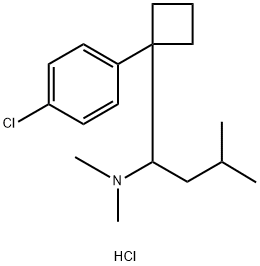
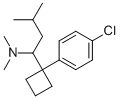
Sibutramine hydrochloride monohydrate
Synonym(s):1-(4-Chlorophenyl)-N,N-dimethyl-alpha-(2-methylpropyl)cyclobutanemethanamine hydrochloride monohydrate;Meridia;Reductil;Sibutramine hydrochloride monohydrate
- CAS NO.:125494-59-9
- Empirical Formula: C17H29Cl2NO
- Molecular Weight: 334.32
- MDL number: MFCD04039806
- EINECS: 603-075-3
- SAFETY DATA SHEET (SDS)
- Update Date: 2026-09-12 18:55:51

What is Sibutramine hydrochloride monohydrate?
Description
Sibutramine was introduced as Meridia in the US for the control of obesity, in conjunction with a reduced-calorie diet. Sibutramine can be prepared in four steps from 4-chlorobenzyl cyanide. Sibutramine acts as a serotonin and noradrenaline reuptake inhibitor ; in animal studies, it reduces energy intake by creating a satieted feeling and increases energy expenditure by enhancing thermogenesis. In a clinical study in obese patients treated with 10 or 15 mg of Sibutramine once-daily, meaningful weight loss was sustained for 12 months ; an additional study demonstrated a lack of abuse potential. An appreciable part of Sibutramine's effect would also be due to its 2N-mono and didesmethylmetabolites, which are very potent monoamine reuptake inhibitors themselves.
Chemical properties
White Solid
Originator
Knoll (Germany)
The Uses of Sibutramine hydrochloride monohydrate
A serotonin and noradrenaline reuptake inhibitor (SNR). Decreases calorie intake and increases energy expenditure
The Uses of Sibutramine hydrochloride monohydrate
antiobesity agent;neurotransmitter reuptake inhibitor
The Uses of Sibutramine hydrochloride monohydrate
antihyperlipidemic
brand name
Meridia (Abbott);Meridia, Reductil.
Properties of Sibutramine hydrochloride monohydrate
| Melting point: | 193-195.5°C |
| Flash point: | 9℃ |
| storage temp. | Room temp |
| solubility | DMSO: >30mg/mL |
| form | solid |
| color | white |
Safety information for Sibutramine hydrochloride monohydrate
| Signal word | Danger |
| Pictogram(s) |
 Flame Flammables GHS02  Skull and Crossbones Acute Toxicity GHS06  Health Hazard GHS08 |
| GHS Hazard Statements |
H225:Flammable liquids H370:Specific target organ toxicity, single exposure |
| Precautionary Statement Codes |
P210:Keep away from heat/sparks/open flames/hot surfaces. — No smoking. P260:Do not breathe dust/fume/gas/mist/vapours/spray. P280:Wear protective gloves/protective clothing/eye protection/face protection. P311:Call a POISON CENTER or doctor/physician. P301+P310:IF SWALLOWED: Immediately call a POISON CENTER or doctor/physician. |
Computed Descriptors for Sibutramine hydrochloride monohydrate
New Products
2-(2-Chlorophenyl)glycine Propiolic Acid 1-(3-Hydroxy-4-methoxyphenyl)-2-nitroethene (±)-amino(2-fluorophenyl)acetic acid trans-3-Benzyloxy-4-methoxy-beta-nitrostyrene 1-Pentadecanol 4-(4-Αminophenyl)-3-Morpholinone 3-Morpholino-1-(4-(2-oxopiperidin-1-yl) phenyl)-5,6-dihyropyridin-2-(1H)-one 1-(4-Aminophenyl)-3-morpholino-5,6-dihydropyridin-2(1H)-one N-cyanoacetylurethane 1H-IndazoleRelated products of tetrahydrofuran


You may like
-
 40216-83-9 trans-4-Hydroxy-L-proline methyl ester hydrochloride 98+View Details
40216-83-9 -
471-25-0 Propiolic Acid 98+View Details
471-25-0 -
84145-28-8 98+View Details
84145-28-8 -
trans-3-Benzyloxy-4-methoxy-beta-nitrostyrene 98+View Details
63909-29-5 -
2-(2-Chlorophenyl)glycine 88744-36-9 98+View Details
88744-36-9 -
40216-83-9 trans-4-Hydroxy-L-proline methyl ester hydrochloride 98+View Details
40216-83-9 -
629-76-5 98+View Details
629-76-5 -
1-(3-Hydroxy-4-methoxyphenyl)-2-nitroethene 98+View Details
39816-35-8