
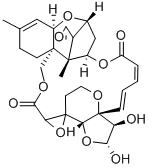
satratoxin G
- CAS NO.:53126-63-9
- Empirical Formula: C29H36O10
- Molecular Weight: 544.59
- MDL number: MFCD01684361
- SAFETY DATA SHEET (SDS)
- Update Date: 2026-05-27 23:55:59
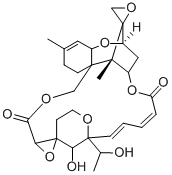
What is satratoxin G?
Biological Activity
Satratoxin G is a macrocyclic trichothecene mycotoxin that has been found in S. chartarum.1,2 It induces cleavage of caspase-3 and poly(ADP-ribose) polymerase (PARP) in HL-60 cells when used at a concentration of 40 nM and is cytotoxic to HepG2, Hep-2, Caco-2, A204, U937, and Jurkat cells (IC50s = 2.2-9.7 ng/ml).3,4 Intranasal administration of satratoxin G (500 μg/kg) induces apoptosis of olfactory sensory neurons in olfactory epithelium and ethmoid turbinate expression of the genes encoding IL-1α, IL-1β, IL-6, TNF-α, and MIP-2 in mice.2 Satratoxin G induces lethality in 4 week-old male mice (LD50 = 1.23 mg/kg, i.p.).1
References
|1. Yoshizawa, T., Ohtsubo, K., Sasaki, T., et al. Acute toxicities of satratoxins G and H in mice--a histopathological observation with special reference to the liver injury caused by satratoxin G. Proc. Jpn. Assoc. Mycotoxicol. 23, 53-57 (1986).|2. Islam, Z., Harkema, J.R., and Pestka, J.J. Satratoxin G from the black mold Stachybotrys chartarum evokes olfactory sensory neuron loss and inflammation in the murine nose and brain. Environ. Health Perspect. 114(7), 1099-1107 (2006).|3. Nagase, M., Shiota, T., Tsushima, A., et al. Molecular mechanism of satratoxin-induced apoptosis in HL-60 cells: Activation of caspase-8 and caspase-9 is involved in activation of caspase-3. Immunol. Lett. 84(1), 23-27 (2002).|4. Nielsen, C., Casteel, M., Didier, A., et al. Trichothecene-induced cytotoxicity on human cell lines. Mycotoxin Res. 25(2), 77-84 (2009).
Properties of satratoxin G
| storage temp. | Store at -20°C |
| solubility | Dichloromethane: soluble,DMSO: soluble,Ethanol: soluble |
| form | A crystalline solid |
Safety information for satratoxin G
Computed Descriptors for satratoxin G
New Products
5-bromo-4-fluoro-2-nitrobenzaldehyde (R)-(-)-2-Amino-1-propanol Cyclobutanone Fmoc-OSu 1-(2-Chloroethyl)pyrrolidine Hydrochloride 2-Amino-2-(4-methylphenyl)acetic acid β-Bromostyrene Ethyl 3-phenylpropanoate Phenethyl cinnamate Dipropyl disulfide 4 pentyn 1 ol N-Vinylformamide Methacrylate-PEG-Methacrylate, Mn:35000 2,4-Dihydroxyacetophenone 2-Chloro 5-Fluoro Pyridine Vasicinone 2-Chloroisonicotinic Acid Tween 80 or Polysorbate 80 2-Butyn-1-oL 2-Pentyn-1-oL 4-Nitrobenzotrifluoride N-(4-fluoro-2-methoxy-5-nitrophenyl)-4-(1-methyl-1H-indol-3-yl)pyrimidin-2-amine Pirtobrutinib intd. N-(4-Cyano-3-(trifluoromethyl)phenyl)-2-methyloxirane-2-carboxamideRelated products of tetrahydrofuran
![1,6-Dioxaspiro[2.5]octane](https://img.chemicalbook.in/CAS/GIF/185-72-8.gif)

You may like
-
 Fmoc-OSu 98+View Details
82911-69-1 -
(R)-(-)-2-Amino-1-propanol 35320-23-1 98+View Details
35320-23-1 -
7250-67-1 1-(2-Chloroethyl)pyrrolidine Hydrochloride 98+View Details
7250-67-1 -
13227-01-5 98+View Details
13227-01-5 -
7250-67-1 1-(2-Chloroethyl)pyrrolidine Hydrochloride 98+View Details
7250-67-1 -
13227-01-5 98+View Details
13227-01-5 -
7250-67-1 1-(2-Chloroethyl)pyrrolidine Hydrochloride 98+View Details
7250-67-1 -
13227-01-5 98+View Details
13227-01-5