
(S)-(+)-2-Aminobutane
Synonym(s):(S)-(+)-2-Aminobutane
- CAS NO.:513-49-5
- Empirical Formula: C4H11N
- Molecular Weight: 73.14
- MDL number: MFCD00064417
- EINECS: 208-164-7
- SAFETY DATA SHEET (SDS)
- Update Date: 2026-01-13 11:23:56
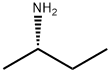
What is (S)-(+)-2-Aminobutane?
Chemical properties
Colorless to light yellow liqui
Chemical properties
Butyl amines are highly flammable, colorless liquids (n-turns yellow on standing) with ammoniacal or fishlike odors. n-isomer:
The Uses of (S)-(+)-2-Aminobutane
It is an active pharmaceutical intermediate.
Potential Exposure
Alert: (n-isomer): Possible risk of forming tumors, suspected of causing genetic defects, suspected reprotoxic hazard, Primary irritant (w/o allergic reaction), (sec-isomer): Drug. n-Butylamine is used in pharmaceuticals; dyestuffs, rubber, chemicals, emulsifying agents; photography, desizing agents for textiles; pesticides, and synthetic agents. sec-Butylamine is used as a fungistate. tert-Butylamine is used as a chemical intermediate in the production of tert-Butylaminoethyl methacrylate (a lube oil additive); as an intermediate in the production of rubber and in rust preventatives and emulsion deterrents in petroleum products. It is used in the manufacture of several drugs
Shipping
UN1125 n-Butylamine, Hazard Class: 3; Labels: 3—Flammable liquid, 8—Corrosive material. UN2014 Isobutylamine, Hazard Class: 3; Labels: 3—Flammable liquid, 8—Corrosive material
Incompatibilities
May form explosive mixture with air. May accumulate static electrical charges, and may causeignition of its vapors. n-Butylamine is a weak base; reacts with strong oxidizers and acids, causing fire and explosion hazard. Incompatible with organic anhydrides; isocyanates, vinyl acetate; acrylates, substituted allyls; alkylene oxides; epichlorohydrin, ketones, aldehydes, alcohols, glycols, phenols, cresols, caprolactum solution. Attacks some metals in presence of moisture. The tert-isomer will attack some forms of plastics
Waste Disposal
Use a licensed professional waste disposal service to dispose of this material. Dissolve or mix the material with a combustible solvent and burn in a chemical incinerator equipped with an afterburner andscrubber. All federal, state, and local environmental regulations must be observed.
Properties of (S)-(+)-2-Aminobutane
| Melting point: | -104 °C |
| Boiling point: | 63 °C(lit.) |
| alpha | 7.5 º (C=NEAT 19 ºC) |
| Density | 0.731 g/mL at 25 °C(lit.) |
| refractive index | n |
| Flash point: | −3 °F |
| storage temp. | Flammables area |
| pka | 10.74±0.10(Predicted) |
| color | Clear, colourless |
| Odor | fishy ammonia |
| optical activity | [α]19/D +7.5°, neat |
| Water Solubility | Fully miscible in water. |
| Sensitive | Air Sensitive |
| Merck | 14,1544 |
| BRN | 1718760 |
| CAS DataBase Reference | 513-49-5(CAS DataBase Reference) |
| NIST Chemistry Reference | 2-Butanamine, (S)-(513-49-5) |
| EPA Substance Registry System | (S)-2-Aminobutane (513-49-5) |
Safety information for (S)-(+)-2-Aminobutane
| Signal word | Danger |
| Pictogram(s) |
 Flame Flammables GHS02  Corrosion Corrosives GHS05  Exclamation Mark Irritant GHS07  Environment GHS09 |
| GHS Hazard Statements |
H225:Flammable liquids H314:Skin corrosion/irritation H410:Hazardous to the aquatic environment, long-term hazard |
| Precautionary Statement Codes |
P210:Keep away from heat/sparks/open flames/hot surfaces. — No smoking. P273:Avoid release to the environment. P280:Wear protective gloves/protective clothing/eye protection/face protection. P303+P361+P353:IF ON SKIN (or hair): Remove/Take off Immediately all contaminated clothing. Rinse SKIN with water/shower. P305+P351+P338:IF IN EYES: Rinse cautiously with water for several minutes. Remove contact lenses, if present and easy to do. Continuerinsing. |
Computed Descriptors for (S)-(+)-2-Aminobutane
New Products
2-Ethoxyphenol Methyl 2-methoxy-5-sulfamoylbenzoate Ethyl 2-chloro-2-(2-(4-methoxyphenyl)hydrazono)acetate 3,6-Dichloropyridazine 3,6-Dichloro-4-Isopropylpyridazine 2-[(2-Ethoxyphenoxy)methyl]oxirane m-Tolualdehyde p-Anisaldehyde 2-Bromobenzaldehyde 4-Fluorobenzaldehyde 1-Propyl-4-piperidone 3-Amino-3-(3-fluorophenyl)propanoic acid 6-Methyl-2-pyridinemethanol 2-Pyridinecarboxaldehdye tert-Butyl ((1R,2S,5S)-2-amino-5-(dimethylcarbamoyl)cyclohexyl)carbamate 1-Indanone 2-Chloromethyl-6-methyl-pyridine 4-Morpholinoaniline Abiraterone Ethyl Ether 1-nitro-3,5-dimethyl adamantine (NMEM) Vardenafil Bis-sulphonamide(Dimer) 3-(2-aminoethyl) benzene sulfonamide Nabumetone Impurity 5 2,2-dibromo-1-cyclopropyl-2-(2-fluorophenyl)ethan-1-oneRelated products of tetrahydrofuran



You may like
-
 (S)-(+)-2-Aminobutane CAS 513-49-5View Details
513-49-5 -
(S)-(+)-sec-Butylamine CAS 513-49-5View Details
513-49-5 -
3-(4-Bromo-3-methyl-2-oxo-2,3-dihydro-1h-benzo[d]imidazol-1-yl)piperidine-2,6-dione 2304754-51-4 99%+View Details
2304754-51-4 -
1126-74-5 99%+View Details
1126-74-5 -
2-Fluoro-6-iodobenzoic acid 99%+View Details
111771-08-5 -
120013-39-0 2,3-Dihydro-5,6-dimethoxy-2-(4-piperidinylmethyl)-1H-inden-1-one hydrochloride 99%+View Details
120013-39-0 -
ethyl 2-oxo-2,3,9,10-tetrahydro-1H-pyrido[3',4':4,5]pyrrolo[1,2,3-de]quinoxaline-8(7H)-carboxylate 313544-31-9 99%+View Details
313544-31-9 -
1-Boc-4-cyanopiperidine 91419-52-2 99%+View Details
91419-52-2