
RUBIJERVINE
- CAS NO.:79-58-3
- Empirical Formula: C27H43NO2
- Molecular Weight: 413.64
- SAFETY DATA SHEET (SDS)
- Update Date: 2022-12-21 16:56:50
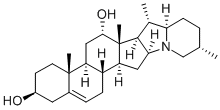
What is RUBIJERVINE?
Description
First isolated by Wright and Luff from Veratrum album and V. viride, the original formula of C26H4302N was altered by Jacobs and Craig to that given above. The base crystallizes from aqueous EtOH or Me2CO as the monohydrate. It has [α]D + 19° (EtOH) and is a tertiary base, both oxygen atoms being in the form of non-phenolic hydroxyl groups. The hydrobromide has m.p. 265-270°C; the hydriodide, m.p. 293-6°C (26l-2°C); the diacetyl derivative has m.p. l60-3°C and the p-bromobenzoyl compound melts at 254-6°C (dec.). On catalytic hydrogenation it yields the dihydro derivative, m.p. 222°C from which a diacetyl compound, m.p. 2l6-9°C may be prepared. Selenium dehydrogenation of the base at 340°C furnishes 5-methyl-2- ethylpyridine and a high proportion of a hydrocarbon, C18H16, m.p. 74-7°C which yields a picrate, m.p. 131-2°C and a syrn-trinitrobenzene additive compound, m.p. l44-5°C. The alkaloid undergoes the usual sterol reactions, e.g. the Oppenauer process gives a ketone, rubijervone, m.p. 205-9°C; [α]30D + 100° (EtOH) which is reduced by sodium isopropoxide to the corresponding epimeric alcohols. The earlier structure has been revised to 22G'H, 25{3H-solanid- 5-en-3{3,12G'-diol.
Purification Methods
Rubijervine crystallises from 95% EtOH as colourless rods. It has solvent of crystallisation and is dried at 120o/2mm. It is precipitated by digitonin. The hydrobromide crystallises from MeOH/Me2CO with m 265-270o(dec). The diacetate crystallises from MeOH with m 160-163o. The 3-benzoate gives colourless prisms from *C6H6 with m 156-159o and [] D 27.5 +22o (c 1.6, CHCl3). [Pelletier & Locke J Am Chem Soc 79 4531 1957, Jacobs & Craig J Biol Chem 148 41 1943, Beilstein 21 III/IV 2310.]
References
Poethke., Arch. Pharrn., 276, 170 (1938)
Jacobs, Craig.,J. Bioi. Chern., 148,41 (1943)
Jacobs, Craig., ibid, 149,451 (1943)
Jacobs, Craig., ibid, 159, 617 (1945)
Jacobs, Craig., ibid, 160,555 (1945)
Sato, Jacobs., ibid, 179,623 (1949)
Stereochemistry:
Hohne et al., Tetrahedron, 22,673 (1966)
Properties of RUBIJERVINE
| Melting point: | 240-246° |
| Boiling point: | 532.75°C (rough estimate) |
| alpha | D25 +19.0° (ethanol) |
| Density | 1.0159 (rough estimate) |
| refractive index | 1.6400 (estimate) |
Safety information for RUBIJERVINE
Computed Descriptors for RUBIJERVINE
New Products
5-bromo-4-fluoro-2-nitrobenzaldehyde (R)-(-)-2-Amino-1-propanol Cyclobutanone Fmoc-OSu 1-(2-Chloroethyl)pyrrolidine Hydrochloride 2-Amino-2-(4-methylphenyl)acetic acid β-Bromostyrene Ethyl 3-phenylpropanoate Phenethyl cinnamate Dipropyl disulfide 4 pentyn 1 ol N-Vinylformamide Methacrylate-PEG-Methacrylate, Mn:35000 2,4-Dihydroxyacetophenone 2-Chloro 5-Fluoro Pyridine Vasicinone 2-Chloroisonicotinic Acid Tween 80 or Polysorbate 80 2-Butyn-1-oL 2-Pentyn-1-oL 4-Nitrobenzotrifluoride N-(4-fluoro-2-methoxy-5-nitrophenyl)-4-(1-methyl-1H-indol-3-yl)pyrimidin-2-amine Pirtobrutinib intd. N-(4-Cyano-3-(trifluoromethyl)phenyl)-2-methyloxirane-2-carboxamideRelated products of tetrahydrofuran
You may like
-
 Fmoc-OSu 98+View Details
82911-69-1 -
(R)-(-)-2-Amino-1-propanol 35320-23-1 98+View Details
35320-23-1 -
7250-67-1 1-(2-Chloroethyl)pyrrolidine Hydrochloride 98+View Details
7250-67-1 -
13227-01-5 98+View Details
13227-01-5 -
7250-67-1 1-(2-Chloroethyl)pyrrolidine Hydrochloride 98+View Details
7250-67-1 -
13227-01-5 98+View Details
13227-01-5 -
7250-67-1 1-(2-Chloroethyl)pyrrolidine Hydrochloride 98+View Details
7250-67-1 -
13227-01-5 98+View Details
13227-01-5