
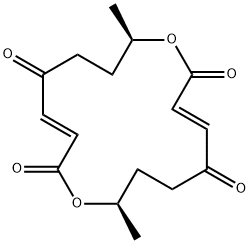
Pyrenophorin
- CAS NO.:5739-85-5
- Empirical Formula: C16H20O6
- Molecular Weight: 308.33
- SAFETY DATA SHEET (SDS)
- Update Date: 2025-04-17 18:22:24
What is Pyrenophorin?
Biological Activity
Pyrenophorin is a fungal metabolite that has been found in D. avenae and has phytotoxic activity.1 It inhibits seed germination and reduces root growth of the graminaceous plants A. sterilis, A. fatua, A. sativa, T. aestivum, and H. vulgare when used at a concentration of 60 μM. Pyrenophorin (320 μM) reduces chlorophyll levels in leaf sections from seedlings of the same plants.
References
1.Kastanias, M.A., and Chrysayi-Tokousbalides, M.Comparative phytotoxicity of pyrenophorin and pyrenophorol isolated from a Drechslera avenae pathotype1999 Brighton crop protection conference: Weeds2581-582(1999)
Properties of Pyrenophorin
| storage temp. | -20°C |
| form | A solid |
Safety information for Pyrenophorin
Computed Descriptors for Pyrenophorin
New Products
2-(2-Chlorophenyl)glycine Propiolic Acid 1-(3-Hydroxy-4-methoxyphenyl)-2-nitroethene (±)-amino(2-fluorophenyl)acetic acid trans-3-Benzyloxy-4-methoxy-beta-nitrostyrene 1-Pentadecanol 4-(4-Αminophenyl)-3-Morpholinone 3-Morpholino-1-(4-(2-oxopiperidin-1-yl) phenyl)-5,6-dihyropyridin-2-(1H)-one 1-(4-Aminophenyl)-3-morpholino-5,6-dihydropyridin-2(1H)-one N-cyanoacetylurethane 1H-IndazoleRelated products of tetrahydrofuran
You may like
-
 40216-83-9 trans-4-Hydroxy-L-proline methyl ester hydrochloride 98+View Details
40216-83-9 -
471-25-0 Propiolic Acid 98+View Details
471-25-0 -
84145-28-8 98+View Details
84145-28-8 -
trans-3-Benzyloxy-4-methoxy-beta-nitrostyrene 98+View Details
63909-29-5 -
2-(2-Chlorophenyl)glycine 88744-36-9 98+View Details
88744-36-9 -
40216-83-9 trans-4-Hydroxy-L-proline methyl ester hydrochloride 98+View Details
40216-83-9 -
629-76-5 98+View Details
629-76-5 -
1-(3-Hydroxy-4-methoxyphenyl)-2-nitroethene 98+View Details
39816-35-8
Statement: All products displayed on this website are only used for non medical purposes such as industrial applications or scientific research, and cannot be used for clinical diagnosis or treatment of humans or animals. They are not medicinal or edible.