
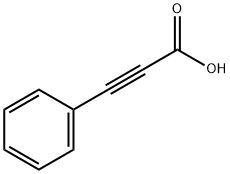
Propiolic Acid
Synonym(s):Acetylenecarboxylic acid;Propynoic acid
- CAS NO.:471-25-0
- Empirical Formula: C3H2O2
- Molecular Weight: 70.05
- MDL number: MFCD00004360
- EINECS: 207-437-8
- SAFETY DATA SHEET (SDS)
- Update Date: 2026-05-28 03:09:12
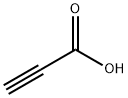
What is Propiolic Acid?
Chemical properties
viscous yellow liquid
The Uses of Propiolic Acid
Propiolic acid is an intermediate in monohalogenated acetylene synthesis and a corrosion inhibitor for steel.
The Uses of Propiolic Acid
Propiolic acid is a reagent used in the preparation of transition metal complexes, haloalkyl propiolates and halopropenoates.
The Uses of Propiolic Acid
Reagent employed in the synthesis of transition metal complexes, haloalkyl propiolates, and halopropenoates.
What are the applications of Application
Propiolic acid is reagent used in the synthesis of transition metal complexes
Definition
ChEBI: A terminal acetylenic compound that is a 3-carbon, straight-chain, monounsaturated fatty acid having one acetylenic bond.
Properties of Propiolic Acid
| Melting point: | 16-18 °C (lit.) |
| Boiling point: | 102 °C/200 mmHg (lit.) |
| Density | 1.138 g/mL at 25 °C (lit.) |
| refractive index | n |
| Flash point: | 138 °F |
| storage temp. | 2-8°C |
| solubility | Chloroform (Soluble), Methanol (Soluble) |
| form | Liquid After Melting |
| pka | 1.84(at 25℃) |
| Specific Gravity | 1.138 |
| color | Clear colorless to light brown |
| Water Solubility | miscible |
| Merck | 14,7821 |
| BRN | 878176 |
| Stability: | Stable. Incompatible with bases, oxidizing agents, reducing agents. Combustible. |
| CAS DataBase Reference | 471-25-0(CAS DataBase Reference) |
| NIST Chemistry Reference | Propiolic acid(471-25-0) |
| EPA Substance Registry System | 2-Propynoic acid (471-25-0) |
Safety information for Propiolic Acid
| Signal word | Danger |
| Pictogram(s) |
 Flame Flammables GHS02  Corrosion Corrosives GHS05  Skull and Crossbones Acute Toxicity GHS06 |
| GHS Hazard Statements |
H226:Flammable liquids H301:Acute toxicity,oral H310:Acute toxicity,dermal H314:Skin corrosion/irritation |
| Precautionary Statement Codes |
P210:Keep away from heat/sparks/open flames/hot surfaces. — No smoking. P233:Keep container tightly closed. P280:Wear protective gloves/protective clothing/eye protection/face protection. P303+P361+P353:IF ON SKIN (or hair): Remove/Take off Immediately all contaminated clothing. Rinse SKIN with water/shower. P305+P351+P338:IF IN EYES: Rinse cautiously with water for several minutes. Remove contact lenses, if present and easy to do. Continuerinsing. |
Computed Descriptors for Propiolic Acid
Propiolic Acid manufacturer
BTC pharm India
5Y
Phone:+91-8790379245
Whatsapp: +91- 6361382515
product: 471-25-0 Propiolic Acid 98+
New Products
2-(2-Chlorophenyl)glycine Propiolic Acid 1-(3-Hydroxy-4-methoxyphenyl)-2-nitroethene (±)-amino(2-fluorophenyl)acetic acid trans-3-Benzyloxy-4-methoxy-beta-nitrostyrene 1-Pentadecanol 4-(4-Αminophenyl)-3-Morpholinone 3-Morpholino-1-(4-(2-oxopiperidin-1-yl) phenyl)-5,6-dihyropyridin-2-(1H)-one 1-(4-Aminophenyl)-3-morpholino-5,6-dihydropyridin-2(1H)-one N-cyanoacetylurethane 1H-IndazoleRelated products of tetrahydrofuran
You may like
-
 471-25-0 99%View Details
471-25-0 -
Propiolic Acid CAS 471-25-0View Details
471-25-0 -
Propiolic acid 90% CAS 471-25-0View Details
471-25-0 -
Propiolic acid CAS 471-25-0View Details
471-25-0 -
471-25-0 Propiolic Acid 95.00%View Details
471-25-0 -
471-25-0 Propiolic Acid 98+View Details
471-25-0 -
471-25-0 Propiolic Acid 98+View Details
471-25-0 -
471-25-0 Propiolic Acid 98+View Details
471-25-0
Statement: All products displayed on this website are only used for non medical purposes such as industrial applications or scientific research, and cannot be used for clinical diagnosis or treatment of humans or animals. They are not medicinal or edible.