
Pramlintide
- Molecular Weight: 0
What is Pramlintide?
Description
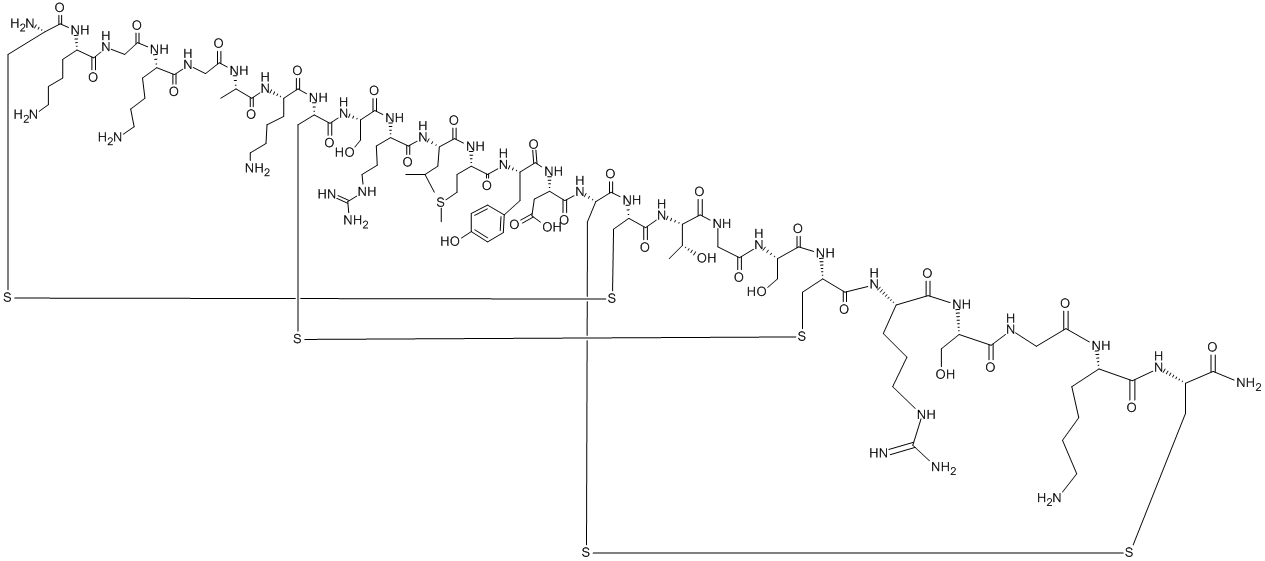
Pramlintide is an analogue of amylin in which proline has replaced the normal amino acids at positions 25, 28, and 29, as indicated above. The result of these substitutions is an increase in water solubility and a reduced tendency for self-aggregation.
The Uses of Pramlintide
Antidiabetic.
General Description
Pramlintide is the 25-L-proline-28-L-proline-29-L-prolinetrisubstitution product of human amylin. The marketedformulation (Symlin) is an acetate salt, the exactcomposition of which may not be public-domain knowledge,although salts containing up to four acetic acidmolecules per pramlintide molecule would be possible byvirtue of the free amino terminus andLys1, Arg11, andHis18 residues. The carboxyl terminus of pramlintide, as inamylin, is amidated, and there are no appreciably acidicmoities in the structure; thus, in solution at the pH of bloodand tissues pramlintide would be present almost entirely asone or the other of two significant molecular species, onehaving a +3 charge (histidine imidazole deprotonated anduncharged) predominating modestly over the quadruplyprotonated (+4) species.
Mechanism of action
Amylin receptors have been identified in distinct areas of the brain, including the nucleus accumbens and the dorsal vagal complex. Stimulation of these receptors reduces food intake and depresses GI motility. It is assumed that pranlintide stimulates these receptors, leading to the reported benefits of the drug in patients with diabetes, although the exact mechanism is still poorly understood. Pranlintide causes a moderate reduction in HbA1c and postprandial glucose levels when used in combination with insulin, which has benefits in normalizing fluctuations of circulating glucose levels.
Pharmacokinetics
Pramlintide is administered via subcutaneous injection immediately before meals, reaches maximum circulating concentrations within 20 minutes, and has a half-life of 29 minutes. The drug is eliminated from the body primarily through the kidney. The plasma concentrations are similar to those seen with postprandial amylin. Because the drug is formulated at pH 4.0, it is potentially incompatible with insulin (pH 7.8) if administered within the same syringe, although one study of pramlintide combined with Novolin or Humulin did not show changes in the pharmacokinetics of either drugs.
Clinical Use
Pramlintide’s effects upon administration to patients almostcertainly arise in significant measure from directAMY-mediated actions within the brainstem. Amylin receptorsare abundant in the circumventricular organs, includingthe subfornical organ (where AMY1(a) receptors areknown to be expressed in relative abundance), the organumvasculosum lateralis terminalis, and the area postrema(AMY3(a)
), where the action of pramlintide (or of -cell–secretedamylin) is not precluded by a diffusional BBB.Amylin receptors are also expressed in various other brainareas, in particular the nucleus accumbens, but neitheramylin or pramlintide circulating in the bloodstream arelikely to exert any action at these BBB-shielded locations.Direct amylin receptor–mediated actions of pramlintide in the periphery, if any, remain poorly characterized.Unsurprisingly, though, the appetite-suppressing actions,and benefits of pramlintide and amylin agonists in general,are receiving significant clinical and scientific attention.Side Effects
The major side effects reported for pramlintide consist of mild to moderate nausea, with severe nausea appearing in patients using large doses of the drug. The nausea may decrease on continued use of the drug. The rate of hypoglycemia appears to be quite low.
Safety information for Pramlintide
New Products
2-(2-Chlorophenyl)glycine Propiolic Acid 1-(3-Hydroxy-4-methoxyphenyl)-2-nitroethene (±)-amino(2-fluorophenyl)acetic acid trans-3-Benzyloxy-4-methoxy-beta-nitrostyrene 1-Pentadecanol 2,4-Dihydroxybenzaldehyde Dipropyl disulfide Pyrrolo[1,2-a]pyrimidine-6-carboxylic acid, 4,6,7,8-tetrahydro-4-oxo-, sodium salt (1:1), (6S) Obidoxime hydrochloride API 4 pentyn 1 ol N-Vinylformamide Methacrylate-PEG-Methacrylate, Mn:35000 2,4-Dihydroxyacetophenone 2-Chloro 5-Fluoro Pyridine Vasicinone 2-Chloroisonicotinic Acid Tween 80 or Polysorbate 80 2-Butyn-1-oL N-(4-Cyano-3-(trifluoromethyl)phenyl)-2-methyloxirane-2-carboxamide N-(4-fluoro-2-methoxy-5-nitrophenyl)-4-(1-methyl-1H-indol-3-yl)pyrimidin-2-amine Pirtobrutinib intd. 2-Pentyn-1-oL 4-NitrobenzotrifluorideRelated products of tetrahydrofuran



You may like
-
 40216-83-9 trans-4-Hydroxy-L-proline methyl ester hydrochloride 98+View Details
40216-83-9 -
471-25-0 Propiolic Acid 98+View Details
471-25-0 -
84145-28-8 98+View Details
84145-28-8 -
trans-3-Benzyloxy-4-methoxy-beta-nitrostyrene 98+View Details
63909-29-5 -
2-(2-Chlorophenyl)glycine 88744-36-9 98+View Details
88744-36-9 -
40216-83-9 trans-4-Hydroxy-L-proline methyl ester hydrochloride 98+View Details
40216-83-9 -
629-76-5 98+View Details
629-76-5 -
1-(3-Hydroxy-4-methoxyphenyl)-2-nitroethene 98+View Details
39816-35-8