
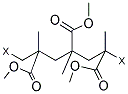
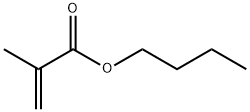
Poly(methyl methacrylate-co-butyl methacrylate)
Synonym(s):Poly(butyl methacrylate-co-methyl methacrylate)
- CAS NO.:25608-33-7
- Empirical Formula: C13H22O4
- Molecular Weight: 242.32
- MDL number: MFCD00803843
- SAFETY DATA SHEET (SDS)
- Update Date: 2026-09-12 18:48:00

What is Poly(methyl methacrylate-co-butyl methacrylate)?
The Uses of Poly(methyl methacrylate-co-butyl methacrylate)
Pigment-wetting binder for coatings on plastics.
The Uses of Poly(methyl methacrylate-co-butyl methacrylate)
Binding agent for printing inks and foil, hardboard and ceramic lacquers.
The Uses of Poly(methyl methacrylate-co-butyl methacrylate)
Poly(butyl methacrylate-co-methyl methacrylate) (P(BMA-co-MMA) ) may be used to synthesize porous interpenetrating polymer network (IPN) with low-density polymers. These IPN structures are applicable as membranes for separation of liquid mixtures due to their high mechanical strength and selectivity. P(BMA-co-MMA) particles may be used to encapsulate single non-aggregated semiconducting quantum dots (QDs) for size enlargement.These hybrid organic/inorganic nanostructures may be used as single photon sources.
Properties of Poly(methyl methacrylate-co-butyl methacrylate)
| Density | 1.15 g/mL at 25 °C(lit.) |
| Flash point: | 23 °C |
| storage temp. | room temp |
| solubility | alcohols and aliphatic hydrocarbons: insoluble |
| EPA Substance Registry System | Butyl methacrylate methyl methacrylate polymer (25608-33-7) |
Safety information for Poly(methyl methacrylate-co-butyl methacrylate)
| Signal word | Danger |
| Pictogram(s) |
 Flame Flammables GHS02  Exclamation Mark Irritant GHS07  Health Hazard GHS08 |
| GHS Hazard Statements |
H226:Flammable liquids H304:Aspiration hazard H315:Skin corrosion/irritation H319:Serious eye damage/eye irritation H335:Specific target organ toxicity, single exposure;Respiratory tract irritation H373:Specific target organ toxicity, repeated exposure H412:Hazardous to the aquatic environment, long-term hazard |
| Precautionary Statement Codes |
P210:Keep away from heat/sparks/open flames/hot surfaces. — No smoking. P273:Avoid release to the environment. P314:Get medical advice/attention if you feel unwell. P331:Do NOT induce vomiting. P301+P310:IF SWALLOWED: Immediately call a POISON CENTER or doctor/physician. P303+P361+P353:IF ON SKIN (or hair): Remove/Take off Immediately all contaminated clothing. Rinse SKIN with water/shower. |
Computed Descriptors for Poly(methyl methacrylate-co-butyl methacrylate)
New Products
9-Mesityl-10-methylacridinium perchlorate Sulfapyridine Fmoc-OSu (R)-(-)-2-Amino-1-propanol Cyclobutanone 5-bromo-4-fluoro-2-nitrobenzaldehyde 4 pentyn 1 ol N-Vinylformamide Phenethyl cinnamate Pyrrolo[1,2-a]pyrimidine-6-carboxylic acid, 4,6,7,8-tetrahydro-4-oxo-, sodium salt (1:1), (6S) Ethyl 3-phenylpropanoate β-Bromostyrene Methacrylate-PEG-Methacrylate, Mn:35000 2,4-Dihydroxyacetophenone 2-Chloro 5-Fluoro Pyridine Vasicinone 2-Chloroisonicotinic Acid Tween 80 or Polysorbate 80 5-Bromo-1-Pentyne 1-(2-Methyl-5-nitrophenyl)guanidine Nitrate Methyl trans-4-Aminocyclohexanecarboxylate Hydrochloride N-(4-Cyano-3-(trifluoromethyl)phenyl)-2-methyloxirane-2-carboxamide 4-Nitrobenzotrifluoride 2-Pentyn-1-oLRelated products of tetrahydrofuran
You may like
-
 Eukitt® Quick-hardening mounting medium CAS 25608-33-7View Details
25608-33-7 -
1191-95-3 Cyclobutanone 98+View Details
1191-95-3 -
Fmoc-OSu 98+View Details
82911-69-1 -
(R)-(-)-2-Amino-1-propanol 35320-23-1 98+View Details
35320-23-1 -
1191-95-3 Cyclobutanone 98+View Details
1191-95-3 -
213382-45-7 98+View Details
213382-45-7 -
Fmoc-OSu 98+View Details
82911-69-1 -
(R)-(-)-2-Amino-1-propanol 35320-23-1 98+View Details
35320-23-1
Statement: All products displayed on this website are only used for non medical purposes such as industrial applications or scientific research, and cannot be used for clinical diagnosis or treatment of humans or animals. They are not medicinal or edible.