
POLYIMIDE RESIN
- CAS NO.:62929-02-6
- Empirical Formula: C35H28N2O7
- Molecular Weight: 588.60602
- MDL number: MFCD01868102
- EINECS: 214-686-6
- SAFETY DATA SHEET (SDS)
- Update Date: 2026-05-28 05:22:23
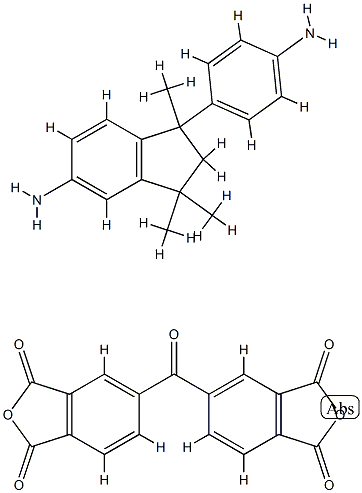
What is POLYIMIDE RESIN?
The Uses of POLYIMIDE RESIN
Polyimides (PI, also known by alternative brand names: Pyralin Apical, Kapton, and Kaptrex) are polymers made of imide monomers (two carbonyl groups bonded to nitrogen). It has a density of 1430 kg/m3, Young’s modulus 3200 MPa, tensile strength (75–90) MPa, glass transition temperature > 400℃, thermal conductivity of 0.53 W/(m K), and a low relative dielectric constant of 2.9. Polyimides have applications similar to BCBs and also find applications as a low dielectric constant material in high-frequency interconnects (low-k material). The higher thermal conductivity and high glass transition temperature when compared to other types of insulating polymers also makes them a good choice where heat dissipation is important or other applications requiring good thermal management or low parasitic capacitances. Microchannels and high-frequency microdevices embedded in both photosensitive and nonphotosensitive polyimides have been fabricated and reported.
The Uses of POLYIMIDE RESIN
Soluble thermoplastic polyimide for high temperature adhesives and compositesPolyimide sealing is utilized to make a permanent and leak-free union between two pieces of silica tubing, stainless steel or glass and press fit unions are most commonly used. Soluble thermoplastic polyimide used for high temperature adhesives and composites. They are used in the electronics industry for flexible cables, as an insulating film on magnet wire and for medical tubing. It is also employed as a mechanical stress buffer. It is utilized for the reverse osmotic film in purification of water or the concentration of dilute materials from water, such as maple syrup production.
Industrial uses
Available both as thermoplastic and thermosetresins, polyimides (PIs) are a family of someof the most heat- and fire-resistant polymersknown. Moldings and laminates are generallybased on thermoset resins, although some aremade from thermoplastic grades. Unlike mostplastics, polyimides are available as laminatesand shapes, molded parts, and stock shapesfrom some materials producers. Thin-film products— enamel, adhesives, and coatings — areusually derived from thermoplastic polyimideresins.
Polyimide parts and laminates can serve continuouslyin air at 260°C; service temperaturefor intermittent exposure can range from cryogenicto as high as 482°C. Glass-fiber-reinforcedversions retain over 70% of their flexuralstrength and modulus at 249°C. Creep is almostnonexistent, even at high temperatures, anddeformation under load (27.2 MPa) is less than0.05% at room temperature for 24 h.
These materials have good wear resistanceand low coefficients of friction, both of whichare further improved by polytetrafluoroethylenefillers. Self-lubricating parts containing graphitepowders have flexural strengths above 68MPa, which is considerably higher than thoseof typical thermoplastic bearing compounds.
Electrical properties of polymide moldingsare outstanding over a wide range of temperatureand humidity conditions.
Properties of POLYIMIDE RESIN
| Melting point: | >300°C |
| Density | 1.2 |
| Flash point: | >93°(199°F) |
| form | Powder |
| Specific Gravity | 1.2 |
| color | Yellow |
| Water Solubility | Insoluble in water. |
| EPA Substance Registry System | 1,3-Isobenzofurandione, 5,5'-carbonylbis-, polymer with 1(or 3)-(4-aminophenyl)-2,3-dihydro-1,3,3(or 1,1,3)-trimethyl-1H-inden-5-amine (62929-02-6) |
Safety information for POLYIMIDE RESIN
| Pictogram(s) |
 Exclamation Mark Irritant GHS07 |
| GHS Hazard Statements |
H315:Skin corrosion/irritation H319:Serious eye damage/eye irritation H335:Specific target organ toxicity, single exposure;Respiratory tract irritation |
| Precautionary Statement Codes |
P261:Avoid breathing dust/fume/gas/mist/vapours/spray. P304+P340:IF INHALED: Remove victim to fresh air and Keep at rest in a position comfortable for breathing. P305+P351+P338:IF IN EYES: Rinse cautiously with water for several minutes. Remove contact lenses, if present and easy to do. Continuerinsing. P405:Store locked up. |
Computed Descriptors for POLYIMIDE RESIN
New Products
2-Bromo-4-hydroxypyridine Dibenzoyl-L-tartaric acid Anhydrous (Resolution Reagent) Dibenzo[b,f][1,4]thiazepin-11(10H)-one 1,2,3,9-Tetrahydro-9-Methyl-4H-Carbazole-4-One Cis-Tosylate 1-(4-methoxyphenyl)-4-(4-Nitrophenyl)Piperazine (IT-1) 2'-Fluoroacetophenone 1-aminocyclobutanecarbonitrile hydrochloride AMINO-O-TOLYL-ACETIC ACID N-Methyl-2-amino-2-methylpropionamide 4-(FMOC-AMINO)-TETRAHYDROPYRAN-4-CARBOXYLIC ACID 1-Aminocyclobutanecarboxylic Acid Hydrochloride METHANOL-D1(OD) TERTIARY BUTANOL-D9 N-ETHYL-D5-AMINE HYDROCHLORIDE BENZOIC ACID-D CHLOROFORM-D TOLUENE-D3 2-(2-Bromophenyl)ethanol Boc-D-Glu(OMe)-OMe 2,5 Dibromopyridine Ethyl 4-hydroxy-3-oxobutanoate Dimethyl (2S)-2-((tert-butoxycarbonyl)amino)-4-(cyanomethyl)pentanedioate 1-(3-Chlorophenyl)piperazine hydrochlorideRelated products of tetrahydrofuran






You may like
-
 Polyimide, 0.025mm thick x 20mm width CAS 62929-02-6View Details
62929-02-6 -
98071-16-0 1-Aminocyclobutanecarboxylic Acid Hydrochloride 98+View Details
98071-16-0 -
106914-07-2 N-Methyl-2-amino-2-methylpropionamide 98+View Details
106914-07-2 -
129592-98-9 98+View Details
129592-98-9 -
4-(FMOC-AMINO)-TETRAHYDROPYRAN-4-CARBOXYLIC ACID 98+View Details
285996-72-7 -
1-aminocyclobutanecarbonitrile hydrochloride 845821-84-3 98+View Details
845821-84-3 -
98071-16-0 1-Aminocyclobutanecarboxylic Acid Hydrochloride 98+View Details
98071-16-0 -
 ADC-151View Details
27176-87-0