
POLY(D-LACTIDE)
- CAS NO.:106989-11-1
- Empirical Formula: C3H6O3
- Molecular Weight: 90.08
- MDL number: MFCD00131929
- SAFETY DATA SHEET (SDS)
- Update Date: 2026-01-13 11:16:01
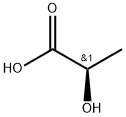
What is POLY(D-LACTIDE)?
The Uses of POLY(D-LACTIDE)
Poly(D-lactide) (PDLA), a polymer of a stereospecific cyclic di-ester of lactic acid, is used in biomaterial research for the development of devices such as therapeutic drug delivery vessels. Poly(D-lactide) is used for the preparation of microparticles and resorbable polylactide scaffolds.
What are the applications of Application
Poly(D-lactide) is a polymer of a stereospecific cyclic di-ester of lactic acid for proteomics research
Definition
ChEBI: Methyl isobutyrate is the fatty acid methyl ester of isobutyric acid. It has a role as a metabolite. It is functionally related to an isobutyric acid.
Properties of POLY(D-LACTIDE)
| Melting point: | 154 °C |
| storage temp. | 2-8°C |
Safety information for POLY(D-LACTIDE)
Computed Descriptors for POLY(D-LACTIDE)
New Products
2-(2-Chlorophenyl)glycine Propiolic Acid 1-(3-Hydroxy-4-methoxyphenyl)-2-nitroethene (±)-amino(2-fluorophenyl)acetic acid trans-3-Benzyloxy-4-methoxy-beta-nitrostyrene 1-Pentadecanol 4-(4-Αminophenyl)-3-Morpholinone 3-Morpholino-1-(4-(2-oxopiperidin-1-yl) phenyl)-5,6-dihyropyridin-2-(1H)-one 1-(4-Aminophenyl)-3-morpholino-5,6-dihydropyridin-2(1H)-one N-cyanoacetylurethane 1H-IndazoleRelated products of tetrahydrofuran
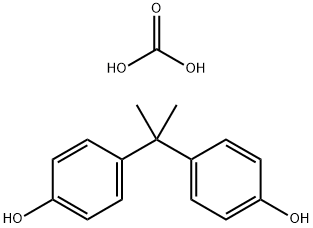
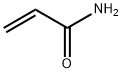
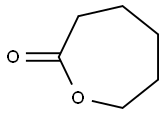
You may like
-
 40216-83-9 trans-4-Hydroxy-L-proline methyl ester hydrochloride 98+View Details
40216-83-9 -
471-25-0 Propiolic Acid 98+View Details
471-25-0 -
84145-28-8 98+View Details
84145-28-8 -
trans-3-Benzyloxy-4-methoxy-beta-nitrostyrene 98+View Details
63909-29-5 -
2-(2-Chlorophenyl)glycine 88744-36-9 98+View Details
88744-36-9 -
40216-83-9 trans-4-Hydroxy-L-proline methyl ester hydrochloride 98+View Details
40216-83-9 -
629-76-5 98+View Details
629-76-5 -
1-(3-Hydroxy-4-methoxyphenyl)-2-nitroethene 98+View Details
39816-35-8
Statement: All products displayed on this website are only used for non medical purposes such as industrial applications or scientific research, and cannot be used for clinical diagnosis or treatment of humans or animals. They are not medicinal or edible.