
POLY(2-HYDROXYETHYL METHACRYLATE)
Synonym(s):Poly(2-HEMA);Poly-HEMA
- CAS NO.:25249-16-5
- Empirical Formula: C6H10O3
- Molecular Weight: 130.14
- MDL number: MFCD00084374
- SAFETY DATA SHEET (SDS)
- Update Date: 2026-06-24 18:39:39
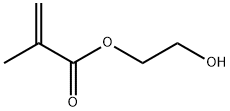
What is POLY(2-HYDROXYETHYL METHACRYLATE)?
The Uses of POLY(2-HYDROXYETHYL METHACRYLATE)
Poly(2-hydroxyethyl methacrylate) has been used:
- as a nonadhesive substrate in the preparation of single cell suspensions
- to implant into mice cornea for corneal micropocket assay
- to coat the well plates for sphere assay using adipose-derived mesenchymal stem cells
The Uses of POLY(2-HYDROXYETHYL METHACRYLATE)
pHEMA scaffolds are used in tissue engineering. It can be used in hydrogels for biomedical applications, as sorbents for metal ions.pHEMA has been used in applications such as soft contact lenses, in drug delivery systems, and in kidney dialysis membranes.Nanoparticles of pHEMA may be employed as a carrier for controlled delivery of anticancer and antitumor drugs.
What are the applications of Application
Poly(2-hydroxyethyl methacrylate) is a polymer that inhibits cell adhesion to growth surfaces in culture vessels.
Definition
ChEBI: An acrylate macromolecule, composed of repeating 2-hydroxyethyl 2-methylpropanoate units.
General Description
Solid Poly(2-hydroxyethyl methacrylate) (pHEMA) is brittle, while pHEMA hydrogel is a soft material. Glass transition temperature for pHEMA hydrogels is reduced by increasing a content of water in the matrix. Macromolecular properties in pHEMA are characterized by non-covalent interactions of hydrogen-bonds among the polymer chains as well as the hydrated water molecules. The presence of polar groups of hydroxyl and carboxyl on each repeat unit makes this polymer compatible with water. The hydrophobic a-methyl groups of the backbone convey hydrolytic stability to the polymer and enhance mechanical strength of the polymer matrix.
Biochem/physiol Actions
Poly(2-hydroxyethyl methacrylate) is an acrylic compound and has dental usage. It is mainly used to inhibit cell adhesion to growth surfaces in culture vessels.
Properties of POLY(2-HYDROXYETHYL METHACRYLATE)
| Density | 1.15 g/mL at 25 °C(lit.) |
| storage temp. | 4°C, away from moisture |
| solubility | ethanol: 120 mg/mL |
| form | powder |
| color | White to off-white |
| EPA Substance Registry System | 2-Propenoic acid, 2-methyl-, 2-hydroxyethyl ester, homopolymer (25249-16-5) |
Safety information for POLY(2-HYDROXYETHYL METHACRYLATE)
Computed Descriptors for POLY(2-HYDROXYETHYL METHACRYLATE)
New Products
Dibenzoyl-L-tartaric acid Anhydrous (Resolution Reagent) Cis-Tosylate Dibenzo[b,f][1,4]thiazepin-11(10H)-one 1,2,3,9-Tetrahydro-9-Methyl-4H-Carbazole-4-One 1-(4-methoxyphenyl)-4-(4-Nitrophenyl)Piperazine (IT-1) BOC Piperazine 1-Benzhydrylazetane-3-carbonitrile 8-oxa-1,3-diazaspiro[4.5]decane-2,4-dione (±)-amino(2-fluorophenyl)acetic acid 2-(2-Chlorophenyl)glycine AMINO-(3-CHLORO-PHENYL)-ACETIC ACID 2'-Fluoroacetophenone METHANOL-D1(OD) TERTIARY BUTANOL-D9 N-ETHYL-D5-AMINE HYDROCHLORIDE BENZOIC ACID-D CHLOROFORM-D TOLUENE-D3 Trans,trans muconic acid HC Blue-16 4-Amino-2-chloro-6,7-dimethoxyquinazoline Ethyl 4,5-bis(2-methoxyethoxy)-2-nitrobenzoate 2,3-Dimethoxypyridine 1-(3-Chlorophenyl)piperazine hydrochlorideRelated products of tetrahydrofuran



You may like
-
 Poly(2-hydroxyethyl methacrylate) CAS 25249-16-5View Details
25249-16-5 -
Poly(2-hydroxyethyl methacrylate) CAS 25249-16-5View Details
25249-16-5 -
Poly(2-hydroxyethyl methacrylate) CAS 25249-16-5View Details
25249-16-5 -
Poly(2-hydroxyethyl methacrylate) CAS 25249-16-5View Details
25249-16-5 -
 Product InrtroductionView Details
 -
 DGO24View Details
 -
 DGO29View Details
 -
 DGO32View Details