
Pinitol oil
- CAS NO.:8002-09-3
- Molecular Weight: 0
- MDL number: MFCD00147790
- EINECS: 692-006-0
- Update Date: 2026-06-24 18:39:39
What is Pinitol oil?
Chemical properties
The production of essential oil from this pine has been abandoned. The needles are probably distilled with those from spruce. A large addition of white pine needles to spruce needles tends to lower considerably the ester content of the distilled spruce oil.
The Uses of Pinitol oil
pine oil (Pinus palustris) is originally used as a solvent and a disinfectant, it is also deodorizing, anti-bacterial and anti-septic. Studies are now showing that certain fractions of pine oil may stimulate fibroblast growth, which would mean an increase in the turnover of epidermal cells. Pine oil is produced by distillation of small pine branches. It may be irritating to the skin and mucous membranes.
Definition
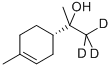
Extractives and their physically modified derivatives. A complex combination of terpenes produced by the high temperature distillation of oil of turpentine residues or by the catalytic hydration of pinenes. Composed primarily of isomeric tertiary and secondary cyclic terpene alcohols. May contain terpene hydrocarbons and ethers. Exact composition varies with production methods and turpentine source.
General Description
A clear colorless to light amber colored liquid. Contains mainly tertiary and secondary terpene alcohols Produced from the wood of pine trees by extraction or steam distillation. Flash point below 141°F. Less dense than water and insoluble in water. Hence floats on water. Vapors are heavier than air.
Air & Water Reactions
Flammable. Insoluble in water.
Reactivity Profile
Pine oil has a high content of various alcohols. Flammable and/or toxic gases are generated by the combination of alcohols with alkali metals, nitrides, and strong reducing agents. They react with oxoacids and carboxylic acids to form esters plus water. Oxidizing agents convert them to aldehydes or ketones. Alcohols exhibit both weak acid and weak base behavior. They may initiate the polymerization of isocyanates and epoxides.
Health Hazard
Vapors can cause headache, confusion, respiratory distress. Liquid irritates skin. If ingested, can irritate the entire digestive system and may injure kidneys. If liquid is taken into lungs, causes severe pneumonitis,pulmonary edema/hemorrhage.
Fire Hazard
Behavior in Fire: Forms heavy black smoke and soot.
Safety Profile
Moderately toxic by ingestion. Mddly toxic by skin contact. A weak allergen and a severe irritant to skin and mucous membranes. Human systemic effects by ingestion: excitement, ataxia, headache. A flammable liquid when exposed to heat or flame; can react with oxidizing materials. Moderate spontaneous heating. To fight fire, use foam, CO2, dry chemical. Used as an odorant, dtsinfectant, solvent, wetting agent, and frothing agent.
Properties of Pinitol oil
| Melting point: | −55 °C(lit.) |
| Boiling point: | 153-175 °C(lit.) |
| Density | 0.86 g/mL at 25 °C(lit.) |
| vapor density | 4.84 (−7 °C, vs air) |
| vapor pressure | 4 mm Hg ( −6.7 °C) |
| refractive index | n |
| Flash point: | 86 °F |
| Odor | at 100.00 %. pine |
| CAS DataBase Reference | 8002-09-3(CAS DataBase Reference) |
| EPA Substance Registry System | Pine oil (8002-09-3) |
Safety information for Pinitol oil
Computed Descriptors for Pinitol oil
New Products
2-(2-Chlorophenyl)glycine Propiolic Acid 1-(3-Hydroxy-4-methoxyphenyl)-2-nitroethene (±)-amino(2-fluorophenyl)acetic acid trans-3-Benzyloxy-4-methoxy-beta-nitrostyrene 1-Pentadecanol 2,4-Dihydroxybenzaldehyde Dipropyl disulfide Pyrrolo[1,2-a]pyrimidine-6-carboxylic acid, 4,6,7,8-tetrahydro-4-oxo-, sodium salt (1:1), (6S) Obidoxime hydrochloride API 4 pentyn 1 ol N-Vinylformamide Methacrylate-PEG-Methacrylate, Mn:35000 2,4-Dihydroxyacetophenone 2-Chloro 5-Fluoro Pyridine Vasicinone 2-Chloroisonicotinic Acid Tween 80 or Polysorbate 80 2-Butyn-1-oL N-(4-Cyano-3-(trifluoromethyl)phenyl)-2-methyloxirane-2-carboxamide N-(4-fluoro-2-methoxy-5-nitrophenyl)-4-(1-methyl-1H-indol-3-yl)pyrimidin-2-amine Pirtobrutinib intd. 2-Pentyn-1-oL 4-NitrobenzotrifluorideRelated products of tetrahydrofuran



You may like
-
 40216-83-9 trans-4-Hydroxy-L-proline methyl ester hydrochloride 98+View Details
40216-83-9 -
471-25-0 Propiolic Acid 98+View Details
471-25-0 -
84145-28-8 98+View Details
84145-28-8 -
trans-3-Benzyloxy-4-methoxy-beta-nitrostyrene 98+View Details
63909-29-5 -
2-(2-Chlorophenyl)glycine 88744-36-9 98+View Details
88744-36-9 -
40216-83-9 trans-4-Hydroxy-L-proline methyl ester hydrochloride 98+View Details
40216-83-9 -
629-76-5 98+View Details
629-76-5 -
1-(3-Hydroxy-4-methoxyphenyl)-2-nitroethene 98+View Details
39816-35-8