
AMINOGUANIDINE
- CAS NO.:79-17-4
- Empirical Formula: CH6N4
- Molecular Weight: 74.09
- MDL number: MFCD00242587
- EINECS: 2011831
- SAFETY DATA SHEET (SDS)
- Update Date: 2026-04-24 14:59:07
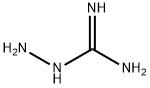
What is AMINOGUANIDINE?
Chemical properties
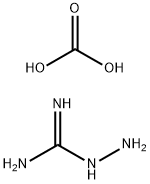
Aminoguanidine [CAS: 79-17-4], CH6N4, Mr 74.09, is a base that forms salts with both inorganic and organic acids. It is soluble in water and ethanol. Free aminoguanidine is stable for only a short time; therefore, it is marketed in the form of its stable salts. Commercially, aminoguanidine is offered as the bicarbonate salt [2582-30-1], a white powder of usually 99 % assay. The water solubility at room temperature is low (< 5 g/L). It is offered by most world-scale hydrazine producers (→Hydrazine). Other salts can be prepared from the bicarbonate by reaction with acid.
Chemical properties
Aminoguanidine is prepared from hydrazine
and aqueous cyanamide solution. Processes
based on the reduction of nitroguanidine have
no industrial significance.
The Uses of AMINOGUANIDINE
Inhibitor (advanced glycosylation end-product formation).
Definition
ChEBI: Aminoguanidine is a one-carbon compound whose unique structure renders it capable of acting as a derivative of hydrazine, guanidine or formamide. It has a role as an EC 1.4.3.4 (monoamine oxidase) inhibitor and an EC 1.14.13.39 (nitric oxide synthase) inhibitor. It is a member of guanidines and a one-carbon compound.
Enzyme inhibitor
This substituted hydrazine (FWhydrochloride = 110.55 g/mol; CAS 79-17-4), also named pimagedine, is a strong inhibitor of diamine oxidases as well as nitric oxide synthase. Note that aminoguanidine also inhibits the formation of advanced glycosylation end-products, reportedly by reacting with and trapping Amadori rearrangement-derived fragmentation products in solution. In view of this property, aminoguanidine has often been used to treat complications associated with chronic diabetes. Target(s): amine oxidase (copper-containing), or diamine oxidase; methylamine dehydrogenase; tryptophan tryptophylquinone enzymes; nitric-oxide synthase; b-fructofuranosidase, or invertase; monoamine oxidase, or amine oxidase; histidine decarboxylase; aldose reductase; catalase; formation of advanced glycosylation end products; adenosylmethionine decarboxylase; arginine deaminase; arginine kinase; aspartate aminotransferase; histamine N-methyltransferase.
Properties of AMINOGUANIDINE
| Melting point: | 182-185 °C (decomp) |
| Boiling point: | 159.5±23.0 °C(Predicted) |
| Density | 1.72±0.1 g/cm3(Predicted) |
| refractive index | 1.6660 (estimate) |
| pka | 11.08±0.70(Predicted) |
Safety information for AMINOGUANIDINE
Computed Descriptors for AMINOGUANIDINE
New Products
9-Mesityl-10-methylacridinium perchlorate Sulfapyridine Fmoc-OSu (R)-(-)-2-Amino-1-propanol Cyclobutanone 5-bromo-4-fluoro-2-nitrobenzaldehyde 4 pentyn 1 ol N-Vinylformamide Phenethyl cinnamate Pyrrolo[1,2-a]pyrimidine-6-carboxylic acid, 4,6,7,8-tetrahydro-4-oxo-, sodium salt (1:1), (6S) Ethyl 3-phenylpropanoate β-Bromostyrene Methacrylate-PEG-Methacrylate, Mn:35000 2,4-Dihydroxyacetophenone 2-Chloro 5-Fluoro Pyridine Vasicinone 2-Chloroisonicotinic Acid Tween 80 or Polysorbate 80 5-Bromo-1-Pentyne 1-(2-Methyl-5-nitrophenyl)guanidine Nitrate Methyl trans-4-Aminocyclohexanecarboxylate Hydrochloride N-(4-Cyano-3-(trifluoromethyl)phenyl)-2-methyloxirane-2-carboxamide 4-Nitrobenzotrifluoride 2-Pentyn-1-oLRelated products of tetrahydrofuran

You may like
-
 1191-95-3 Cyclobutanone 98+View Details
1191-95-3 -
213382-45-7 98+View Details
213382-45-7 -
Fmoc-OSu 98+View Details
82911-69-1 -
(R)-(-)-2-Amino-1-propanol 35320-23-1 98+View Details
35320-23-1 -
1191-95-3 Cyclobutanone 98+View Details
1191-95-3 -
213382-45-7 98+View Details
213382-45-7 -
Fmoc-OSu 98+View Details
82911-69-1 -
(R)-(-)-2-Amino-1-propanol 35320-23-1 98+View Details
35320-23-1