
Pifoxime
- CAS NO.:31224-92-7
- Empirical Formula: C15H20N2O3
- Molecular Weight: 276.33
- SAFETY DATA SHEET (SDS)
- Update Date: 2026-05-11 16:31:51
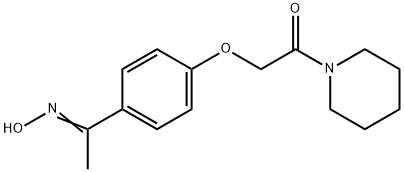
What is Pifoxime?
Originator
Flamanil ,Salvoxyl-Wander, France ,1975
Manufacturing Process
(A) Preparation of p-Acetylphenoxyacetic Acid: p-Hydroxy-acetophenone is treated with chloroacetic acid in aqueous solution in the presence of sodium hydroxide. The desired acid is then isolated from its sodium salt in a total yield of 80 to 82%, excess of p-hydroxy-acetophenone having been extracted with methylene chloride.
(B) Preparation of Methyl p-Acetylphenoxy-Acetate: A mixture of 80 g of the acid obtained in (A) and 200 ml of methyl alcohol in 600 ml of dichloromethane is refluxed in the presence of sulfuric acid. The desired ester is isolated in accordance with a method known per se, and recrystallized. When the refluxing period is 12 hours, the ester is obtained with a yield of 70%. When the refluxing period is 18 hours, the yield for this ester is 85%.
(C) Preparation of N-(p-Acetylphenoxy-Acetyl)-Piperidine: The ester from (B) is refluxed for 8 hours with 2.5 mols of thoroughly dried piperidine. Then 1 volume of water is added and the product is left to crystallize in the cold. The desired amide is obtained in an 80% yield.
(D) Preparation of N-(p-[1-Isonitrosoethyl]-Phenoxy-Acetyl)-Piperidine: The amide from (C) is refluxed for 5 hours with technical (98%) hydroxylamine and alcohol denatured with methanol. The desired product is obtained in a 75% yield.
In semiindustrial synthesis, to achieve better yields, it is possible to omit (A), by directly preparing the ester (B) by reaction of p-hydroxy acetophenone on ethyl 2-bromoacetate in the presence of potassium carbonate in butanone. The yield of ester is 90%, and elimination of excess of phydroxyacetophenone is effected by washing with sodium hydroxide.
Therapeutic Function
Antiinflammatory
Properties of Pifoxime
| Boiling point: | 494.7±30.0 °C(Predicted) |
| Density | 1.18±0.1 g/cm3(Predicted) |
| pka | 11.50±0.70(Predicted) |
Safety information for Pifoxime
Computed Descriptors for Pifoxime
New Products
N-Carbethoxy-4-piperidone 1-Aminocyclopentane carbonitrile Tetrabutylammonium perchlorate N,O-Dimethylhydroxylamine hydrochloride (RS)-beta-Amino-beta-(4-bromophenyl)propionic acid 2-Amino-5-bromo-4-(trifluoromethyl)pyridine N-Vinylformamide 4 pentyn 1 ol Phenethyl cinnamate Pyrrolo[1,2-a]pyrimidine-6-carboxylic acid, 4,6,7,8-tetrahydro-4-oxo-, sodium salt (1:1), (6S) Ethyl 3-phenylpropanoate β-Bromostyrene Methacrylate-PEG-Methacrylate, Mn:35000 2,4-Dihydroxyacetophenone 2-Chloro 5-Fluoro Pyridine Vasicinone 2-Chloroisonicotinic Acid Tween 80 or Polysorbate 80 5-Bromo-1-Pentyne 1-(2-Methyl-5-nitrophenyl)guanidine Nitrate Methyl trans-4-Aminocyclohexanecarboxylate Hydrochloride 2-Pentyn-1-oL 4-Nitrobenzotrifluoride N-(4-Cyano-3-(trifluoromethyl)phenyl)-2-methyloxirane-2-carboxamideRelated products of tetrahydrofuran
You may like
-
 144-83-2 Sulfapyridine 98+View Details
144-83-2 -
29976-53-2 98+View Details
29976-53-2 -
2-Amino-5-bromo-4-(trifluoromethyl)pyridine 98+View Details
944401-56-3 -
(RS)-beta-Amino-beta-(4-bromophenyl)propionic acid 39773-47-2 98+View Details
39773-47-2 -
6638-79-5 N,O-Dimethylhydroxylamine hydrochloride 98+View Details
6638-79-5 -
674783-97-2 98+View Details
674783-97-2 -
1-Aminocyclopentane carbonitrile 98+View Details
49830-37-7 -
Tetrabutylammonium perchlorate 1923-70-2 98+View Details
1923-70-2