
(PHENYLTHIOMETHYL)TRIMETHYLSILANE
Synonym(s):(Phenylthiomethyl)trimethylsilane;(Trimethylsilyl)methyl phenyl sulfide;Phenyl (trimethylsilyl)methyl sulfide
- CAS NO.:17873-08-4
- Empirical Formula: C10H16SSi
- Molecular Weight: 196.38
- MDL number: MFCD00009838
- SAFETY DATA SHEET (SDS)
- Update Date: 2026-05-28 06:32:27
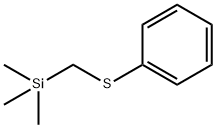
What is (PHENYLTHIOMETHYL)TRIMETHYLSILANE?
Physical properties
bp 158–159 °C/52 mmHg; d20 0.967 g cm?3; n20 D 1.5390.
The Uses of (PHENYLTHIOMETHYL)TRIMETHYLSILANE
lithio derivative is a one-carbon homologating agent leading to aldehydes via sila-Pummerer rearrangement, vinyl sulfides via Peterson alkenation, and vinylsilanes from silyl epoxides.
Purification Methods
If the sample is suspect, then add H2O, wash it with 10% aqueous NaOH, H2O again, dry (anhydrous CaCl2) and fractionally distil it through a 2ft column packed with glass helices. [Cooper J Am Chem Soc 76 3713 1954.]
Properties of (PHENYLTHIOMETHYL)TRIMETHYLSILANE
| Boiling point: | 158-159 °C52 mm Hg(lit.) |
| Density | 0.967 g/mL at 25 °C(lit.) |
| refractive index | n |
| Flash point: | 103 °F |
| solubility | sol most common organic solvents. |
| form | clear liquid |
| color | Colorless to Almost colorless |
| Specific Gravity | 0.97 |
| Hydrolytic Sensitivity | 4: no reaction with water under neutral conditions |
| BRN | 1932375 |
| NIST Chemistry Reference | Silane, trimethyl[(phenylthio)methyl]-(17873-08-4) |
Safety information for (PHENYLTHIOMETHYL)TRIMETHYLSILANE
| Signal word | Warning |
| Pictogram(s) |
 Flame Flammables GHS02  Exclamation Mark Irritant GHS07 |
| GHS Hazard Statements |
H226:Flammable liquids H315:Skin corrosion/irritation H319:Serious eye damage/eye irritation |
| Precautionary Statement Codes |
P210:Keep away from heat/sparks/open flames/hot surfaces. — No smoking. P233:Keep container tightly closed. P240:Ground/bond container and receiving equipment. P241:Use explosion-proof electrical/ventilating/lighting/…/equipment. P242:Use only non-sparking tools. P243:Take precautionary measures against static discharge. P264:Wash hands thoroughly after handling. P264:Wash skin thouroughly after handling. P280:Wear protective gloves/protective clothing/eye protection/face protection. P303+P361+P353:IF ON SKIN (or hair): Remove/Take off Immediately all contaminated clothing. Rinse SKIN with water/shower. P305+P351+P338:IF IN EYES: Rinse cautiously with water for several minutes. Remove contact lenses, if present and easy to do. Continuerinsing. P332+P313:IF SKIN irritation occurs: Get medical advice/attention. P337+P313:IF eye irritation persists: Get medical advice/attention. P370+P378:In case of fire: Use … for extinction. P403+P235:Store in a well-ventilated place. Keep cool. |
Computed Descriptors for (PHENYLTHIOMETHYL)TRIMETHYLSILANE
New Products
2-Amino-5-bromo- benzoic acid 2-Benzyl-1,1,3,3-tetramethylisoindoline Dibenzoyl-L-tartaric acid Anhydrous (Resolution Reagent) Dibenzo[b,f][1,4]thiazepin-11(10H)-one 1,2,3,9-Tetrahydro-9-Methyl-4H-Carbazole-4-One Cis-Tosylate 1-(4-methoxyphenyl)-4-(4-Nitrophenyl)Piperazine (IT-1) 1-aminocyclobutanecarbonitrile hydrochloride AMINO-O-TOLYL-ACETIC ACID 1-Aminocyclobutanecarboxylic Acid Hydrochloride AMINO(2-BROMOPHENYL)ACETIC ACID 6-BROMOTETRAZOLO[1,5-A]PYRIDINE 3-Oxocyclobutanecarboxylic acid PHOSPORIC ACID-D3 85 W% IN D2O TERTIARY BUTANOL-D9 N-ETHYL-D5-AMINE HYDROCHLORIDE BENZOIC ACID-D CHLOROFORM-D TOLUENE-D3 3-tert-Butyl-5-bromobenzaldehyde Methyl 6-(hydroxymethyl)nicotinate 4-Bromo-3-iodoaniline 4-(piperazin-1-yl)benzene-1,2-diamine 1-(3-Chlorophenyl)piperazine hydrochlorideRelated products of tetrahydrofuran
You may like
-
 (Phenylthiomethyl)trimethylsilane CAS 17873-08-4View Details
17873-08-4 -
254762-66-8 AMINO(2-BROMOPHENYL)ACETIC ACID 98+View Details
254762-66-8 -
254762-66-8 AMINO(2-BROMOPHENYL)ACETIC ACID 98+View Details
254762-66-8 -
23716-23-1 98+View Details
23716-23-1 -
6-BROMOTETRAZOLO[1,5-A]PYRIDINE 98+View Details
5799-75-7 -
254762-66-8 AMINO(2-BROMOPHENYL)ACETIC ACID 98+View Details
254762-66-8 -
23716-23-1 98+View Details
23716-23-1 -
6-BROMOTETRAZOLO[1,5-A]PYRIDINE 98+View Details
5799-75-7
Statement: All products displayed on this website are only used for non medical purposes such as industrial applications or scientific research, and cannot be used for clinical diagnosis or treatment of humans or animals. They are not medicinal or edible.