
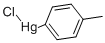
Phenylmercuric chloride
- CAS NO.:100-56-1
- Empirical Formula: C6H5ClHg
- Molecular Weight: 313.15
- MDL number: MFCD00000463
- EINECS: 202-865-1
- SAFETY DATA SHEET (SDS)
- Update Date: 2026-09-12 18:55:54

What is Phenylmercuric chloride?
Chemical properties
white fine crystalline powder
The Uses of Phenylmercuric chloride
Phenylmercuric chloride has been used as an agricultural fungicide.
The Uses of Phenylmercuric chloride
The reaction of phenylmercury (II) chloride with acetophenonethiosemicarbazone (Hatsc) in ethanol in 1: 1 mole ratio undergoes symmetrisation forming the products, HgCl2 (Hatse) 2 and Ph2Hg instead of the anticipated compound PhHgCl (Hatse). A new method for the determination of chloride ion is based on the formation of phenylmercury(II) chloride, its extraction into chloroform and reaction with sodium diethyldithiocarbamate to form phenylmercury(II) diethyldithiocarbamate.
Safety Profile
Poison by ingestion, intraperitoneal, and subcutaneous routes. Human mutation data reported. When heated to decomposition ir emits very toxic fumes of Cland Hg. See also MERCURY COMPOUNDS and CHLORIDES.
Properties of Phenylmercuric chloride
| Melting point: | 248-250 °C (dec.)(lit.) |
| storage temp. | Poison room |
| solubility | soluble in DMSO |
| form | solid |
| Water Solubility | Soluble in benzene, ether, pyridine. Very slightly soluble in water |
| Merck | 14,7301 |
| BRN | 3536717 |
| Exposure limits | ACGIH: TWA 0.1 mg/m3 (Skin) NIOSH: IDLH 10 mg/m3; TWA 0.05 mg/m3; Ceiling 0.1 mg/m3 |
| CAS DataBase Reference | 100-56-1(CAS DataBase Reference) |
| EPA Substance Registry System | Mercury, chlorophenyl- (100-56-1) |
Safety information for Phenylmercuric chloride
| Signal word | Danger |
| Pictogram(s) |
 Skull and Crossbones Acute Toxicity GHS06  Health Hazard GHS08  Environment GHS09 |
| GHS Hazard Statements |
H300:Acute toxicity,oral H310:Acute toxicity,dermal H330:Acute toxicity,inhalation H373:Specific target organ toxicity, repeated exposure H400:Hazardous to the aquatic environment, acute hazard H410:Hazardous to the aquatic environment, long-term hazard |
| Precautionary Statement Codes |
P260:Do not breathe dust/fume/gas/mist/vapours/spray. P273:Avoid release to the environment. P280:Wear protective gloves/protective clothing/eye protection/face protection. P302+P352:IF ON SKIN: wash with plenty of soap and water. P309+P311:IF exposed or if you feel unwell: call a POISON CENTER or doctor/physician. |
Computed Descriptors for Phenylmercuric chloride
New Products
5-bromo-4-fluoro-2-nitrobenzaldehyde (R)-(-)-2-Amino-1-propanol Cyclobutanone Fmoc-OSu 1-(2-Chloroethyl)pyrrolidine Hydrochloride 2-Amino-2-(4-methylphenyl)acetic acid β-Bromostyrene Ethyl 3-phenylpropanoate Phenethyl cinnamate Dipropyl disulfide 4 pentyn 1 ol N-Vinylformamide Methacrylate-PEG-Methacrylate, Mn:35000 2,4-Dihydroxyacetophenone 2-Chloro 5-Fluoro Pyridine Vasicinone 2-Chloroisonicotinic Acid Tween 80 or Polysorbate 80 2-Butyn-1-oL 2-Pentyn-1-oL 4-Nitrobenzotrifluoride N-(4-fluoro-2-methoxy-5-nitrophenyl)-4-(1-methyl-1H-indol-3-yl)pyrimidin-2-amine Pirtobrutinib intd. N-(4-Cyano-3-(trifluoromethyl)phenyl)-2-methyloxirane-2-carboxamideRelated products of tetrahydrofuran

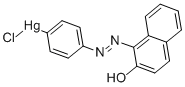
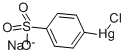
You may like
-
 Fmoc-OSu 98+View Details
82911-69-1 -
(R)-(-)-2-Amino-1-propanol 35320-23-1 98+View Details
35320-23-1 -
7250-67-1 1-(2-Chloroethyl)pyrrolidine Hydrochloride 98+View Details
7250-67-1 -
13227-01-5 98+View Details
13227-01-5 -
7250-67-1 1-(2-Chloroethyl)pyrrolidine Hydrochloride 98+View Details
7250-67-1 -
13227-01-5 98+View Details
13227-01-5 -
7250-67-1 1-(2-Chloroethyl)pyrrolidine Hydrochloride 98+View Details
7250-67-1 -
13227-01-5 98+View Details
13227-01-5