
Phenylarsine oxide
Synonym(s):Arzene;Oxophenylarsine;PAO;PAO, Oxophenylarsine, PTP Inhibitor IX, PDI Inhibitor II, Protein Disulfide Isomerase Inhibitor II;Phenylarsine Oxide - CAS 637-03-6 - Calbiochem
- CAS NO.:637-03-6
- Empirical Formula: C6H5AsO
- Molecular Weight: 168.02
- MDL number: MFCD00001990
- EINECS: 211-275-3
- SAFETY DATA SHEET (SDS)
- Update Date: 2026-05-28 05:20:54
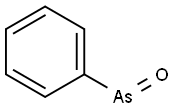
What is Phenylarsine oxide?
Chemical properties
WHITE TO ALMOST WHITE CRYSTALS OR CRYST. POWDER
The Uses of Phenylarsine oxide
Phenylarsine oxide is used as a poultry coccidiostat in veterinary medicine. It is also used in a membrane-permeable protein tyrosine phosphatase inhibitor.
The Uses of Phenylarsine oxide
Pesticide.
What are the applications of Application
Phenylarsine oxide is a membrane-permeable PTPase inhibitor
Definition
ChEBI: An arsine oxide derived from phenylarsine.
General Description
Phenylarsine oxide (PhAsO4) is a bifunctional SH group chemical. It is hydrophobic in nature.
Biochem/physiol Actions
Phenylarsine oxide?(PAO) can reduce the motility and sustainability of Setaria cervi. It has the ability to stimulate cyclosporin A-sensitive transition in the presence of EGTA (ethylene glycol-bis(β-aminoethyl ether)-N,N,N′,N′-tetraacetic acid). It acts as a stimulator of mitochondrial ion fluxes.
Safety Profile
Poison by intravenous and intraperitoneal routes. When heated to decomposition it emits toxic fumes of As. See also ARSENIC COMPOUNDS
Properties of Phenylarsine oxide
| Melting point: | 145-148 °C |
| storage temp. | Poison room |
| solubility | DMSO: 50 mg/mL |
| form | powder |
| color | white to yellow |
| Water Solubility | Soluble in dimethyl sulfoxide, chloroform, benzene, ether, ethanol, 50:50 dimethyl sulfoxide:1 M hydrochloric acid (3.0 mg/ml) and toluene. Insoluble in water. |
| Merck | 14,6949 |
| BRN | 2935227 |
| Stability: | Stable. |
| CAS DataBase Reference | 637-03-6(CAS DataBase Reference) |
| EPA Substance Registry System | Oxophenylarsine (637-03-6) |
Safety information for Phenylarsine oxide
| Signal word | Danger |
| Pictogram(s) |
 Skull and Crossbones Acute Toxicity GHS06  Environment GHS09 |
| GHS Hazard Statements |
H410:Hazardous to the aquatic environment, long-term hazard |
| Precautionary Statement Codes |
P261:Avoid breathing dust/fume/gas/mist/vapours/spray. P264:Wash hands thoroughly after handling. P264:Wash skin thouroughly after handling. P270:Do not eat, drink or smoke when using this product. P273:Avoid release to the environment. P301+P310:IF SWALLOWED: Immediately call a POISON CENTER or doctor/physician. |
Computed Descriptors for Phenylarsine oxide
New Products
Cyclobutanone (R)-(-)-2-Amino-1-propanol Fmoc-OSu 5-bromo-4-fluoro-2-nitrobenzaldehyde 2-Amino-2-(4-methylphenyl)acetic acid 1-(2-Chloroethyl)pyrrolidine Hydrochloride 2,4-Dihydroxybenzaldehyde Obidoxime hydrochloride API Pyrrolo[1,2-a]pyrimidine-6-carboxylic acid, 4,6,7,8-tetrahydro-4-oxo-, sodium salt (1:1), (6S) Dipropyl disulfide N-Vinylformamide 4 pentyn 1 ol Methacrylate-PEG-Methacrylate, Mn:35000 2,4-Dihydroxyacetophenone 2-Chloro 5-Fluoro Pyridine Vasicinone 2-Chloroisonicotinic Acid Tween 80 or Polysorbate 80 2-Butyn-1-oL N-(4-fluoro-2-methoxy-5-nitrophenyl)-4-(1-methyl-1H-indol-3-yl)pyrimidin-2-amine Pirtobrutinib intd. 2-Pentyn-1-oL 4-Nitrobenzotrifluoride N-(4-Cyano-3-(trifluoromethyl)phenyl)-2-methyloxirane-2-carboxamideRelated products of tetrahydrofuran
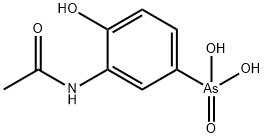

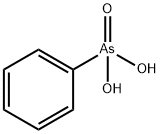

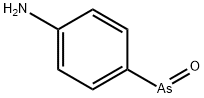

You may like
-
 Phenylarsine Oxide CAS 637-03-6View Details
637-03-6 -
Phenylarsine oxide CAS 637-03-6View Details
637-03-6 -
7250-67-1 1-(2-Chloroethyl)pyrrolidine Hydrochloride 98+View Details
7250-67-1 -
13227-01-5 98+View Details
13227-01-5 -
545445-44-1 3-Morpholino-1-(4-(2-oxopiperidin-1-yl) phenyl)-5,6-dihyropyridin-2-(1H)-one 98%View Details
545445-44-1 -
6629-04-5 98%View Details
6629-04-5 -
4-(4-Αminophenyl)-3-Morpholinone 98%View Details
438056-69-0 -
1-(4-Aminophenyl)-3-morpholino-5,6-dihydropyridin-2(1H)-one 1267610-26-3 98%View Details
1267610-26-3