
Phenol, 4,4'-(2-pyridinylmethylene)bis-, 1,1'-bis(hydrogen sulfate)
- CAS NO.:10040-34-3
- Empirical Formula: C18H15NO8S2
- Molecular Weight: 437.44
- SAFETY DATA SHEET (SDS)
- Update Date: 2022-12-21 16:56:50
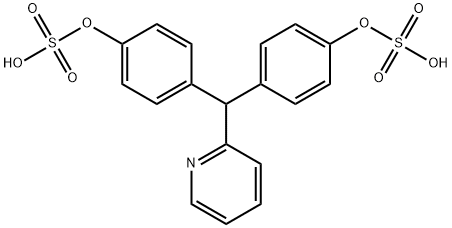
What is Phenol, 4,4'-(2-pyridinylmethylene)bis-, 1,1'-bis(hydrogen sulfate)?
Absorption
After the first dose of an oral sodium picosulfate, magnesium oxide, and anhydrous citric acid product, healthy volunteers had a picosulfate mean peak plasma concentration (Cmax) of 2.3 ng/mL that was reached at 2 hours (tmax). After the administration of two doses separated by 6 hours, the mean Cmax for picosulfate was 3.2 ng/mL, with a tmax of 7 hours.
Toxicity
Overdosage of laxative preparations containing sodium picosulfate may lead to severe electrolyte disturbances, in addition to dehydration and hypovolemia, with signs and symptoms of these disturbances. In case of overdose, monitor for fluid and electrolyte disturbances with symptomatic treatment. In vitro, 800 and 1600 mg/mL of sodium picosulfate exerted cytotoxic effects on cultured liver cells by inducing dose-dependent vacuolic and fatty change, as well as necrosis combined with a lowered mitotic activity and a slight increase in LDH values of the rapidly growing cultured liver cells of rabbit.
Background
Picosulfuric acid is found in laxative products. Sodium picosulfate is a used to treat constipation or induce colon cleansing to prepare the large bowels before colonoscopy or surgery. The combination product containing sodium picosulfate and magnesium citrate was introduced to the Canadian market in 2005 and has been used in European countries for many years.
Indications
Sodium picosulfate, in combination with magnesium oxide and anhydrous citric acid, is indicated for cleansing of the colon as a preparation for colonoscopy in adults and pediatric patients ages 9 years and older.
Pharmacokinetics
Sodium picosulfate is a stimulant laxative that in conjunction with magnesium citrate, produces a purgative effect on stools. In a multicentre, observational study comprising of patients undergoing colonoscopy, more than 93.0% of the patients receiving sodium picosulfate-containing preparations reported the colon cleansing effect to be effective.
Metabolism
Sodium picosulfate is hydrolyzed by colonic bacteria to form an active metabolite bis-(p-hydroxy-phenyl)-pyridyl-2-methane (BHPM).
Properties of Phenol, 4,4'-(2-pyridinylmethylene)bis-, 1,1'-bis(hydrogen sulfate)
| Density | 1.573±0.06 g/cm3(Predicted) |
| pka | -4?+-.0.18(Predicted) |
Safety information for Phenol, 4,4'-(2-pyridinylmethylene)bis-, 1,1'-bis(hydrogen sulfate)
Computed Descriptors for Phenol, 4,4'-(2-pyridinylmethylene)bis-, 1,1'-bis(hydrogen sulfate)
New Products
9-Mesityl-10-methylacridinium perchlorate Sulfapyridine Fmoc-OSu (R)-(-)-2-Amino-1-propanol Cyclobutanone 5-bromo-4-fluoro-2-nitrobenzaldehyde 4 pentyn 1 ol N-Vinylformamide Phenethyl cinnamate Pyrrolo[1,2-a]pyrimidine-6-carboxylic acid, 4,6,7,8-tetrahydro-4-oxo-, sodium salt (1:1), (6S) Ethyl 3-phenylpropanoate β-Bromostyrene Methacrylate-PEG-Methacrylate, Mn:35000 2,4-Dihydroxyacetophenone 2-Chloro 5-Fluoro Pyridine Vasicinone 2-Chloroisonicotinic Acid Tween 80 or Polysorbate 80 Methyl trans-4-Aminocyclohexanecarboxylate Hydrochloride N-(4-fluoro-2-methoxy-5-nitrophenyl)-4-(1-methyl-1H-indol-3-yl)pyrimidin-2-amine Pirtobrutinib intd. 4-Nitrobenzotrifluoride 2-Pentyn-1-oL N-(4-Cyano-3-(trifluoromethyl)phenyl)-2-methyloxirane-2-carboxamideYou may like
-
 1191-95-3 Cyclobutanone 98+View Details
1191-95-3 -
213382-45-7 98+View Details
213382-45-7 -
Fmoc-OSu 98+View Details
82911-69-1 -
(R)-(-)-2-Amino-1-propanol 35320-23-1 98+View Details
35320-23-1 -
1191-95-3 Cyclobutanone 98+View Details
1191-95-3 -
213382-45-7 98+View Details
213382-45-7 -
Fmoc-OSu 98+View Details
82911-69-1 -
(R)-(-)-2-Amino-1-propanol 35320-23-1 98+View Details
35320-23-1