
Phenformin
- CAS NO.:114-86-3
- Empirical Formula: C10H15N5
- Molecular Weight: 205.26
- MDL number: MFCD00242966
- EINECS: 204-057-4
- SAFETY DATA SHEET (SDS)
- Update Date: 2026-07-27 17:00:41
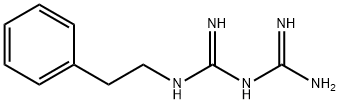
What is Phenformin?
Originator
DBI ,Geigy, US ,1959
The Uses of Phenformin
N-Phenethylbiguanide is used in cancer treatment methods using thermotherapy and/or enhanced immunotherapy.
Indications
For the reatment of type II diabetes mellitus.
Background
A biguanide hypoglycemic agent with actions and uses similar to those of metformin. Although it is generally considered to be associated with an unacceptably high incidence of lactic acidosis, often fatal, it is still available in some countries. (From Martindale, The Extra Pharmacopoeia, 30th ed, p290)
Definition
ChEBI: A member of the class of biguanides that is biguanide in which one of the terminal nitrogen atoms is substituted by a 2-phenylethyl group. It was used as an anti-diabetic drug but was later withdrawn from the market due to potential risk of lactic acidos s.
Manufacturing Process
15.76 g of β-phenylethylamine hydrochloride and 8.4 g of dicyandiamide were ground and intimately mixed. The mixture was heated in an oil bath in a 3neck flask fitted with a thermometer and stirrer, and the mixture began to melt at a bath temperature of 125°C and was completely fluid at 130°C. Further heating at 145°C to 150°C initiated an exothermic reaction and the temperature of the fusion mixture (156°C) exceeded the oil bath temperature (150°C) by 6°. Heating was continued for one hour at bath temperature of 148°C to 150°C. The reaction mixture was cooled, dissolved in about 100 cc of methanol and filtered. The methanol filtrate was concentrated under reduced pressure, cooled and the product (β-phenylethylbiguanide hydrochloride) filtered off and recrystallized from 95% isopropanol.
brand name
DBI (Ciba-Geigy);Adibetin;Antipond;Bi-uglucon ud87;D bretard;Daopar;Db comb.;Db retard;De be;Debej;Diaformin;Dibein retard;Dibenide;Dibinyl;Dibolin;Dibophen;Dibun;Diebin retard;Diguabet;Dobeom;Fenguanide;Gluciferne;Glucifrene;Glucopstin;Kataglicina;Ls 6030;Oraleo;Prontoformin;Tolbrtaphen.
Therapeutic Function
Antidiabetic
World Health Organization (WHO)
Phenformin, a biguanide with oral hypoglycaemic activity, was introduced in 1957 for the management of diabetes mellitus. By 1970 its use had been associated with incidences of lactic acidosis and by 1976 clinical studies had conclusively demonstrated that the hazards of phenformin treatment outweighed the benefits. Preparations containing phenformin were withdrawn in several countries and their use restricted in others. Elsewhere, however, proprietary preparations containing this drug may remain available. The related biguanide, buformin, has been also associated with lactic acidosis and has been subjected to similar restrictions as phenformin, whereas there is some evidence that metformin is less liable to induce lactic acidosis. (Reference: (WHODI) WHO Drug Information, 2, 4, 1977)
Pharmacokinetics
Used to treat diabetes, phenformin is a biguanide (contains 2 guanidino groups) hypoglycemic agent with actions and uses similar to those of metformin (Glucophage). Both drugs work by (1) decreasing the absorption of glucose by the intestines, (2) decreasing the production of glucose in the liver, and by (3) increasing the body's ability to use insulin more effectively. More specifically, phenformin improves glycemic control by improving insulin sensitivity. Phenformin is generally considered to be associated with an unacceptably high incidence of actic acidosis. In general biguanides should be used only in stable type II diabetics who are free of liver, kidney and cardiovascular problems and who cannot be controlled with diet.
Safety Profile
Poison by intraperitoneal, subcutaneous, and intravenous routes. Moderately toxic by ingestion. When heated to decomposition it emits toxic fumes of NOx.
Enzyme inhibitor
This oral, biguanide-class antidiabetic (FWhydrochloride = 241.72 g/mol; M.P. = 175-178°C; typically supplied as the water-soluble hydrochloride salt), also known as phenethylbiguanide and phenylethylbiguanide, and named systematically as N’-b-phenethylformamidinyliminourea, was withdrawn from the U.S. market in 1977 due to high risk of inducing often fatal lactic acidosis. Target(s): cholesterol biosynthesis; 7-dehydrocholesterol reductase; diamine oxidase; glucose transport; insulysin; pyruvate kinase; and ubiquinol:cytochrome c reductase. Phenformin is an activator of AMP-stimulated protein kinase, and like ther AMPK activators also induce nucleoli re-organization, with attendanty changes in cell proliferation. Among the compounds tested, phenformin and resveratrol had the most pronounced impact on nucleolar organization. 1. McDonald & Dalidowicz Biochemistry
Metabolism
Not Available
Properties of Phenformin
| Melting point: | 176.5 °C |
| Boiling point: | 333.94°C (rough estimate) |
| Density | 1.0541 (rough estimate) |
| refractive index | 1.6380 (estimate) |
| pka | pKa 3.1/12.9±0.01(H2O,t =25,I>0.1) (Uncertain) |
| CAS DataBase Reference | 114-86-3(CAS DataBase Reference) |
| NIST Chemistry Reference | Imidodicarbonimidic diamide, n-(2-phenylethyl)-(114-86-3) |
Safety information for Phenformin
Computed Descriptors for Phenformin
New Products
9-Mesityl-10-methylacridinium perchlorate Sulfapyridine Fmoc-OSu (R)-(-)-2-Amino-1-propanol Cyclobutanone 5-bromo-4-fluoro-2-nitrobenzaldehyde 4 pentyn 1 ol N-Vinylformamide Phenethyl cinnamate Pyrrolo[1,2-a]pyrimidine-6-carboxylic acid, 4,6,7,8-tetrahydro-4-oxo-, sodium salt (1:1), (6S) Ethyl 3-phenylpropanoate β-Bromostyrene Methacrylate-PEG-Methacrylate, Mn:35000 2,4-Dihydroxyacetophenone 2-Chloro 5-Fluoro Pyridine Vasicinone 2-Chloroisonicotinic Acid Tween 80 or Polysorbate 80 5-Bromo-1-Pentyne 1-(2-Methyl-5-nitrophenyl)guanidine Nitrate Methyl trans-4-Aminocyclohexanecarboxylate Hydrochloride N-(4-Cyano-3-(trifluoromethyl)phenyl)-2-methyloxirane-2-carboxamide 4-Nitrobenzotrifluoride 2-Pentyn-1-oLRelated products of tetrahydrofuran


You may like
-
 Phenformin 95% CAS 114-86-3View Details
114-86-3 -
1191-95-3 Cyclobutanone 98+View Details
1191-95-3 -
Fmoc-OSu 98+View Details
82911-69-1 -
(R)-(-)-2-Amino-1-propanol 35320-23-1 98+View Details
35320-23-1 -
1191-95-3 Cyclobutanone 98+View Details
1191-95-3 -
213382-45-7 98+View Details
213382-45-7 -
Fmoc-OSu 98+View Details
82911-69-1 -
(R)-(-)-2-Amino-1-propanol 35320-23-1 98+View Details
35320-23-1