
phanquone
- CAS NO.:84-12-8
- Empirical Formula: C12H6N2O2
- Molecular Weight: 210.19
- MDL number: MFCD00448638
- EINECS: 201-516-0
- SAFETY DATA SHEET (SDS)
- Update Date: 2026-05-28 03:05:05
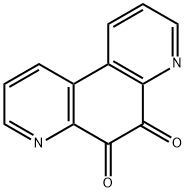
What is phanquone?
Originator
Phanquinone ,Yick-Vic Chemicals and
Definition
ChEBI: An orthoquinone that is the 5,6-diketo derivative of 4,7-phenanthroline.
Manufacturing Process
2 parts of 6-methoxy-4:7-phenanthroline are mixed with 10 parts by volume of concentrated sulfuric acid and while cooling with a mixture of ice and sodium chloride, with 6 parts by volume of fuming nitric acid (density = 1.51), and the whole is heated for 2 h at 120°C. The reaction solution is poured on to ice, its pH value is adjusted to 7 by means of a 10 N solution of caustic soda, after standing for 2 h the whole is filtered with suction to remove the precipitate which separates, and the latter is washed with hot water. After recrystallising the product from methyl alcohol and drying it at 100°C under 0.1 mm pressure, there are obtained 1.8 parts (i.e. 90 % of the calculated yield) of 4:7-phenanthroline-5:6-quinone in the form of pale yellow crystals melting at 295°C.
Therapeutic Function
Antiamebic
Safety Profile
Poison by ingestion. Mutation data reported. When heated to decomposition it emits toxic fumes of NOx.
Purification Methods
The dione crystallises from MeOH. The mono-oxime forms yellow crystals from MeOH with m 250o(dec), the di-oxime forms yellow crystals from MeOH with m 300o(dec) and the mono-semihydrazone forms yellow crystals from MeOH with m 195o(dec). [Druey & Schmidt Helv Chim Acta 33 1080 1950, Beilstein 24 III/IV 1741.]
Properties of phanquone
| Melting point: | 295° (dec) |
| Boiling point: | 349.71°C (rough estimate) |
| Density | 1.2785 (rough estimate) |
| refractive index | 1.6000 (estimate) |
| pka | -0.30±0.20(Predicted) |
| form | Solid |
| color | Crystals from methanol |
Safety information for phanquone
| Signal word | Warning |
| Pictogram(s) |
 Exclamation Mark Irritant GHS07 |
| GHS Hazard Statements |
H302:Acute toxicity,oral H315:Skin corrosion/irritation H319:Serious eye damage/eye irritation H335:Specific target organ toxicity, single exposure;Respiratory tract irritation |
| Precautionary Statement Codes |
P261:Avoid breathing dust/fume/gas/mist/vapours/spray. P305+P351+P338:IF IN EYES: Rinse cautiously with water for several minutes. Remove contact lenses, if present and easy to do. Continuerinsing. |
Computed Descriptors for phanquone
New Products
2-(2-Chlorophenyl)glycine Propiolic Acid 1-(3-Hydroxy-4-methoxyphenyl)-2-nitroethene (±)-amino(2-fluorophenyl)acetic acid trans-3-Benzyloxy-4-methoxy-beta-nitrostyrene 1-Pentadecanol 2,4-Dihydroxybenzaldehyde Dipropyl disulfide Pyrrolo[1,2-a]pyrimidine-6-carboxylic acid, 4,6,7,8-tetrahydro-4-oxo-, sodium salt (1:1), (6S) Obidoxime hydrochloride API 4 pentyn 1 ol N-Vinylformamide Methacrylate-PEG-Methacrylate, Mn:35000 2,4-Dihydroxyacetophenone 2-Chloro 5-Fluoro Pyridine Vasicinone 2-Chloroisonicotinic Acid Tween 80 or Polysorbate 80 2-Butyn-1-oL N-(4-Cyano-3-(trifluoromethyl)phenyl)-2-methyloxirane-2-carboxamide N-(4-fluoro-2-methoxy-5-nitrophenyl)-4-(1-methyl-1H-indol-3-yl)pyrimidin-2-amine Pirtobrutinib intd. 2-Pentyn-1-oL 4-NitrobenzotrifluorideRelated products of tetrahydrofuran
You may like
-
 40216-83-9 trans-4-Hydroxy-L-proline methyl ester hydrochloride 98+View Details
40216-83-9 -
471-25-0 Propiolic Acid 98+View Details
471-25-0 -
84145-28-8 98+View Details
84145-28-8 -
trans-3-Benzyloxy-4-methoxy-beta-nitrostyrene 98+View Details
63909-29-5 -
2-(2-Chlorophenyl)glycine 88744-36-9 98+View Details
88744-36-9 -
40216-83-9 trans-4-Hydroxy-L-proline methyl ester hydrochloride 98+View Details
40216-83-9 -
629-76-5 98+View Details
629-76-5 -
1-(3-Hydroxy-4-methoxyphenyl)-2-nitroethene 98+View Details
39816-35-8