
Pevonedistat
- CAS NO.:905579-51-3
- Empirical Formula: C21H25N5O4S
- Molecular Weight: 443.52
- MDL number: MFCD17215201
- SAFETY DATA SHEET (SDS)
- Update Date: 2026-07-14 16:49:18
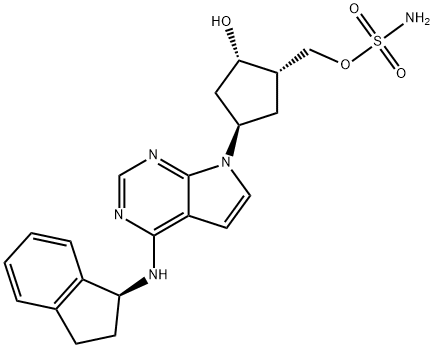
What is Pevonedistat?
Description
MLN4924 (905579-51-3) is a potent and selective NEDD8-activating enzyme (NAE) inhibitor.1?It disrupts cullin-RING ligase-mediated protein turnover leading to apoptosis in human tumor cells. Suppresses the growth of human tumor xenografts in mice.2?Upregulates PD-L1 expression and enhances the efficacy of immune checkpoint blockade in glioblastoma.3?Modulates tumor microenvironment.4?Cell permeable.
Chemical properties
White Solid
The Uses of Pevonedistat
A potent and selective inhibitor of NAE.
The Uses of Pevonedistat
A potent and selective inhibitor of NAE. An inhibitor of NEDD8-activating enzyme as a new approach to treat cancer. The ubiquitin-proteasome pathway mediates the destruction of unwanted proteins. Potent NAE inhibitor; NEDD8 E1 Activating Enzyme Inhibitor.
Definition
ChEBI: Pevonedistat is a pyrrolopyrimidine that is 7H-pyrrolo[2,3-d]pyrimidine which is substituted by a (1S)-2,3-dihydro-1H-inden-1-ylnitrilo group at position 4 and by a (1S,3S,4S)-3-hydroxy-4-[(sulfamoyloxy)methyl]cyclopentyl group at position 7. It is a potent and selective NEDD8-activating enzyme inhibitor with an IC50 of 4.7 nM, and currently under clinical investigation for the treatment of acute myeloid leukemia (AML) and myelodysplastic syndromes. It has a role as an apoptosis inducer and an antineoplastic agent. It is a pyrrolopyrimidine, a secondary amino compound, a member of cyclopentanols, a sulfamidate and a member of indanes.
Enzyme inhibitor
This first-in-class small molecule inhibitor (FW = 443.52 g/mol; CAS 905579-51-3; Solubility = 10 mg/mL DMSO), also named MLN4924 and [(1S,2S,4R)-4-[4-[[(1S)-2,3-dihydro-1H-inden-1-yl]amino]-7H-pyrrolo[2,3- d]pyrimidin-7-yl]-2-hydroxycyclopentyl]sulfamate methyl ester, targets Nedd8 activating enzyme, or NAE (IC50 = 4.7 nM), with much weaker action against UAE (IC50 = 1.5 μM), SAE (IC50 = 8.2 μM), and UBA6 (IC50 = 1.8 μM). In most cancer cells, pevonedistat treatment results in the induction of DNA re-replication, resulting in DNA damage and cell death. MLN4924 also exhibits an alternative mechanism of action. Treatment of activated B cell-like (ABC) diffuse large B-cell lymphoma (DLBCL) cells with pevonedistat resulted in rapid accumulation of pIkBa, decrease in nuclear p65 content, reduction of transcriptional activity of NF-kB (or nuclear factor k-light-chain-enhancer of activated B cells), and G1 arrest, ultimately resulting in apoptosis induction, events consistent with potent NF-kB pathway inhibition. Treatment of germinal-center B cell-like (GCB) DLBCL cells resulted in an increase in cellular Cdt-1 and accumulation of cells in S-phase, consistent with cells undergoing DNA rereplication. Pevonedistat also inhibits Vpx/Vpr-induced SAMHD1 degradation by inhibiting the neddylation of E3 ubiquitin-ligase and blocking SIVmac replication in myeloid cells, therebyindicating the potential efficacy of inhibiting neddylation as an antiretroviral strategy
Storage
Store at -20°C
References
1) Soucy, et al. (2009), An inhibitor of NEDD8-activating enzyme as a new approach to treat cancer. Nature 458 732 2) Milhollen, et al. (2010) MLN4924, a NEDD8-activating enzyme inhibitor, is active in diffuse large B-cell lymphoma models: rationale for treatment of NF-(kappa)B-dependent lymphoma. Blood, 116 1515 3) Zhou et al. (2019) Neddylation inhibition upregulates PD-L1 expression and enhances the efficacy of immune checkpoint blockade in glioblastoma; Int. J. Cancer, 145 763 4) Zhou et al. (2019) Neddylation: a novel modulator of the tumor microenvironment; Mol. Cancer 18 77
Properties of Pevonedistat
| Melting point: | 161-163°C |
| Boiling point: | 721.0±70.0 °C(Predicted) |
| Density | 1.62 |
| storage temp. | -20°C Freezer |
| solubility | Soluble in DMSO (up to 10 mg/ml). |
| form | solid |
| pka | 9.35±0.70(Predicted) |
| color | White |
| Stability: | Stable for 2 years from date of purchase as supplied. Solutions in DMSO may be stored at -20° for up to 3 months. |
Safety information for Pevonedistat
| Signal word | Warning |
| Pictogram(s) |
 Exclamation Mark Irritant GHS07 |
| GHS Hazard Statements |
H315:Skin corrosion/irritation H319:Serious eye damage/eye irritation |
| Precautionary Statement Codes |
P264:Wash hands thoroughly after handling. P264:Wash skin thouroughly after handling. P280:Wear protective gloves/protective clothing/eye protection/face protection. P302+P352:IF ON SKIN: wash with plenty of soap and water. P305+P351+P338:IF IN EYES: Rinse cautiously with water for several minutes. Remove contact lenses, if present and easy to do. Continuerinsing. P332+P313:IF SKIN irritation occurs: Get medical advice/attention. P337+P313:IF eye irritation persists: Get medical advice/attention. |
Computed Descriptors for Pevonedistat
New Products
9-Mesityl-10-methylacridinium perchlorate Sulfapyridine Fmoc-OSu (R)-(-)-2-Amino-1-propanol Cyclobutanone 5-bromo-4-fluoro-2-nitrobenzaldehyde 4 pentyn 1 ol N-Vinylformamide Phenethyl cinnamate Pyrrolo[1,2-a]pyrimidine-6-carboxylic acid, 4,6,7,8-tetrahydro-4-oxo-, sodium salt (1:1), (6S) Ethyl 3-phenylpropanoate β-Bromostyrene Methacrylate-PEG-Methacrylate, Mn:35000 2,4-Dihydroxyacetophenone 2-Chloro 5-Fluoro Pyridine Vasicinone 2-Chloroisonicotinic Acid Tween 80 or Polysorbate 80 5-Bromo-1-Pentyne 1-(2-Methyl-5-nitrophenyl)guanidine Nitrate Methyl trans-4-Aminocyclohexanecarboxylate Hydrochloride N-(4-Cyano-3-(trifluoromethyl)phenyl)-2-methyloxirane-2-carboxamide 4-Nitrobenzotrifluoride 2-Pentyn-1-oLRelated products of tetrahydrofuran


You may like
-
 MLN4924 >95% CAS 905579-51-3View Details
905579-51-3 -
1191-95-3 Cyclobutanone 98+View Details
1191-95-3 -
Fmoc-OSu 98+View Details
82911-69-1 -
(R)-(-)-2-Amino-1-propanol 35320-23-1 98+View Details
35320-23-1 -
1191-95-3 Cyclobutanone 98+View Details
1191-95-3 -
213382-45-7 98+View Details
213382-45-7 -
Fmoc-OSu 98+View Details
82911-69-1 -
(R)-(-)-2-Amino-1-propanol 35320-23-1 98+View Details
35320-23-1