
palovarotene
- CAS NO.:410528-02-8
- Empirical Formula: C27H30N2O2
- Molecular Weight: 414.54
- MDL number: MFCD10565968
- EINECS: 200-258-5
- SAFETY DATA SHEET (SDS)
- Update Date: 2026-08-11 13:38:40
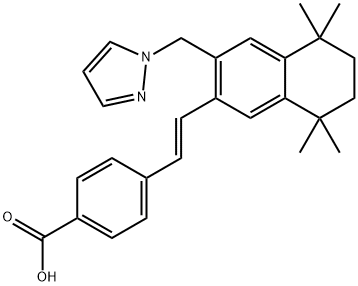
What is palovarotene?
Absorption
Following oral administration of 20mg once daily in healthy adult subjects, the median Tmax was 4.6 hours, the mean Cmax was 140 ng/mL, and the mean AUC(0-τ) was 942 ng*hr/mL. At steady-state, the mean trough concentration of palovarotene was 3.5 ng/mL.
The administration of palovarotene with a high-fat, high-calorie meal resulted in an approximate 40% increase in AUC, an approximate 16% increase in Cmax, and a delay in Tmax by approximately 2 hours when compared to its administration under fasting conditions.
Toxicity
Palovarotene is contraindicated during pregnancy. Based on the findings in animal studies and class effects of retinoids, SOHONOS can cause fetal harm when administered during pregnancy. In animal reproduction studies, oral administration of palovarotene to pregnant rats during the period of organogenesis resulted in multiple fetal malformations typical of retinoids (e.g., cleft palate, malformed skull bone, shortening of the long bones) at doses ≥0.25 mg/kg/day (less than the clinical exposure). There are no available human data on palovarotene use in pregnant women. If pregnancy occurs during treatment with palovarotene, discontinue treatment immediately and refer the patient to an obstetrician/gynecologist or other specialist experienced in reproductive toxicity for further evaluation and counseling.
No clinical experience with an overdose of palovarotene has been reported. Palovarotene is a derivative of vitamin A. In case of accidental overdose, signs of hypervitaminosis A could appear, including severe headache, nausea or vomiting, drowsiness, irritability, and pruritus. Any overdose should be treated with supportive care according to the signs and symptoms exhibited by the patient. If an overdose is suspected, patients should be treated with supportive care as clinically indicated.
Long-term studies to assess the carcinogenic potential of palovarotene have not been conducted. Palovarotene and its metabolites were negative in the vitro bacterial reverse mutation (Ames) assay and an in vitro micronucleus assay in primary human lymphocyte. Palovarotene did not have any clastogenic effect in the in vivo mouse micronucleus study.
Palovarotene effects on fertility and reproductive function were assessed in male and female rats. In a female rat fertility study, palovarotene was orally administered to females for 14 days prior to mating with drug na?ve males and up to GD 7 at the dose levels of 0.3, 1, and 3 mg/kg/day. Palovarotene caused prolonged periods of diestrous and reduced ovulation rate, resulting in lower numbers of implantation sites and live embryos at 3 mg/kg/day, a dose associated with maternal toxicity.
In a male rat fertility study, palovarotene was orally administered prior to mating, during mating, and up to scheduled euthanasia (approximately 11 weeks in total) at 0.3, 1, and 3 mg/kg/day. Palovarotene did not cause adverse effects on mating, fertility indices, conception rate, reproductive organ weights, or sperm parameters up to 1 mg/kg/day (less than the clinical exposure). Males did not tolerate 3 mg/kg/day, as it produced severe systemic toxicity including deaths, adverse skin and hair coat clinical signs, and substantially reduced body weight.
Description
Palovarotene an orally bioavailable retinoic acid receptor γ (RARγ) agonist. It increases retinoic acid response element (RARE) activity and decreases NF-κB activity induced by IL-1β in primary mouse stromal cells in reporter assays when used at a concentration of 60 nM. Palovarotene (10 nM) inhibits activin A-induced chondrogenic and osteogenic differentiation of mouse fibro/adipogenic progenitors (FAPs) expressing a mutated form of human activin A receptor type I (ACVR1R206H). It inhibits heterotopic ossification and preserves limb movement and growth in a ACVR1R206H fibrodysplasia ossificans progressiva (FOP) mouse model. Palovarotene (1 mg/kg per day for 14 days) decreases heterotopic ossification by 50 to 60% in a rat model of traumatic blast injury.
The Uses of palovarotene
Palovarotene, is a highly selective retinoic acid receptor gamma (RAR-γ) agonist that is under investigation as a potential treatment for emphysema.
Background
Fibrodysplasia Ossificans Progressiva (FOP), with an estimated worldwide prevalence of one in 2 million individuals, is an exceptionally rare genetic disorder. FOP is caused by a gain-of-function mutation in the ACVR1/ALK2 gene which results in progressive heterotopic ossification, a process wherein connective tissues (e.g. skeletal muscle, ligaments, tendons) are replaced with bone. The ossification occurring as a result of FOP is insidious and cumulative and is provoked during flare-ups or in response to injury. Treatment options for patients with FOP are extremely limited, although there has been substantial recent interest in novel treatments for this disease.
Palovarotene is a selective agonist of retinoic acid receptor gamma (RARγ) belonging to a class of medications known as retinoids, similar in mechanism to drugs like tazarotene or trifarotene, which are derivatives of vitamin A. It first garnered interest as a potential treatment for emphysema but was eventually recognized as a potential novel therapy for patients with FOP. Agonists for retinoic acid receptors have been shown to inhibit chondrogenesis of heterotopic ossification in a transgenic mice model of FOP, with selective RARγ agonists (e.g. palovarotene) demonstrating the greatest efficacy.
Palovarotene was approved for use in Canada in January 2022 for the management of heterotopic ossification (HO) in patients with FOP, representing the first global approval for any FOP therapy. It has been granted rare pediatric disease and breakthrough therapy designations from the US FDA, although a previously submitted NDA was withdrawn in August 2021 pending the resubmission of additional data analyses. On August 16, 2023, palovarotene was also approved by the FDA for the management of HO associated with FOP.
Indications
Palovarotene is indicated in Canada to reduce the formation of heterotopic ossification in adults and children (≥8 years old for females and ≥10 years old for males) with Fibrodysplasia Ossificans Progressiva (FOP) by Health Canada and FDA.
Definition
ChEBI: Palovarotene is a stilbenoid.
Pharmacokinetics
Palovarotene exerts its pharmacologic effects by inhibiting the pathway(s) responsible for heterotopic ossification in patients with FOP. It is orally bioavailable and can be administered once daily, with allowances for short-term increases in dosage in the event of a flare-up.
As with other retinoids, palovarotene can cause birth defects, and it should not be used by patients who are, or intend to become, pregnant. Palovarotene is contraindicated in patients of childbearing potential unless a number of pregnancy prevention strategies are met (e.g. effective contraception, regular pregnancy testing).
Palovarotene may also cause a premature physeal closure in growing children. Physeal growth plates should be monitored every 3 months throughout therapy, or more frequently if evidence of adverse effects on growth are observed.
At doses up to 2.5 times the maximum recommended dose, palovarotene does not prolong the QT interval to any clinically relevant extent.
Palovarotene binds to retinoic acid receptor gamma (RARγ) with a 10-fold greater affinity compared to retinoic acid receptor alpha or beta. In animal models of Fibrodysplasia Ossificans Progressiva (BMP implant in WT mouse, Q207D mouse model, R206H mouse model), palovarotene decreased heterotopic ossification (HO) in a dose-dependent manner as well as inflammatory and fibroproliferative responses at the sites of injury. Additionally, palovarotene also outperformed corticosteroids in preventing HO, with a dexamethasone treatment of 4.4 mg/kg/day for 4 days demonstrating no clinical efficacy on heterotropic bone volume.
Metabolism
Palovarotene undergoes extensive metabolism by CYP3A4 and, to a lesser extent, CYP2C8 and CYP2C19. Five metabolites have been observed in plasma: M1 (6,7-dihydroxy), M2 (6-hydroxy), M3 (7-hydroxy), M4a (6-oxo), and M4b (7-oxo). Following oral administration of palovarotene, the parent drug and its four main metabolites (M2, M3, M4a, and M4b) account for approximately 40% of total plasma exposure.
The metabolites of palovarotene are functionally inactive, with M3 and M4b carrying 1.7% and 4.2% of the activity of their parent compound, respectively.
Properties of palovarotene
| Melting point: | 249-252°C |
| Boiling point: | 592.3±50.0 °C(Predicted) |
| Density | 1.11 |
| storage temp. | Refrigerator |
| solubility | DMSO (Slightly), Ethyl Acetate (Slightly, Heated), Methanol (Slightly, Heated) |
| form | Solid |
| pka | 4.26±0.10(Predicted) |
| color | White to Off-White |
Safety information for palovarotene
| Signal word | Warning |
| Pictogram(s) |
 Exclamation Mark Irritant GHS07 |
| GHS Hazard Statements |
H302:Acute toxicity,oral H315:Skin corrosion/irritation H319:Serious eye damage/eye irritation H335:Specific target organ toxicity, single exposure;Respiratory tract irritation |
| Precautionary Statement Codes |
P261:Avoid breathing dust/fume/gas/mist/vapours/spray. P280:Wear protective gloves/protective clothing/eye protection/face protection. P301+P312:IF SWALLOWED: call a POISON CENTER or doctor/physician IF you feel unwell. P302+P352:IF ON SKIN: wash with plenty of soap and water. P305+P351+P338:IF IN EYES: Rinse cautiously with water for several minutes. Remove contact lenses, if present and easy to do. Continuerinsing. |
Computed Descriptors for palovarotene
New Products
2-Amino-5-bromo- benzoic acid Dibenzoyl-L-tartaric acid Anhydrous (Resolution Reagent) 1,2,3,9-Tetrahydro-9-Methyl-4H-Carbazole-4-One Cis-Tosylate Dibenzo[b,f][1,4]thiazepin-11(10H)-one BOC Piperazine N-Methyl-2-amino-2-methylpropionamide 4-(FMOC-AMINO)-TETRAHYDROPYRAN-4-CARBOXYLIC ACID 1-Aminocyclobutanecarboxylic Acid Hydrochloride 3-Oxocyclobutanecarboxylic acid AMINO(2-BROMOPHENYL)ACETIC ACID 6-BROMOTETRAZOLO[1,5-A]PYRIDINE 4-Amino-2-chloro-6,7-dimethoxyquinazoline 2,3-Dimethoxypyridine 2,6-bis(bromomethyl)pyridine tert-Butyl 4-mercaptopiperidine-1-carboxylate 4'-(Methylmercapto)-acetophrnonone 1-Benzhydrylazetidin-3-ol-Hcl 1-(3-Chlorophenyl)piperazine hydrochloride Enzyme Breaker for Coal Bed Methane Slickwaterr Gas Well Guar Gum Enzyme Breaker Enzyme Breaker for Conventional Slickwater Fracturing Conventional Fracturing Guar Gum Enzyme Breaker Coalbed Methane Guar Gum Enzyme BreakerRelated products of tetrahydrofuran

You may like
-
 Palovarotene CAS 410528-02-8View Details
410528-02-8 -
254762-66-8 AMINO(2-BROMOPHENYL)ACETIC ACID 98+View Details
254762-66-8 -
23716-23-1 98+View Details
23716-23-1 -
6-BROMOTETRAZOLO[1,5-A]PYRIDINE 98+View Details
5799-75-7 -
254762-66-8 AMINO(2-BROMOPHENYL)ACETIC ACID 98+View Details
254762-66-8 -
23716-23-1 98+View Details
23716-23-1 -
6-BROMOTETRAZOLO[1,5-A]PYRIDINE 98+View Details
5799-75-7 -
1778-09-2 4'-(Methylmercapto)-acetophrnonone 98%View Details
1778-09-2