
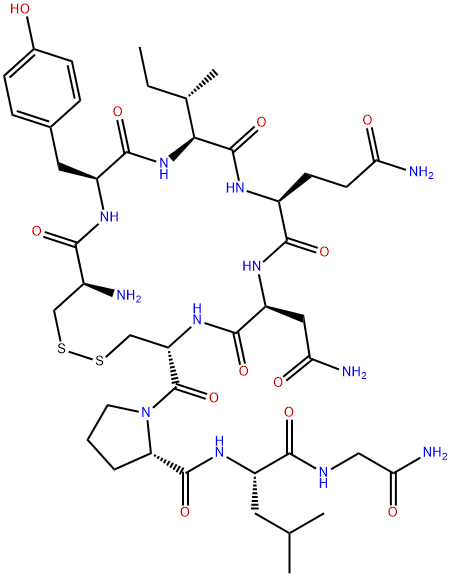
Oxytocin acetate
Synonym(s):Oxytocin monoacetate salt
- CAS NO.:6233-83-6
- Empirical Formula: C43H66N12O12S2.C2H4O2
- Molecular Weight: 1067.24
- EINECS: 228-347-5
- Update Date: 2026-08-28 13:40:57
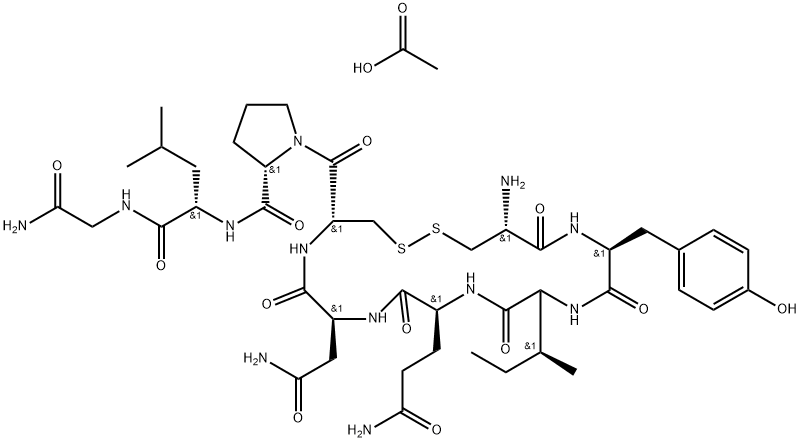
What is Oxytocin acetate?
Description
Oxytocin acetate is an analog of oxytocin, a hormone that stimulates the uterus during labor. It is synthesized by chemically conjugation oxytocin with acetic acid. The stability of this molecule has been proven to be higher than that of oxytocin. This drug demonstrates a stronger binding affinity for the oxytocin receptor, which may be attributed to its increased molecular weight. Additionally, oxytocin acetate has been observed to increase levels of growth factors and fatty acids in tissues when administered intramuscularly, while also stimulating neurotransmission. It exhibits a shorter onset latency and a longer duration of action compared to other analogs. Apart from its medical applications, oxytocin acetate can also serve as a disinfectant in cosmetic use and as an amide-forming agent in organic synthesis reactions.
Chemical properties
White Solid
The Uses of Oxytocin acetate
The principal uterus-contracting and lactation-stimulating hormone of the posterior pituitary gland.
The Uses of Oxytocin acetate
Oxytocin Acetate is the principal uterus-contracting and lactation-stimulating hormone of the posterior pituitary gland.
Mechanism of action
The actions of oxytocin are mediated by a single G protein-coupled receptor distributed in many peripheral tissues and specific brain areas. Oxytocin secreted into the circulation stimulates uterine contractions during labor and stimulates milk ejection during lactation.
Properties of Oxytocin acetate
| storage temp. | Store at -20°C |
| solubility | DMSO:44.0(Max Conc. mg/mL);41.23(Max Conc. mM) Water:50.0(Max Conc. mg/mL);46.85(Max Conc. mM) |
| form | A crystalline solid |
| color | White to off-white |
Safety information for Oxytocin acetate
Computed Descriptors for Oxytocin acetate
| InChIKey | DSZOEVVLZMNAEH-SIVBSZNNNA-N |
New Products
9-Mesityl-10-methylacridinium perchlorate Sulfapyridine Fmoc-OSu (R)-(-)-2-Amino-1-propanol Cyclobutanone 5-bromo-4-fluoro-2-nitrobenzaldehyde 4 pentyn 1 ol N-Vinylformamide Phenethyl cinnamate Pyrrolo[1,2-a]pyrimidine-6-carboxylic acid, 4,6,7,8-tetrahydro-4-oxo-, sodium salt (1:1), (6S) Ethyl 3-phenylpropanoate β-Bromostyrene Methacrylate-PEG-Methacrylate, Mn:35000 2,4-Dihydroxyacetophenone 2-Chloro 5-Fluoro Pyridine Vasicinone 2-Chloroisonicotinic Acid Tween 80 or Polysorbate 80 5-Bromo-1-Pentyne 1-(2-Methyl-5-nitrophenyl)guanidine Nitrate Methyl trans-4-Aminocyclohexanecarboxylate Hydrochloride 2-Pentyn-1-oL 4-Nitrobenzotrifluoride N-(4-Cyano-3-(trifluoromethyl)phenyl)-2-methyloxirane-2-carboxamideRelated products of tetrahydrofuran

You may like
-
 1191-95-3 Cyclobutanone 98+View Details
1191-95-3 -
213382-45-7 98+View Details
213382-45-7 -
Fmoc-OSu 98+View Details
82911-69-1 -
(R)-(-)-2-Amino-1-propanol 35320-23-1 98+View Details
35320-23-1 -
1191-95-3 Cyclobutanone 98+View Details
1191-95-3 -
213382-45-7 98+View Details
213382-45-7 -
Fmoc-OSu 98+View Details
82911-69-1 -
(R)-(-)-2-Amino-1-propanol 35320-23-1 98+View Details
35320-23-1