
Oxycarboxin
- CAS NO.:5259-88-1
- Empirical Formula: C12H13NO4S
- Molecular Weight: 267.3
- MDL number: MFCD00055404
- EINECS: 226-066-2
- SAFETY DATA SHEET (SDS)
- Update Date: 2026-09-12 18:55:43
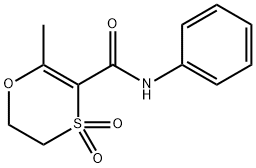
What is Oxycarboxin?
Chemical properties
Oxydisulfoton is a white corrosive solid.
Definition
ChEBI: An anilide obtained by formal condensation of the amino group of aniline with the carboxy group of 2-methyl-5,6-dihydro-4,4-dioxo-1,4-oxathiine-3-carboxylic acid. A fungicide for the control of rust diseases on ornamentals, cereals and nursery trees as wel as fairy rings on turf.
Agricultural Uses
Fungicide: Registered as a foliar systemic fungicide for use against rust on carnations and greenhouse geranium. Not approved for use in EU countries. Registered for use in the U.S. and Canada
Trade name
CARBOJECT®[C]; DYNAM®; F461®;FUNGISOL®[C]; PLANTVAX®; PLANT WAX®; VITAVEX®
Metabolic pathway
The oxathiin ring of the oxycarboxin undergoes a glass-catalyzed ring-opening reaction resulting in a simple step for hydrolytic removal of an acetyl group to give 2-(vinylsulfonyl)acetanilide in aqueous solution. The decomposition of oxycarboxin involves the container and is surface-type dependent.
Shipping
UN3077 Environmentally hazardous substances, solid, n.o.s., Hazard class: 9; Labels: 9-Miscellaneoushazardous material, Technical Name Required. UN1596 Dinotoanilines, Hazard Class: 6.1; Labels: 6.1-Poisonous materials.
Incompatibilities
May react with strong oxidizers such as chlorates, peroxides, and nitrates. Can become unstable in acidic and alkaline media. Combustible; dust may form explosive mixture with air. Corrosive, may attack some metals, rubbers, and plastics.
Waste Disposal
Do not discharge into drains or sewers. Dispose of waste material as hazardous waste using alicensed disposal contractor to an approved landfill. Consult with environmental regulatory agencies for guidance on acceptable disposal practices. If allowed, Incineration with effluent gas scrubbing is recommended. Containers must be disposed of properly by following package label directions or by contacting your local or federal environmental control agency, or by contacting your regional EPA office.
Properties of Oxycarboxin
| Melting point: | 128-130℃ (ethanol ) |
| Boiling point: | 527.6±50.0 °C(Predicted) |
| Density | 1.3431 (rough estimate) |
| refractive index | 1.6280 (estimate) |
| Flash point: | 100 °C |
| storage temp. | 0-6°C |
| pka | 11.26±0.70(Predicted) |
| Water Solubility | 1g/L(25 ºC) |
| EPA Substance Registry System | Oxycarboxin (5259-88-1) |
Safety information for Oxycarboxin
| Signal word | Warning |
| Pictogram(s) |
 Exclamation Mark Irritant GHS07 |
| GHS Hazard Statements |
H302:Acute toxicity,oral H412:Hazardous to the aquatic environment, long-term hazard |
| Precautionary Statement Codes |
P273:Avoid release to the environment. |
Computed Descriptors for Oxycarboxin
New Products
2-(2-Chlorophenyl)glycine Propiolic Acid 1-(3-Hydroxy-4-methoxyphenyl)-2-nitroethene (±)-amino(2-fluorophenyl)acetic acid trans-3-Benzyloxy-4-methoxy-beta-nitrostyrene 1-Pentadecanol 4-(4-Αminophenyl)-3-Morpholinone 3-Morpholino-1-(4-(2-oxopiperidin-1-yl) phenyl)-5,6-dihyropyridin-2-(1H)-one 1-(4-Aminophenyl)-3-morpholino-5,6-dihydropyridin-2(1H)-one N-cyanoacetylurethane 1H-IndazoleRelated products of tetrahydrofuran


You may like
-
 40216-83-9 trans-4-Hydroxy-L-proline methyl ester hydrochloride 98+View Details
40216-83-9 -
471-25-0 Propiolic Acid 98+View Details
471-25-0 -
84145-28-8 98+View Details
84145-28-8 -
trans-3-Benzyloxy-4-methoxy-beta-nitrostyrene 98+View Details
63909-29-5 -
2-(2-Chlorophenyl)glycine 88744-36-9 98+View Details
88744-36-9 -
40216-83-9 trans-4-Hydroxy-L-proline methyl ester hydrochloride 98+View Details
40216-83-9 -
629-76-5 98+View Details
629-76-5 -
1-(3-Hydroxy-4-methoxyphenyl)-2-nitroethene 98+View Details
39816-35-8