
oxetacaine hydrochloride
- CAS NO.:13930-31-9
- Empirical Formula: C28H41N3O3.ClH
- Molecular Weight: 504.111
- EINECS: 237-698-3
- SAFETY DATA SHEET (SDS)
- Update Date: 2022-12-21 16:56:50
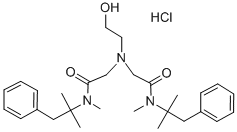
What is oxetacaine hydrochloride?
Originator
Oxaine,Wyeth,US,1960
Manufacturing Process
Chlor-N-methyl-N-ω-phenyl-tert-butyl acetamide (23.95 g) (0.1 mol) is added to n-butanol (150.0 cc) containing anhydrous potassium carbonate (50.0 g). To the stirred refluxing solution is added dropwise freshly distilled ethanolamine (3.1 g) (0.05 mol). Stirring and refluxing is maintained for twenty hours. Upon cooling the solution is filtered; the residue is washed with n-butanol. The combined filtrates are washed with aqueous sodium carbonate solution then water and finally dried over anhydrous magnesium sulfate. The solvent is distilled under vacuum leaving a dry solid residue. The residue is dissolved in dry benzene to which is added n-hexane to crystallize the product melting at 104°C to 104.5°C. Yield 71-73%. Analysis-Carbon: calc. 71.9%; found 71.93%; hydrogen: calc. 8.8%; found 8.9%; nitrogen: calc. 9.0%; found 9.0%.
To make the hydrochloride salt, the bisacetamide or, by another name, 1,11diphenyl-2,2,3,9,10,10-hexamethyl-4,8-diketo-6-(β-hydroxyethyl)-3,6,9triazaundecane is dissolved in n-butanol. The solution is chilled and then dry hydrogen chloride gas is passed into the solution causing an oil to separate. To the heavy oil ether is added and then stirred causing crystallization to occur. MP 146°C to 147°C. Analysis for nitrogen: calc. 83%. found 8.2%.
To make the acetate salt, the bisacetamide (4.7 g) (0.01 mol) is dissolved in ethyl acetate to which is added glacial acetic acid (0.6 g) (0.01 mol). Ether is added to precipitate the acetate as a gum which is washed with hexane, and finally added to dry ether. Allow to stand for crystallization. MP 141°C. Analysis for nitrogen: calc. 8.0%; found 8.2%.
Other salts are: sulfate, MP 56°C; acid oxalate, MP 127°C; tartrate, MP 45°C; picrate, MP 151°C to 152°C.
Therapeutic Function
Local anesthetic
Hazard
Moderately toxic by ingestion.
Properties of oxetacaine hydrochloride
| Melting point: | 146-147° |
Safety information for oxetacaine hydrochloride
Computed Descriptors for oxetacaine hydrochloride
New Products
2-(2-Chlorophenyl)glycine Propiolic Acid trans-3-Benzyloxy-4-methoxy-beta-nitrostyrene 1-(3-Hydroxy-4-methoxyphenyl)-2-nitroethene (±)-amino(2-fluorophenyl)acetic acid 1-Pentadecanol N-Vinylformamide 4 pentyn 1 ol 4-(4-Αminophenyl)-3-Morpholinone 3-Morpholino-1-(4-(2-oxopiperidin-1-yl) phenyl)-5,6-dihyropyridin-2-(1H)-one 1-(4-Aminophenyl)-3-morpholino-5,6-dihydropyridin-2(1H)-one N-cyanoacetylurethane 1H-IndazoleYou may like
-
 40216-83-9 trans-4-Hydroxy-L-proline methyl ester hydrochloride 98+View Details
40216-83-9 -
471-25-0 Propiolic Acid 98+View Details
471-25-0 -
84145-28-8 98+View Details
84145-28-8 -
trans-3-Benzyloxy-4-methoxy-beta-nitrostyrene 98+View Details
63909-29-5 -
2-(2-Chlorophenyl)glycine 88744-36-9 98+View Details
88744-36-9 -
40216-83-9 trans-4-Hydroxy-L-proline methyl ester hydrochloride 98+View Details
40216-83-9 -
629-76-5 98+View Details
629-76-5 -
1-(3-Hydroxy-4-methoxyphenyl)-2-nitroethene 98+View Details
39816-35-8