
O-1918
- CAS NO.:536697-79-7
- Empirical Formula: C19H26O2
- Molecular Weight: 286.41
- MDL number: MFCD08062137
- SAFETY DATA SHEET (SDS)
- Update Date: 2026-04-24 14:58:06
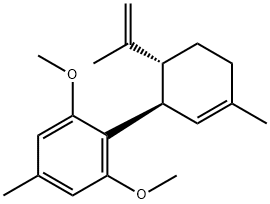
What is O-1918?
The Uses of O-1918
O-1918 is a cannabidiol analog and a selective antagonist at the endothelial cannabidiol receptor. It is an inhibitor of GPR18. O-1918 can also induce endothelium-dependent vasodilation.
What are the applications of Application
O-1918 is a cannabidiol analog and antagonist at the endothelial cannabinoid receptor
Biological Activity
Selective, silent antagonist of a putative endothelial anandamide receptor distinct from CB 1 or CB 2 receptors. Inhibits vasodilation and cell migration induced by abnormal-cannabidiol (abn-CBD; 4-[(1R,6R)-3-Methyl-6-(1-methylethenyl)-2-cyclohexen-1-yl]-5-pentyl-1,3-benzenediol).
Enzyme inhibitor
This endocannabinoid antagonist (FW = 286.42 g/mol; CAS 536697-79-7), systematically named 1,3-dimethoxy-5-methyl-2-[(1R,6R)-3-methyl-6-(1- methylethenyl)-2-cyclohexen-1-yl]benzene, is a cannabidinodiol analogue that selectively targets a putative G-coupled endothelial anandamide receptor that is distinct from CB1 or CB2 endocannabinoid receptors. O- 1918 does not bind to CB1 or CB2 receptors and does not cause vasorelaxation at concentrations up to 30 μM, but inhibits the vasorelaxant effects of abn-cbd and anandamide in a concentration-dependent manner (1- 30 μM). (See abn-cbd; Anandamide; Oleamide). While the atypical cannabinoids O-1602 and abn-cbd (or abnormal cannabidiol) stimulate GPR55-dependent GTPgS activity (EC50 ~ 2 nM), O-1918 antagonizes such effects. O-1918 is involved in the delayed hypotension induced by anandamide in anaesthetized rats.
Storage
Store at -20°C
Properties of O-1918
| Boiling point: | 383.9±42.0 °C(Predicted) |
| Density | 0.981±0.06 g/cm3(Predicted) |
| storage temp. | Store at -20°C |
| solubility | Soluble in DMSO > 10 mM |
| form | Powder |
| color | Colorless to light yellow |
Safety information for O-1918
Computed Descriptors for O-1918
New Products
Dibenzoyl-L-tartaric acid Anhydrous (Resolution Reagent) Cis-Tosylate Dibenzo[b,f][1,4]thiazepin-11(10H)-one 1,2,3,9-Tetrahydro-9-Methyl-4H-Carbazole-4-One 1-(4-methoxyphenyl)-4-(4-Nitrophenyl)Piperazine (IT-1) BOC Piperazine 1-Benzhydrylazetane-3-carbonitrile 8-oxa-1,3-diazaspiro[4.5]decane-2,4-dione (±)-amino(2-fluorophenyl)acetic acid 2-(2-Chlorophenyl)glycine AMINO-(3-CHLORO-PHENYL)-ACETIC ACID 2'-Fluoroacetophenone METHANOL-D1(OD) TERTIARY BUTANOL-D9 N-ETHYL-D5-AMINE HYDROCHLORIDE BENZOIC ACID-D CHLOROFORM-D TOLUENE-D3 Trans,trans muconic acid HC Blue-16 4-Amino-2-chloro-6,7-dimethoxyquinazoline Ethyl 4,5-bis(2-methoxyethoxy)-2-nitrobenzoate 2,3-Dimethoxypyridine 1-(3-Chlorophenyl)piperazine hydrochlorideRelated products of tetrahydrofuran
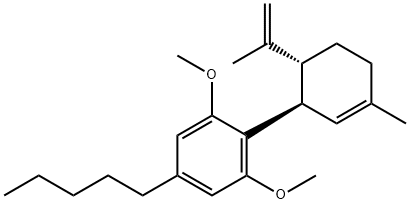
![5-METHYL-2-[(1R,6R)-3-METHYL-6-(1-METHYLETHENYL)-2-CYCLOHEXEN-1-YL]-1,3-BENZENEDIOL](https://img.chemicalbook.in/CAS/GIF/35482-50-9.gif)
You may like
-
 Product IntroductionView Details
 -
 Product InrtroductionView Details
 -
 DGO24View Details
 -
 DGO25View Details
 -
 DGO29View Details
 -
 DGO32View Details
 -
 DGO36View Details
 -
 DGO37View Details