
Asymmetric dimethylarginine
- CAS NO.:30315-93-6
- Empirical Formula: C8H18N4O2
- Molecular Weight: 202.25
- MDL number: MFCD00038406
- SAFETY DATA SHEET (SDS)
- Update Date: 2026-07-25 07:39:42
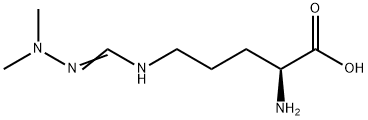
What is Asymmetric dimethylarginine?
The Uses of Asymmetric dimethylarginine
Metabolomics
Definition
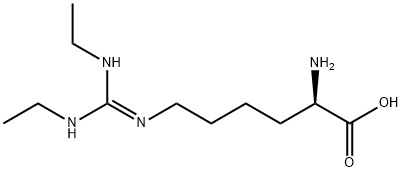
ChEBI: A L-arginine derivative having two methyl groups both attached to the primary amino moiety of the guanidino group.
General Description
Asymmetric dimethylarginine (ADMA) is a naturally occurring chemical found in blood plasma. It is a metabolic by-product of continual protein modification processes in the cytoplasm of all human cells. It is closely related to L-arginine, a conditionally-essential amino acid. ADMA interferes with L-arginine in the production of nitric oxide, a key chemical to endothelial and hence cardiovascular health. Asymmetric dimethylarginine is created in protein methylation, a common mechanism of post-translational protein modification. This reaction is catalyzed by an enzyme set called S-adenosylmethionine protein N-methyltransferases (protein methylases I and II). The methyl groups transferred to create ADMA are derived from the methyl group donor S-adenosylmethionine, an intermediate in the metabolism of homocysteine. (Homocysteine is an important blood chemical, because it is also a marker of cardiovascular disease). After synthesis, ADMA migrates into the extracellular space and then into blood plasma.
Properties of Asymmetric dimethylarginine
| Boiling point: | 340.8±52.0 °C(Predicted) |
| Density | 1.23±0.1 g/cm3(Predicted) |
| storage temp. | 2-8°C(protect from light) |
| solubility | DMF: 5 mg/ml; DMSO: 3 mg/ml; Ethanol: 3 mg/ml; PBS (pH 7.2): freely soluble |
| form | A crystalline solid |
| pka | 2.50±0.24(Predicted) |
| color | White to off-white |
Safety information for Asymmetric dimethylarginine
| Signal word | Warning |
| Pictogram(s) |
 Exclamation Mark Irritant GHS07 |
| GHS Hazard Statements |
H302:Acute toxicity,oral H315:Skin corrosion/irritation H319:Serious eye damage/eye irritation H335:Specific target organ toxicity, single exposure;Respiratory tract irritation |
| Precautionary Statement Codes |
P261:Avoid breathing dust/fume/gas/mist/vapours/spray. P305+P351+P338:IF IN EYES: Rinse cautiously with water for several minutes. Remove contact lenses, if present and easy to do. Continuerinsing. |
Computed Descriptors for Asymmetric dimethylarginine
New Products
2-(2-Chlorophenyl)glycine Propiolic Acid 1-(3-Hydroxy-4-methoxyphenyl)-2-nitroethene (±)-amino(2-fluorophenyl)acetic acid trans-3-Benzyloxy-4-methoxy-beta-nitrostyrene 1-Pentadecanol 2,4-Dihydroxybenzaldehyde Dipropyl disulfide Pyrrolo[1,2-a]pyrimidine-6-carboxylic acid, 4,6,7,8-tetrahydro-4-oxo-, sodium salt (1:1), (6S) Obidoxime hydrochloride API 4 pentyn 1 ol N-Vinylformamide Methacrylate-PEG-Methacrylate, Mn:35000 2,4-Dihydroxyacetophenone 2-Chloro 5-Fluoro Pyridine Vasicinone 2-Chloroisonicotinic Acid Tween 80 or Polysorbate 80 2-Butyn-1-oL N-(4-Cyano-3-(trifluoromethyl)phenyl)-2-methyloxirane-2-carboxamide N-(4-fluoro-2-methoxy-5-nitrophenyl)-4-(1-methyl-1H-indol-3-yl)pyrimidin-2-amine Pirtobrutinib intd. 2-Pentyn-1-oL 4-NitrobenzotrifluorideRelated products of tetrahydrofuran
![5-[[(DiMethylaMino)iMinoMethyl]aMino]-2-oxopentanoic Acid](https://img.chemicalbook.in/CAS/GIF/107347-90-0.gif)
You may like
-
 Ng,ng-dimethylarginine hydrochloride 95% CAS 30315-93-6View Details
30315-93-6 -
Dimethyl-L-arginine CAS 30315-93-6View Details
30315-93-6 -
471-25-0 Propiolic Acid 98+View Details
471-25-0 -
84145-28-8 98+View Details
84145-28-8 -
trans-3-Benzyloxy-4-methoxy-beta-nitrostyrene 98+View Details
63909-29-5 -
2-(2-Chlorophenyl)glycine 88744-36-9 98+View Details
88744-36-9 -
40216-83-9 trans-4-Hydroxy-L-proline methyl ester hydrochloride 98+View Details
40216-83-9 -
1-(3-Hydroxy-4-methoxyphenyl)-2-nitroethene 98+View Details
39816-35-8