
Neotuberostemonine
- CAS NO.:143120-46-1
- Empirical Formula: C22H33NO4
- Molecular Weight: 375.5
- MDL number: MFCD17214798
- EINECS: 200-158-5
- SAFETY DATA SHEET (SDS)
- Update Date: 2026-07-16 07:06:08
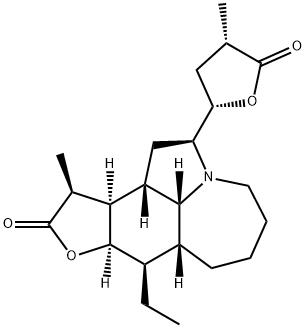
What is Neotuberostemonine?
Description
Neotuberostemonine (NTS) is one of the main antitussive alkaloids in the root of Stemona tuberosa Lour, it has a significant protective effect on bleomycin (BLM)-induced pulmonary fibrosis through suppressing the recruitment and M2 polarization of macrophages. Neotuberostemonine demonstrates antitussive properties in guinea pigs.
The Uses of Neotuberostemonine
Neotuberostemonine is a major bioactive alkaloid of Stemona tuberosa. It can also be used to treat pulmonary fibrosis.
Definition
ChEBI: Neotuberostemonine is an alkaloid. It has a role as a metabolite.
Biological Functions
Neotuberostemonine is an alkaloid originally isolated from S. tuberosa that has diverse biological activities. It inhibits LPS-induced increases in inducible nitric oxide synthase (iNOS) protein levels and NO production in RAW 264.7 cells when used at a concentration of 100 μM. Neotuberostemonine (50 μM) inhibits RANKL-induced osteoclast differentiation of RAW 264.7 cells. It reduces the citric acid-induced cough reflex in conscious guinea pigs when administered at a dose of 133 μmol/kg. Neotuberostemonine (40 mg/kg) inhibits pulmonary collagen deposition and fibrosis, as well as bronchoalveolar lavage fluid (BALF) monocyte and lymphocyte infiltration in a mouse model of bleomycin-induced pulmonary fibrosis.
Biological Activity
Neotuberostemonine, one of the main antitussive alkaloids in the root of Stemona tuberosa Lour, attenuates bleomycin-induced pulmonary fibrosis by suppressing the recruitment and activation of macrophages.
Properties of Neotuberostemonine
| Boiling point: | 554.2±50.0 °C(Predicted) |
| Density | 1.19±0.1 g/cm3(Predicted) |
| solubility | DMSO: 10 mM |
| form | A crystalline solid |
| pka | 8.90±0.70(Predicted) |
| color | White to off-white |
Safety information for Neotuberostemonine
Computed Descriptors for Neotuberostemonine
New Products
1-(4-methoxyphenyl)-4-(4-Nitrophenyl)Piperazine (IT-1) 1,2,3,9-Tetrahydro-9-Methyl-4H-Carbazole-4-One Dibenzo[b,f][1,4]thiazepin-11(10H)-one Cis-Tosylate Dibenzoyl-L-tartaric acid Anhydrous (Resolution Reagent) 1-Benzhydrylazetane-3-carbonitrile 8-oxa-1,3-diazaspiro[4.5]decane-2,4-dione (±)-amino(2-fluorophenyl)acetic acid 2-(2-Chlorophenyl)glycine AMINO-(3-CHLORO-PHENYL)-ACETIC ACID 2'-Fluoroacetophenone METHANOL-D1(OD) N-ETHYL-D5-AMINE HYDROCHLORIDE BENZOIC ACID-D CHLOROFORM-D BENZENE-D6 TOLUENE-D3 2-Hydroxybutanenitrile 1-Benzylindolin-2-one Ethyl 2-bromo-3-oxobutanoate 4-(3-chloropropyl)morpholine 1-Benzylindoline-2,3-dione 3-Oxocyclobutanecarboxylic acid 1-(3-Chlorophenyl)piperazine hydrochlorideRelated products of tetrahydrofuran



You may like
-
 5-Bromo-2-chloro- benzoic acid 21739-92-4 98%View Details
21739-92-4 -
Guar Hydroxypropyltrimonium Chloride 98%View Details
65497-29-2 -
(2,4-dimethoxyphenyl)methanol 7314-44-5 98%View Details
7314-44-5 -
52092-43-0 2-Bromo-4-nitropyridine-N-oxide 98%View Details
52092-43-0 -
2,4,6-Trichloro-5-nitropyrimidine 98%View Details
4359-87-9 -
ethyl 2-amino-4-methoxy-5-(3-morpholinopropoxy)benzoate 1040264-49-0 98%View Details
1040264-49-0 -
1-Methylpiperidine-4-thiol 1072-99-7 98%View Details
1072-99-7 -
68886-07-7 98%View Details
68886-07-7