
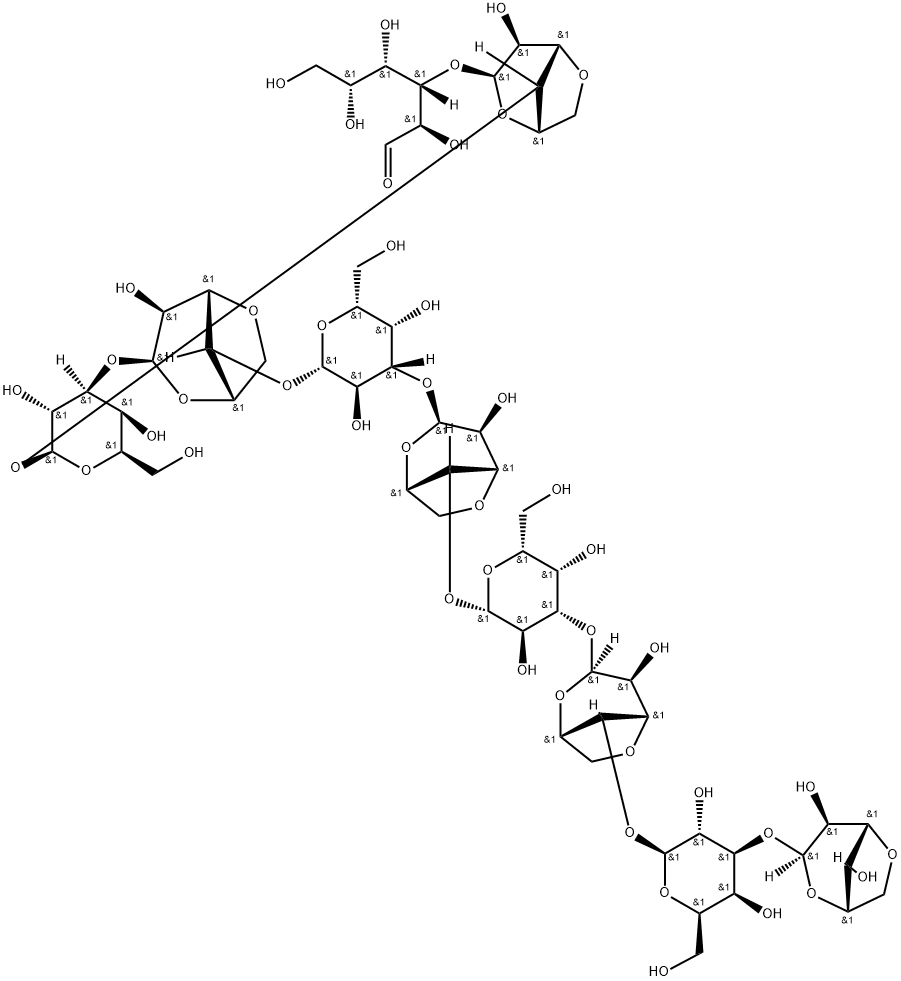
neoagarobiose
- CAS NO.:484-58-2
- Empirical Formula: C12H20O10
- Molecular Weight: 324.28
- MDL number: MFCD00133656
- SAFETY DATA SHEET (SDS)
- Update Date: 2025-07-04 15:07:44
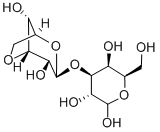
What is neoagarobiose?
Description
Many kinds of skin moisturizers classifiable as polyhydric alcohols containing glycerol and propyrenglycol, natural moisturizing factor (NMF)2) and polysaccharides such as hyaluronic acid3 ) have been developed in the dermatological field.
Neoagarobiose, a disaccharide, showed a higher hygroscopic ability than glycerol or hyaluronic acid, typical moisturizing reagents. Beside, neoagarobiose whitened B16 murine melanoma cells, and showed low cytotoxicity. Therefore neoagarobiose was a rare reagent showing both moisturizing and whitening effects.
Commonly added to food and personal care products as a thickening agent, agar is a seaweed-derived product comprised of numerous agarose polymers. Neoagarobiose is the base unit of agarose that functions as a moisturizer for skin care as well as having mild skin lightening properties. Unfortunately, it is not commercially available due to the difficulties in breaking agar and agarose down into neoagarobiose.
Innovative Technology
Researchers at the University of Maryland have identified the genes used to encode marine bacterial enzymes that effectively degrade agar into neoagarobiose. The researchers have cloned the genes into a common vector with a C-terminal His tag for easy purification. The simple production of these enzymes allows for the simple conversion of agar into neoagarobiose allowing for its use in consumer products for the first time.
Description
Agar is a complex water-soluble polysaccharide composed of gelatin agarose (agarose, also known as agarin) and gelatin free agar pectin (agaropectin, agaric ester) two parts. Agarose is a disaccharide composed of two galactose. Agar can be hydrolyzed by acid to obtain agar disaccharide, agar tetrasaccharide and other oligosaccharides; Oligosaccharides such as neoqiongdisaccharide and neoqiongtetrasaccharide were obtained by enzymatic hydrolysis. Neutral neoqiongdisaccharide with low molecular weight has good hygroscopic and whitening effects.
Properties of neoagarobiose
| Melting point: | 207-208 °C |
| Boiling point: | 731.3±60.0 °C(Predicted) |
| Density | 1.65±0.1 g/cm3(Predicted) |
| storage temp. | 2-8°C |
| pka | 12.25±0.20(Predicted) |
Safety information for neoagarobiose
Computed Descriptors for neoagarobiose
New Products
2-(2-Chlorophenyl)glycine Propiolic Acid 1-(3-Hydroxy-4-methoxyphenyl)-2-nitroethene (±)-amino(2-fluorophenyl)acetic acid trans-3-Benzyloxy-4-methoxy-beta-nitrostyrene 1-Pentadecanol 4-(4-Αminophenyl)-3-Morpholinone 3-Morpholino-1-(4-(2-oxopiperidin-1-yl) phenyl)-5,6-dihyropyridin-2-(1H)-one 1-(4-Aminophenyl)-3-morpholino-5,6-dihydropyridin-2(1H)-one N-cyanoacetylurethane 1H-IndazoleRelated products of tetrahydrofuran

You may like
-
 40216-83-9 trans-4-Hydroxy-L-proline methyl ester hydrochloride 98+View Details
40216-83-9 -
471-25-0 Propiolic Acid 98+View Details
471-25-0 -
84145-28-8 98+View Details
84145-28-8 -
trans-3-Benzyloxy-4-methoxy-beta-nitrostyrene 98+View Details
63909-29-5 -
2-(2-Chlorophenyl)glycine 88744-36-9 98+View Details
88744-36-9 -
40216-83-9 trans-4-Hydroxy-L-proline methyl ester hydrochloride 98+View Details
40216-83-9 -
629-76-5 98+View Details
629-76-5 -
1-(3-Hydroxy-4-methoxyphenyl)-2-nitroethene 98+View Details
39816-35-8