
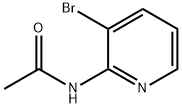
N-(3-Bromo-5-nitropyridin-2-yl)acetamide
- CAS NO.:1065074-93-2
- Empirical Formula: C7H6BrN3O3
- Molecular Weight: 260.04
- MDL number: MFCD11053862
- SAFETY DATA SHEET (SDS)
- Update Date: 2022-12-30 16:20:48
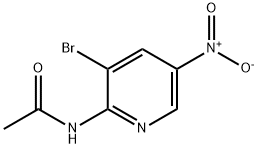
What is N-(3-Bromo-5-nitropyridin-2-yl)acetamide?
The Uses of N-(3-Bromo-5-nitropyridin-2-yl)acetamide
2-Acetamido-3-bromo-5-nitropyridine is a general chemical reagent used in the synthesis of pharmaceutically active compounds and inhibitors. Used in the production of b-Raf inhibitors for the treatment of cancer.
Properties of N-(3-Bromo-5-nitropyridin-2-yl)acetamide
| storage temp. | 2-8°C |
Safety information for N-(3-Bromo-5-nitropyridin-2-yl)acetamide
Computed Descriptors for N-(3-Bromo-5-nitropyridin-2-yl)acetamide
New Products
1-(4-methoxyphenyl)-4-(4-Nitrophenyl)Piperazine (IT-1) 1,2,3,9-Tetrahydro-9-Methyl-4H-Carbazole-4-One Dibenzo[b,f][1,4]thiazepin-11(10H)-one Cis-Tosylate Dibenzoyl-L-tartaric acid Anhydrous (Resolution Reagent) 1-Benzhydrylazetane-3-carbonitrile 8-oxa-1,3-diazaspiro[4.5]decane-2,4-dione (±)-amino(2-fluorophenyl)acetic acid 2-(2-Chlorophenyl)glycine AMINO-(3-CHLORO-PHENYL)-ACETIC ACID 2'-Fluoroacetophenone METHANOL-D1(OD) N-ETHYL-D5-AMINE HYDROCHLORIDE BENZOIC ACID-D CHLOROFORM-D BENZENE-D6 TOLUENE-D3 2-Hydroxybutanenitrile 1-Benzylindolin-2-one Ethyl 2-bromo-3-oxobutanoate 4-(3-chloropropyl)morpholine 1-Benzylindoline-2,3-dione 3-Oxocyclobutanecarboxylic acid 1-(3-Chlorophenyl)piperazine hydrochlorideRelated products of tetrahydrofuran
You may like
-
 5-Bromo-2-chloro- benzoic acid 21739-92-4 98%View Details
21739-92-4 -
Guar Hydroxypropyltrimonium Chloride 98%View Details
65497-29-2 -
(2,4-dimethoxyphenyl)methanol 7314-44-5 98%View Details
7314-44-5 -
52092-43-0 2-Bromo-4-nitropyridine-N-oxide 98%View Details
52092-43-0 -
2,4,6-Trichloro-5-nitropyrimidine 98%View Details
4359-87-9 -
ethyl 2-amino-4-methoxy-5-(3-morpholinopropoxy)benzoate 1040264-49-0 98%View Details
1040264-49-0 -
1-Methylpiperidine-4-thiol 1072-99-7 98%View Details
1072-99-7 -
68886-07-7 98%View Details
68886-07-7
Statement: All products displayed on this website are only used for non medical purposes such as industrial applications or scientific research, and cannot be used for clinical diagnosis or treatment of humans or animals. They are not medicinal or edible.