
Adagrasib
- CAS NO.:2326521-71-3
- Empirical Formula: C32H35ClFN7O2
- Molecular Weight: 604.12
- MDL number: MFCD32263433
- Update Date: 2026-05-28 06:10:33
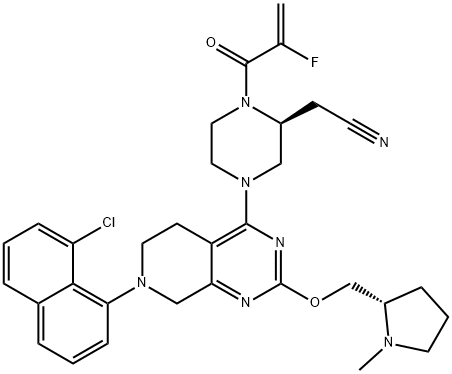
What is Adagrasib?
Absorption
The AUC and Cmax of adagrasib increase in a dose-proportional manner between 400 mg and 600 mg (0.67 to 1 times the approved recommended dose). At the recommended dose, adagrasib reached steady-state within 8 days, with a 6-fold accumulation. The Tmax of adagrasib is approximately 6 hours. The administration of a high-fat and high-calorie meal (900-1000 calories, 50% from fat) did not have a clinically significant effect on the pharmacokinetics of adagrasib. Adagrasib has high oral bioavailability and is able to penetrate the central nervous system.
Toxicity
Toxicity information regarding adagrasib is not readily available. Patients experiencing an overdose are at an increased risk of severe adverse effects such as hepatotoxicity, gastrointestinal adverse reactions and QTc interval prolongation. Symptomatic and supportive measures are recommended.
The carcinogenicity of adagrasib has not been evaluated. In an in vitro bacterial reverse mutation (Ames) assay, adagrasib was not mutagenic. An in vitro chromosomal aberration assay and an in vivo micronucleus assay in rats showed that it was not genotoxic. Studies evaluating the effects of adagrasib on fertility have not been performed. The oral administration of adagrasib to rats for up to 13 weeks induced phospholipidosis at doses higher than 150 mg/kg (approximately 2 times the human exposure at the recommended dose based on AUC). The presence of phospholipidosis led to the increased vacuolation of multiple organs.
The Uses of Adagrasib
MRTX 849 is used as combination therapy for treatment of cancer.
Background
Adagrasib (MRTX849) is an oral, small-molecule KRAS inhibitor developed by Mirati Therapeutics. KRAS mutations are highly common in cancer and account for approximately 85% of all RAS family mutations. However, the development of KRAS inhibitors has been challenging due to their high affinity for guanosine triphosphate (GTP) and guanosine diphosphate (GDP), as well as the lack of a clear binding pocket. Adagrasib targets KRASG12C, one of the most common KRAS mutations, at the cysteine 12 residue and inhibits KRAS-dependent signalling. In a phase I/IB clinical study that included patients with KRASG12C-mutated advanced solid tumors (NCT03785249), adagrasib exhibited anti-tumor activity. The phase II of the same study showed that in patients with KRASG12C-mutated non-small-cell lung cancer (NSCLC), adagrasib was efficient without new safety signals.
In February 2022, the FDA accepted a new drug application (NDA) for adagrasib for the treatment of patients with previously treated KRASG12C–positive NSCLC. In December 2022, the FDA granted accelerated approval to adagrasib for the treatment of KRASG12C-mutated locally advanced or metastatic NSCLC who have received at least one prior systemic therapy. Adagrasib joins sotorasib as another KRASG12C inhibitor approved by the FDA.
Indications
Adagrasib is indicated for the treatment of adult patients with KRAS G12C-mutated locally advanced or metastatic non-small cell lung cancer (NSCLC), as determined by an FDA-approved test, who have received at least one prior systemic therapy.
This indication is approved under accelerated approval based on objective response rate (ORR) and duration of response (DOR). Continued approval for this indication may be contingent upon verification and description of a clinical benefit in a confirmatory trial(s).
brand name
Krazati
General Description
Class: non-kinase; Treatment: KRAS(G12C) NSCLC; Other name: MRTX849; Elimination half-life: 24 h; Protein binding = 98.3%
Mechanism of action
Adagrasib selectively modified mutant cysteine 12 in GDP-bound G12C and inhibited KRASdependent signaling.
Pharmacokinetics
The exposure-response relationship and pharmacodynamic response time course of adagrasib have not been elucidated. The use of adagrasib can cause QTc interval prolongation. The increase in QTc is concentration-dependent. In patients given 600 mg of adagrasib twice daily, the mean QTcF change from baseline (ΔQTcF) was 18 ms at the mean steady-state maximum concentration. The use of adagrasib can also lead to severe gastrointestinal adverse reactions, hepatotoxicity and interstitial lung disease/pneumonitis.
Clinical Use
Adagrasib is an irreversible inhibitor of the RAS GTPase family. It is approved by the FDA for the treatment of adult patients with locally advanced or metastatic non-small cell lung cancer (NSCLC) who have been identified by testing as having a KRAS (G12C) mutation.
Metabolism
Following single-dose administration, adagrasib is mainly metabolized by CYP3A4. However, since adagrasib inhibits CYP3A4 following multiple dosing, other enzymes such as CYP2C8, CYP1A2, CYP2B6, CYP2C9, and CYP2D6 contribute to its metabolism at steady-state.
Storage
Store at -20°C
Properties of Adagrasib
| Boiling point: | 860.2±75.0 °C(Predicted) |
| Density | 1.295±0.06 g/cm3(Predicted) |
| storage temp. | Store at -20°C |
| solubility | Soluble in DMSO:1.0(Max Conc. mg/mL);1.7(Max Conc. mM) |
| form | A crystalline solid |
| pka | 9.31±0.40(Predicted) |
| color | White to yellow |
Safety information for Adagrasib
| Signal word | Warning |
| Pictogram(s) |
 Exclamation Mark Irritant GHS07 |
| GHS Hazard Statements |
H302:Acute toxicity,oral H315:Skin corrosion/irritation H319:Serious eye damage/eye irritation H335:Specific target organ toxicity, single exposure;Respiratory tract irritation |
| Precautionary Statement Codes |
P261:Avoid breathing dust/fume/gas/mist/vapours/spray. P280:Wear protective gloves/protective clothing/eye protection/face protection. P301+P312:IF SWALLOWED: call a POISON CENTER or doctor/physician IF you feel unwell. P302+P352:IF ON SKIN: wash with plenty of soap and water. P305+P351+P338:IF IN EYES: Rinse cautiously with water for several minutes. Remove contact lenses, if present and easy to do. Continuerinsing. |
Computed Descriptors for Adagrasib
New Products
2-(2-Chlorophenyl)glycine Propiolic Acid 1-(3-Hydroxy-4-methoxyphenyl)-2-nitroethene (±)-amino(2-fluorophenyl)acetic acid trans-3-Benzyloxy-4-methoxy-beta-nitrostyrene 1-Pentadecanol 2,4-Dihydroxybenzaldehyde Dipropyl disulfide Pyrrolo[1,2-a]pyrimidine-6-carboxylic acid, 4,6,7,8-tetrahydro-4-oxo-, sodium salt (1:1), (6S) Obidoxime hydrochloride API 4 pentyn 1 ol N-Vinylformamide Methacrylate-PEG-Methacrylate, Mn:35000 2,4-Dihydroxyacetophenone 2-Chloro 5-Fluoro Pyridine Vasicinone 2-Chloroisonicotinic Acid Tween 80 or Polysorbate 80 2-Butyn-1-oL N-(4-Cyano-3-(trifluoromethyl)phenyl)-2-methyloxirane-2-carboxamide N-(4-fluoro-2-methoxy-5-nitrophenyl)-4-(1-methyl-1H-indol-3-yl)pyrimidin-2-amine Pirtobrutinib intd. 2-Pentyn-1-oL 4-NitrobenzotrifluorideRelated products of tetrahydrofuran

You may like
-
 2326521-71-3 Adagrasib 98%View Details
2326521-71-3 -
 AdagrasibView Details
2326521-71-3 -
 471-25-0 Propiolic Acid 98+View Details
471-25-0 -
84145-28-8 98+View Details
84145-28-8 -
trans-3-Benzyloxy-4-methoxy-beta-nitrostyrene 98+View Details
63909-29-5 -
2-(2-Chlorophenyl)glycine 88744-36-9 98+View Details
88744-36-9 -
40216-83-9 trans-4-Hydroxy-L-proline methyl ester hydrochloride 98+View Details
40216-83-9 -
1-(3-Hydroxy-4-methoxyphenyl)-2-nitroethene 98+View Details
39816-35-8