
MOLYBDENUM(II) ACETATE DIMER
Synonym(s):Di-molybdenum tetraacetate
- CAS NO.:14221-06-8
- Empirical Formula: C8H12Mo2O8
- Molecular Weight: 428.06
- MDL number: MFCD00013395
- EINECS: 238-089-5
- SAFETY DATA SHEET (SDS)
- Update Date: 2026-01-13 11:14:12
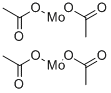
What is MOLYBDENUM(II) ACETATE DIMER?
Description
Molybdenum (II) acetate is a coordination compound with the formula Mo2(O2CCH3)4. It is a yellow, diamagnetic, air-stable solid that is slightly soluble in organic solvents. Molybdenum(II) acetate is an iconic example of a compound with a metal-metal quadruple bond.
Chemical properties
yellow to greenish needle-like crystals or
Physical properties
Molybdenum (II) Acetate adopts the same Chinese lantern structure as related acetate dimers such as rhodium (II) acetate, copper (II) acetate, and chromium (II) acetate. Each Mo(II) center in Mo2(O2CCH3)4 has four d valence electrons. These eight d-electrons form one σ, two π bonds, and one δ bond, creating a bonding electron configuration of σ2π4δ2. Each of these bonds are formed by the overlapping of pairs of d orbitals.The four acetate groups bridge the two metal centers. The Mo-O bond between each Mo(II) center and O atom from acetate has a distance of 2.119 Å, and the Mo-Mo distance between the two metal centers is 2.0934 Å.
The Uses of MOLYBDENUM(II) ACETATE DIMER
Molybdenum(II) acetate dimer is generally used as an intermediate compound in a process to form other quadruply bonded molybdenum compounds.
What are the applications of Application
Mo2(O2CCH3)4 is generally used as an intermediate compound in a process to form other quadruply bonded molybdenum compounds The acetate ligands can be replaced to give new compounds such as [Mo2Cl8]4- and Mo2Cl4[P(C4H9)3]4.
Preparation
Mo2(O2CCH3)4is prepared by treating molybdenum hexa carbonyl (Mo (CO)6) with acetic acid. The process strips CO ligands from hexacarbonyl results in the oxidation of Mo (0) to Mo (II).
2 Mo(CO)6 + 4 HO2CCH3 → Mo2(O2CCH3)4 + 12 CO + 2 H2
Trinuclear clusters are byproducts.
The reaction of HO2CCH3 and Mo(CO)6 was first investigated by Bannister et al. in 1960. At the time, quadruple metal-metal bonds had not yet been discovered, so these authors proposed that "Mo(O2CCH3)2 was tetrahedral. This perspective changed with Mason's characterization .
Properties of MOLYBDENUM(II) ACETATE DIMER
| storage temp. | -20°C |
| form | crystal |
| color | yellow |
| Water Solubility | Slightly soluble in organic solvents. Insoluble in water. |
| Sensitive | Air Sensitive |
| Exposure limits | ACGIH: TWA 0.5 mg/m3; TWA 10 mg/m3; TWA 3 mg/m3 NIOSH: IDLH 1000 mg/m3; IDLH 5000 mg/m3 |
| CAS DataBase Reference | 14221-06-8 |
Safety information for MOLYBDENUM(II) ACETATE DIMER
Computed Descriptors for MOLYBDENUM(II) ACETATE DIMER
New Products
2-Bromo-4-hydroxypyridine Dibenzoyl-L-tartaric acid Anhydrous (Resolution Reagent) Dibenzo[b,f][1,4]thiazepin-11(10H)-one 1,2,3,9-Tetrahydro-9-Methyl-4H-Carbazole-4-One Cis-Tosylate 1-(4-methoxyphenyl)-4-(4-Nitrophenyl)Piperazine (IT-1) 1-aminocyclobutanecarbonitrile hydrochloride AMINO-O-TOLYL-ACETIC ACID 1-Aminocyclobutanecarboxylic Acid Hydrochloride AMINO(2-BROMOPHENYL)ACETIC ACID 6-BROMOTETRAZOLO[1,5-A]PYRIDINE 3-Oxocyclobutanecarboxylic acid METHANOL-D1(OD) TERTIARY BUTANOL-D9 N-ETHYL-D5-AMINE HYDROCHLORIDE BENZOIC ACID-D CHLOROFORM-D TOLUENE-D3 2-(2-Bromophenyl)ethanol Boc-D-Glu(OMe)-OMe 2,5 Dibromopyridine Ethyl 4-hydroxy-3-oxobutanoate Dimethyl (2S)-2-((tert-butoxycarbonyl)amino)-4-(cyanomethyl)pentanedioate 1-(3-Chlorophenyl)piperazine hydrochlorideRelated products of tetrahydrofuran


You may like
-
 Molybdenum(II) acetate dimer CAS 14221-06-8View Details
14221-06-8 -
254762-66-8 AMINO(2-BROMOPHENYL)ACETIC ACID 98+View Details
254762-66-8 -
254762-66-8 AMINO(2-BROMOPHENYL)ACETIC ACID 98+View Details
254762-66-8 -
23716-23-1 98+View Details
23716-23-1 -
6-BROMOTETRAZOLO[1,5-A]PYRIDINE 98+View Details
5799-75-7 -
254762-66-8 AMINO(2-BROMOPHENYL)ACETIC ACID 98+View Details
254762-66-8 -
23716-23-1 98+View Details
23716-23-1 -
6-BROMOTETRAZOLO[1,5-A]PYRIDINE 98+View Details
5799-75-7