
Milrinone lactate
- CAS NO.:100286-97-3
- Empirical Formula: C15H15N3O4
- Molecular Weight: 301.3
- MDL number: MFCD00875852
- SAFETY DATA SHEET (SDS)
- Update Date: 2026-05-27 23:48:53
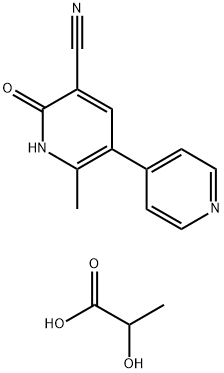
What is Milrinone lactate?
Originator
Primacor,Baxter Healthcare Corporation
Manufacturing Process
A mixture containing 20 g of 1-(4-pyridinyl)-2-propanone and 30 ml ofhexamethylphosphoramide was diluted with 65 ml of dimethylformamidedimethyl acetal and the resulting mixture was refluxed for 30 min. TLCanalysis showed a single spot, thereby indicating completion of the reaction(in another run, the reaction appeared to be complete after 30 min at roomtemperature). The mixture was evaporated under reduced pressure and apressure, thereby resulting in a crystalline residue weighing 24 g. The residuewas purified by continuous chromatographic extraction on alumina (about 150g) using refluxing chloroform as eluant. After 90 min, the extract was heatedin vacuo to remove the chloroform, thereby leaving, as a light yellowcrystalline material, 23.2 g of 1-(4-pyridinyl)-2-(dimethylamino)ethenylmethyl ketone, alternatively named 4-dimethylamino-2-(4-pyridinyl)-3-buten-2-one.
To a mixture containing 23 g of 1-(4-pyridinyl)-2-(dimethylamino)ethenylmethyl ketone and 11 g of α-cyanoacetamide dissolved in 400 ml ofdimethylformamide was added with stirring 14 g of sodium methoxide and theresulting reaction mixture was heated in an oil bath under gentle reflux forone hour. TLC analysis showed no starting material in the reaction mixturewhich was then concentrated in vacuo on a rotary evaporator to a volume ofabout 80 ml. The concentrate was treated with about 160 ml of acetonitrileand the resulting mixture was stirred on a rotary evaporator with warminguntil homogenous and then cooled. The crystalline product was collected,rinsed successively with acetonitrile and ether, and dried overnight at 55°C toyield 28 g of crystalline product, namely, sodium salt of 1,2-dihydro-6-methyl-2-oxo-5-(4-pyridinyl)nicotinonitrile, the presence of cyano being confirmed byIR analysis. An 8 g portion of said sodium salt was dissolved in 75 ml of hotwater, the aqueous solution treated with decolorizing charcoal, filtered, thefiltrate again treated with decolorizing charcoal and filtered, and the filtrateacidified with 6 N hydrochloric acid by dropwise addition to a pH of 3. Theacidic mixture was diluted with ethanol and cooled. The crystalline productwas collected, dried, recrystallized from dimethylformamide-water and dried toproduce 3.75 g of 1,2-dihydro-6-methyl-2-oxo-5-(4-pyridinyl)nicotinonitrile,m.p. >300°C.
Another method of preparation of 1,2-dihydro-6-methyl-2-oxo-5-(4-pyridinyl)nicotinonitrile (Patent US 4,413,127)
A 69.5 g portion of 1-ethoxy-2-(4-pyridinyl)ethenyl methyl ketone wasdissolved in 300 ml of ethanol and to the solution was added 13.2 g ofmalononitrile. The resulting mixture was refluxed for 5 hours, crystals startingto separate after about 30 min of refluxing. The reaction mixture was allowedto cool to room temperature and, the precipitate of fine needles was filtered,washed with ethanol and dried in a vacuum at 90°C to yield 25.4 g of 1,2-dihydro-6-methyl-2-oxo-5-(4-pyridinyl)-nicotinonitrile, m.p. >300°C.Concentration of the mother liquor provided another 2.1 g of product, m.p.>300°C.
To a aqueous solution of 1,2-dihydro-6-methyl-2-oxo-5-(4-pyridinyl)nicotinonitrile was added one molar equivalent of lactic acid to prepare themonolactate of 1,2-dihydro-6-methyl-2-oxo-5-(4-pyridinyl)nicotinonitrile.
Therapeutic Function
Cardiotonic
Properties of Milrinone lactate
| Melting point: | >120°C (dec.) |
| storage temp. | Sealed in dry,Room Temperature |
| solubility | Chloroform (Slightly, Heated), Methanol (Slightly, Heated, Sonicated) |
| form | Solid |
| color | Pale Yellow |
| Stability: | Hygroscopic |
Safety information for Milrinone lactate
| Signal word | Warning |
| Pictogram(s) |
 Exclamation Mark Irritant GHS07 |
| GHS Hazard Statements |
H302:Acute toxicity,oral H315:Skin corrosion/irritation H319:Serious eye damage/eye irritation H335:Specific target organ toxicity, single exposure;Respiratory tract irritation |
| Precautionary Statement Codes |
P261:Avoid breathing dust/fume/gas/mist/vapours/spray. P305+P351+P338:IF IN EYES: Rinse cautiously with water for several minutes. Remove contact lenses, if present and easy to do. Continuerinsing. |
Computed Descriptors for Milrinone lactate
New Products
2-(2-Chlorophenyl)glycine Propiolic Acid 1-(3-Hydroxy-4-methoxyphenyl)-2-nitroethene (±)-amino(2-fluorophenyl)acetic acid trans-3-Benzyloxy-4-methoxy-beta-nitrostyrene 1-Pentadecanol 2,4-Dihydroxybenzaldehyde Dipropyl disulfide Pyrrolo[1,2-a]pyrimidine-6-carboxylic acid, 4,6,7,8-tetrahydro-4-oxo-, sodium salt (1:1), (6S) Obidoxime hydrochloride API 4 pentyn 1 ol N-Vinylformamide Methacrylate-PEG-Methacrylate, Mn:35000 2,4-Dihydroxyacetophenone 2-Chloro 5-Fluoro Pyridine Vasicinone 2-Chloroisonicotinic Acid Tween 80 or Polysorbate 80 2-Butyn-1-oL N-(4-Cyano-3-(trifluoromethyl)phenyl)-2-methyloxirane-2-carboxamide N-(4-fluoro-2-methoxy-5-nitrophenyl)-4-(1-methyl-1H-indol-3-yl)pyrimidin-2-amine Pirtobrutinib intd. 2-Pentyn-1-oL 4-NitrobenzotrifluorideRelated products of tetrahydrofuran


You may like
-
 100286-97-3 Milrinone lactate 98%View Details
100286-97-3 -
 471-25-0 Propiolic Acid 98+View Details
471-25-0 -
84145-28-8 98+View Details
84145-28-8 -
trans-3-Benzyloxy-4-methoxy-beta-nitrostyrene 98+View Details
63909-29-5 -
2-(2-Chlorophenyl)glycine 88744-36-9 98+View Details
88744-36-9 -
40216-83-9 trans-4-Hydroxy-L-proline methyl ester hydrochloride 98+View Details
40216-83-9 -
629-76-5 98+View Details
629-76-5 -
1-(3-Hydroxy-4-methoxyphenyl)-2-nitroethene 98+View Details
39816-35-8