
methyl(methyl-9,10-ethano-9(10H)-anthryl)ammonium chloride
- CAS NO.:10085-81-1
- Empirical Formula: C18H19N.ClH
- Molecular Weight: 285.81
- MDL number: MFCD00137457
- EINECS: 2332160
- SAFETY DATA SHEET (SDS)
- Update Date: 2026-04-20 17:00:22
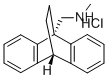
What is methyl(methyl-9,10-ethano-9(10H)-anthryl)ammonium chloride?
Originator
Tacitin,Ciba Geigy,Switz.
The Uses of methyl(methyl-9,10-ethano-9(10H)-anthryl)ammonium chloride
Anxiolytic.
What are the applications of Application
Benzoctamine Hydrochloride is an aromatic amine
Manufacturing Process
A solution of 10 g of 9:10-dihydro-9:10-ethano-(1:2)-anthracene-(9)aldehyde (made from anthracene and acrolein) and 10 g of monomethylamine in 100 cc of ethanol is heated at 80°C for 4 hours in an autoclave. The reaction mixture is then evaporated to dryness under reduced pressure to leave a crystalline residue which is dissolved in 150 cc of ethanol and, after the addition of 2 g of Raney nickel, hydrogenated at 40°C under atmospheric pressure. When the absorption of hydrogen has subsided, the catalyst is filtered off and the filtrate evaporated under reduced pressure. An oil remains which is covered with 100cc of 2N hydrochloric acid, The 9-methylamino-methyl-9:10-dihydro-9:10- ethano-(9:10)-anthracene hydrochloride crystallizes immediately; after crystallization from methanol it melts at 320°-322°C.
Therapeutic Function
Sedative, Muscle relaxant
Safety Profile
Poison by intravenous route. Moderately toxic by ingestion. Experimental teratogenic effects. A sedative and muscle relaxant. When heated to decomposition it emits very toxic fumes of NO, and HCl-.
Properties of methyl(methyl-9,10-ethano-9(10H)-anthryl)ammonium chloride
| Melting point: | 320-322° |
| solubility | DMSO (Slightly), Methanol (Slightly) |
| form | Solid |
| pka | 7.6(at 25℃) |
| Stability: | Hygroscopic |
Safety information for methyl(methyl-9,10-ethano-9(10H)-anthryl)ammonium chloride
Computed Descriptors for methyl(methyl-9,10-ethano-9(10H)-anthryl)ammonium chloride
New Products
N-Carbethoxy-4-piperidone 1-Aminocyclopentane carbonitrile Tetrabutylammonium perchlorate N,O-Dimethylhydroxylamine hydrochloride (RS)-beta-Amino-beta-(4-bromophenyl)propionic acid 2-Amino-5-bromo-4-(trifluoromethyl)pyridine N-Vinylformamide 4 pentyn 1 ol Phenethyl cinnamate Dipropyl disulfide Ethyl 3-phenylpropanoate β-Bromostyrene Methacrylate-PEG-Methacrylate, Mn:35000 2,4-Dihydroxyacetophenone 2-Chloro 5-Fluoro Pyridine Vasicinone 2-Chloroisonicotinic Acid Tween 80 or Polysorbate 80 5-Bromo-1-Pentyne 1-(2-Methyl-5-nitrophenyl)guanidine Nitrate Methyl trans-4-Aminocyclohexanecarboxylate Hydrochloride N-(4-Cyano-3-(trifluoromethyl)phenyl)-2-methyloxirane-2-carboxamide 2-Pentyn-1-oL 4-NitrobenzotrifluorideRelated products of tetrahydrofuran


You may like
-
 144-83-2 Sulfapyridine 98+View Details
144-83-2 -
29976-53-2 98+View Details
29976-53-2 -
2-Amino-5-bromo-4-(trifluoromethyl)pyridine 98+View Details
944401-56-3 -
(RS)-beta-Amino-beta-(4-bromophenyl)propionic acid 39773-47-2 98+View Details
39773-47-2 -
6638-79-5 N,O-Dimethylhydroxylamine hydrochloride 98+View Details
6638-79-5 -
674783-97-2 98+View Details
674783-97-2 -
1-Aminocyclopentane carbonitrile 98+View Details
49830-37-7 -
Tetrabutylammonium perchlorate 1923-70-2 98+View Details
1923-70-2