
Mangafodipir
- CAS NO.:155319-91-8
- Empirical Formula: C22H30N4O14P2.Mn
- Molecular Weight: 691.379
- Update Date: 2025-04-18 09:52:12
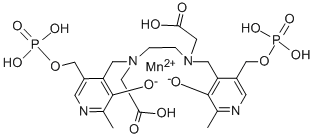
What is Mangafodipir?
Absorption
Mangafodipir is taken up by the liver and pancreas where the contrast enhancement effect is mediated.
Toxicity
Common adverse effects include headache, nausea and feeling of warmth or flushing. Other uncommon side effects include hypersensitivity reactions, fever, diarrhea, vomiting, dizziness, palpitations, paraesthesia, abdominal pain, and taste sensations. There is no identified antidote in case of overdose. Mangafodipir displays embryotoxic and fetotoxic potential thus is contradindicated in pregnant patients. It is not reported to be genotoxic . LD50 in the mouse is 5 mmol/kg .
Background
Mangafodipir is a contrast agent used as a diagnostic tool administered intravenously to enhance contrast in magnetic resonance imaging (MRI) of the liver and pancreas. This drug is made up of paramagnetic manganese (II) ions combined with the chelating agent fodipir (dipyridoxyl diphosphate, DPDP). Manganese absorption into the tissues that makes the normal tissue appear brighter in MRI is limited in abnormal or cancerous tissue. Enhanced contrast by mangafodipir improves visualization and detection of lesions of the liver formed from metastatic disease or hepatocellular carcinomas. The contrast agent is present as mangafodipir trisodium marketed under the name Teslascan. Teslascan has been removed from the Drug Product List by FDA in 2003, and withdrawn from the European market in 2012.
Indications
Indicated for use as an organ-specific paramagnetic contrast agent developed for imaging of the hepatobiliary system and detecting lesions in liver and pancreas.
Pharmacokinetics
Manganese (II) metals exhibit paramagnetic properties that increases contrast between normal liver parenchyma and metastatic liver lesions after uptake into the hepatic or pancreatic parencyma. They serve to increase the signal intensity of liver or pancreas tissue. Enhancement in both organs is near maximal for up to approximately 4 hours after the end of administration. Lesion-related enhancement of certain types of lesions, such as liver metastases and hepatocellular carcinomas, may be detectable for up to 24 hours .
Metabolism
Mangafodipir (MnDPDP) is dephosphorylated to form Mn dipyridoxyl monophosphate (MnDPMP) and fully dephosphorylated Mn dipyridoxyl ethylenediamine diacetate (MnPLED) in a sequential manner, followed by simultaneous transmetallation where maganese is exchanged for plasma zinc . Corresponsing zinc compounds are ZnDPDP, ZnDPMP and ZnPLED . Manganese is released from the complex to be transported to target organs.
Safety information for Mangafodipir
New Products
3-AMINO-3-(2-CHLORO-PHENYL)-PROPIONIC ACID 4-Fluorophenylglycine 1-Boc-3-(cyanomethyl)azetidine Dimedone 1-N-Boc-3-(aminoethyl)azetidine N-BOC-piperidine-4-carboxylic acid 4,6-Dichlororesorcinol 5-Amino-2-Bromo-3-Chloropyridine 2-Picolinic acid N-oxide 4-Butyl Resorcinol 2-Bromo-5-Chloropyridine 5-Bromo-2-Hydroxy-3-Nitro Pyridine 2-Amino-4-phenyl-thiazole N-(4-Bromophenyl)-2-chloroacetamide TRIFLOURO ACETICACID-D METHANE SULFONIC ACID-D4 PHOSPORIC ACID-D3 85 W% IN D2O DEUTERIUM OXIDE FOR NMR BENZENE-D6 TOLUENE-D3You may like
-
 IODOETHANE-D5 6485-58-1 99%View Details
6485-58-1 -
32008-59-6 PARAFORMALDEHYDE-D2 98%View Details
32008-59-6 -
CHLORO BENZENE-D5 3114-55-4 99%View Details
3114-55-4 -
PHENYL ACETYLENE-D 3240-11-07 99%View Details
3240-11-07 -
918-20-7 TERT-BUTYL CHLORIDE-D9 98%View Details
918-20-7 -
84358-13-4 N-BOC-piperidine-4-carboxylic acid 98+View Details
84358-13-4 -
84358-13-4 N-BOC-piperidine-4-carboxylic acid 98+View Details
84358-13-4 -
84358-13-4 N-BOC-piperidine-4-carboxylic acid 98+View Details
84358-13-4