
madopar
- CAS NO.:37270-69-2
- Empirical Formula: C10H15N3O5.C9H11NO4
- Molecular Weight: 454.43
- SAFETY DATA SHEET (SDS)
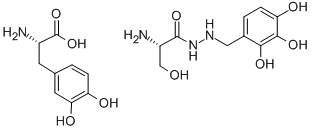
What is madopar?
Drug interactions
Potentially hazardous interactions with other drugs
Anaesthetics: risk of arrhythmias with volatile liquid
anaesthetics such as halothane
.
Antidepressants: hypertensive crisis with MAOIs
and linezolid (including moclobemide) - avoid for at
least 2 weeks after stopping MAOI.
Bupropion: increased risk of side effects of levodopa
Ferrous sulphate: reduces AUC of levodopa by
30-50%, clinically significant in some but not all
patients.
Metabolism
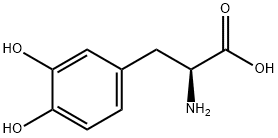
Levodopa is rapidly decarboxylated by the enzyme
aromatic l-amino acid decarboxylase, mostly in the gut,
liver, and kidney, to dopamine, which is metabolised
in turn, principally to dihydroxyphenylacetic acid
(DOPAC) and homovanillic acid (HVA). Other routes
of metabolism include O-methylation, transamination,
and oxidation, producing a variety of minor metabolites
including noradrenaline and 3-O-methyldopa; the latter
may accumulate in the CNS due to its relatively long
half-life.
About 80% of an oral dose of levodopa is excreted in the
urine within 24 hours, mainly as dihydroxyphenylacetic
and homovanillic acids. Only small amounts of levodopa
are excreted unchanged in the faeces.
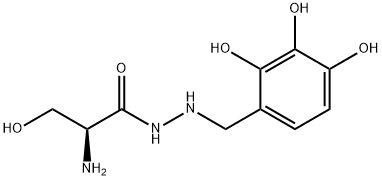
Benserazide is rapidly excreted in the urine in the form
of metabolites, mostly within the first 6 hours; 85% of
urinary excretion occurrs within 12 hours. It is mainly
metabolised in the gut and appears to protect levodopa
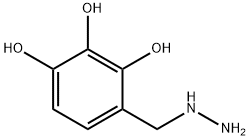
against decarboxylation primarily in the gut, but alsoin the rest of the body, mainly by way of its metabolite
trihydroxybenzylhydrazine.
Safety information for madopar
New Products
N-Carbethoxy-4-piperidone 1-Aminocyclopentane carbonitrile Tetrabutylammonium perchlorate N,O-Dimethylhydroxylamine hydrochloride (RS)-beta-Amino-beta-(4-bromophenyl)propionic acid 2-Amino-5-bromo-4-(trifluoromethyl)pyridine N-Vinylformamide 4 pentyn 1 ol Phenethyl cinnamate Dipropyl disulfide Ethyl 3-phenylpropanoate β-Bromostyrene Methacrylate-PEG-Methacrylate, Mn:35000 2,4-Dihydroxyacetophenone 2-Chloro 5-Fluoro Pyridine Vasicinone 2-Chloroisonicotinic Acid Tween 80 or Polysorbate 80 5-Bromo-1-Pentyne 1-(2-Methyl-5-nitrophenyl)guanidine Nitrate Methyl trans-4-Aminocyclohexanecarboxylate Hydrochloride N-(4-Cyano-3-(trifluoromethyl)phenyl)-2-methyloxirane-2-carboxamide 2-Pentyn-1-oL 4-NitrobenzotrifluorideRelated products of tetrahydrofuran
You may like
-
 144-83-2 Sulfapyridine 98+View Details
144-83-2 -
29976-53-2 98+View Details
29976-53-2 -
2-Amino-5-bromo-4-(trifluoromethyl)pyridine 98+View Details
944401-56-3 -
(RS)-beta-Amino-beta-(4-bromophenyl)propionic acid 39773-47-2 98+View Details
39773-47-2 -
6638-79-5 N,O-Dimethylhydroxylamine hydrochloride 98+View Details
6638-79-5 -
674783-97-2 98+View Details
674783-97-2 -
1-Aminocyclopentane carbonitrile 98+View Details
49830-37-7 -
Tetrabutylammonium perchlorate 1923-70-2 98+View Details
1923-70-2