
MACULOSIN
- CAS NO.:4549-02-4
- Empirical Formula: C14H16N2O3
- Molecular Weight: 260.29
- MDL number: MFCD03093467
- SAFETY DATA SHEET (SDS)
- Update Date: 2026-07-16 07:06:08
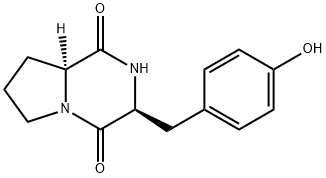
What is MACULOSIN?
Description
Maculosin is a diketopiperazine metabolite produced by A. alternata, L. capsici, Streptomyces, and the Gram-negative, nonobligate predator bacterial strain 679-2. It acts as a host-specific phytotoxin, inducing formation of weeping necrotic lesions in leaves of spotted knapweed (C. maculosa) when used at a concentration of 10 μM. Maculosin reduces the growth of the plant pathogenic bacteria X. axonopodis and R. solanacearum (MICs = 31.25 μg/ml) as well as the pathogenic oomycetes P. cactorum, P. capsici, P. cinnamomi, P. infestans, and P. ultimum when used at concentrations ranging from 10 to 100 mg/ml. Maculosin also inhibits the growth of M. luteus, M. smegmatis, S. cerevisiae, C. albicans, C. neoformans, and A. niger when used in combination with pyrrolnitrin or banegasin.
The Uses of MACULOSIN
Cyclo(L-Pro-L-Tyr) (maculosin) is a diketopiperazine formed by the fusion of tyrosine and proline, reported as a secondary metabolite of fungi and bacteria. In Pseudomonas aeruginosa, cyclo(L-Pro-L-Tyr) is capable of activating N-acylhomoserine lactones (AHLs). Cyclo(L-Pro-L-Tyr) is also capable of activating or antagonizing other LuxR-based quorum-sensing systems. While the mode of action of cyclo(L-Pro-L-Tyr) is not known, its activity suggests the existence of cross talk among bacterial signalling systems. Cyclo(L-Pro-L-Tyr) was identified as a host-specific toxin produced by Alternaria alternata on spotted knapweed.
The Uses of MACULOSIN
Cyclo(L-prolinyl-L-tyrosine) is a diketopiperazine derivative isolated from Bacillus thuringiensis and Bacillus endophyticus.
What are the applications of Application
Maculosin is a secondary metabolite of fungi and bacteria
Definition
ChEBI: A homodetic cyclic peptide that is a dipeptide composed of L-proline and L-tyrosine joined by peptide linkages.
Properties of MACULOSIN
| Melting point: | 156-159 °C |
| Boiling point: | 581.4±43.0 °C(Predicted) |
| Density | 1.36±0.1 g/cm3(Predicted) |
| storage temp. | -15°C
|
| solubility | DMF: soluble; DMSO: soluble; Ethanol: soluble; Methanol: soluble |
| form | A solid |
| pka | 9.92±0.15(Predicted) |
| color | White to off-white |
Safety information for MACULOSIN
Computed Descriptors for MACULOSIN
New Products
2-(2-Chlorophenyl)glycine Propiolic Acid 1-(3-Hydroxy-4-methoxyphenyl)-2-nitroethene (±)-amino(2-fluorophenyl)acetic acid trans-3-Benzyloxy-4-methoxy-beta-nitrostyrene 1-Pentadecanol 2,4-Dihydroxybenzaldehyde Dipropyl disulfide Pyrrolo[1,2-a]pyrimidine-6-carboxylic acid, 4,6,7,8-tetrahydro-4-oxo-, sodium salt (1:1), (6S) Obidoxime hydrochloride API 4 pentyn 1 ol N-Vinylformamide Methacrylate-PEG-Methacrylate, Mn:35000 2,4-Dihydroxyacetophenone 2-Chloro 5-Fluoro Pyridine Vasicinone 2-Chloroisonicotinic Acid Tween 80 or Polysorbate 80 2-Butyn-1-oL N-(4-Cyano-3-(trifluoromethyl)phenyl)-2-methyloxirane-2-carboxamide N-(4-fluoro-2-methoxy-5-nitrophenyl)-4-(1-methyl-1H-indol-3-yl)pyrimidin-2-amine Pirtobrutinib intd. 2-Pentyn-1-oL 4-NitrobenzotrifluorideRelated products of tetrahydrofuran
![1-[[4-[(4-Fluoro-2-methyl-1H-indol-5-yl)oxy]-5-methylpyrrolo[2,1-f][1,2,4]triazin-6-yl]oxy]-2-propanol](https://img.chemicalbook.in/CAS/GIF/649735-46-6.gif)


You may like
-
 40216-83-9 trans-4-Hydroxy-L-proline methyl ester hydrochloride 98+View Details
40216-83-9 -
471-25-0 Propiolic Acid 98+View Details
471-25-0 -
84145-28-8 98+View Details
84145-28-8 -
trans-3-Benzyloxy-4-methoxy-beta-nitrostyrene 98+View Details
63909-29-5 -
2-(2-Chlorophenyl)glycine 88744-36-9 98+View Details
88744-36-9 -
40216-83-9 trans-4-Hydroxy-L-proline methyl ester hydrochloride 98+View Details
40216-83-9 -
629-76-5 98+View Details
629-76-5 -
1-(3-Hydroxy-4-methoxyphenyl)-2-nitroethene 98+View Details
39816-35-8