
Lodoxamidetromethamine
- CAS NO.:63610-09-3
- Empirical Formula: C15H17ClN4O9
- Molecular Weight: 432.77
- MDL number: MFCD04112765
- SAFETY DATA SHEET (SDS)
- Update Date: 2026-07-16 07:06:08
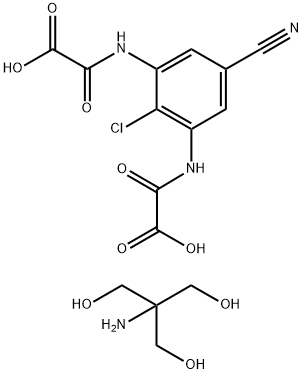
What is Lodoxamidetromethamine?
Description
Lodoxamide tromethamine was launched as an ophthalmic formulation for the treatment of allergic conjunctivitis. It appears to act as a mast cell stabilizer inhibiting degranulation and the release of histamine and other vasoactive products in a similar manner to sodium cromoglycate. The compound is also under investigation as an orally active antiallergic/antiasthmatic agent.
Originator
Upjohn (U.S.A.)
The Uses of Lodoxamidetromethamine
cataract treatment
brand name
Alomide (Alcon);Almide.
General Description
Lodoxamidetromethamine, N, N -(2-chloro-5-cyano-m-phenylene)dioxamicacid (Alomide), is a white crystalline, water-solublepowder. The only significant structural similarity betweenlodoxamide and cromolyn and nedocromil is the presence oftwo acidic groups. Lodoxamide is indicated in the treatmentof the ocular disorders including vernal keratoconjunctivitis,vernal conjunctivitis, and vernal keratitis. Lodoxamide isavailable as a 0.1% solution, with each milliliter containing1.78 mg of lodoxamide tromethamine equivalent to 1 mg oflodoxamide. The solution contains the preservative benzalkoniumchloride (0.007%) as well as mannitol, hydroxypropylmethylcellulose, sodium citrate, citric acid, edetatedisodium, tyloxapol, hydrochloric acid and/or sodium hydroxide(to adjust pH), and purified water.
The dose for adults and children older than 2 years of ageis 1 to 2 drops in each affected eye 4 times daily for up to 3months. The most frequently reported ocular adverse experienceswere transient burning, stinging, or discomfort oninstillation.
Properties of Lodoxamidetromethamine
| storage temp. | under inert gas (nitrogen or Argon) at 2–8 °C |
| solubility | DMSO: 20 mg/mL (36.11 mM and warming) |
| form | Solid |
| color | White to light yellow |
Safety information for Lodoxamidetromethamine
| Signal word | Warning |
| Pictogram(s) |
 Exclamation Mark Irritant GHS07 |
| GHS Hazard Statements |
H302:Acute toxicity,oral H315:Skin corrosion/irritation H319:Serious eye damage/eye irritation H335:Specific target organ toxicity, single exposure;Respiratory tract irritation |
| Precautionary Statement Codes |
P261:Avoid breathing dust/fume/gas/mist/vapours/spray. P305+P351+P338:IF IN EYES: Rinse cautiously with water for several minutes. Remove contact lenses, if present and easy to do. Continuerinsing. |
Computed Descriptors for Lodoxamidetromethamine
New Products
2-(2-Chlorophenyl)glycine Propiolic Acid 1-(3-Hydroxy-4-methoxyphenyl)-2-nitroethene (±)-amino(2-fluorophenyl)acetic acid trans-3-Benzyloxy-4-methoxy-beta-nitrostyrene 1-Pentadecanol 4-(4-Αminophenyl)-3-Morpholinone 3-Morpholino-1-(4-(2-oxopiperidin-1-yl) phenyl)-5,6-dihyropyridin-2-(1H)-one 1-(4-Aminophenyl)-3-morpholino-5,6-dihydropyridin-2(1H)-one N-cyanoacetylurethane 1H-IndazoleRelated products of tetrahydrofuran

You may like
-
 Lodoxamide tromethamine 98% CAS 63610-09-3View Details
63610-09-3 -
471-25-0 Propiolic Acid 98+View Details
471-25-0 -
84145-28-8 98+View Details
84145-28-8 -
trans-3-Benzyloxy-4-methoxy-beta-nitrostyrene 98+View Details
63909-29-5 -
2-(2-Chlorophenyl)glycine 88744-36-9 98+View Details
88744-36-9 -
40216-83-9 trans-4-Hydroxy-L-proline methyl ester hydrochloride 98+View Details
40216-83-9 -
629-76-5 98+View Details
629-76-5 -
1-(3-Hydroxy-4-methoxyphenyl)-2-nitroethene 98+View Details
39816-35-8