
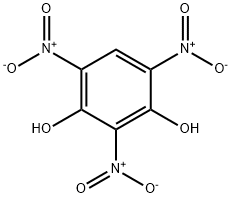
lead 2,4,6-trinitro-m-phenylene dioxide
- CAS NO.:15245-44-0
- Empirical Formula: C6HN3O8Pb
- Molecular Weight: 450.28744
- EINECS: 239-290-0
- SAFETY DATA SHEET (SDS)
- Update Date: 2026-05-28 04:57:54

What is lead 2,4,6-trinitro-m-phenylene dioxide?
Description
Pure tetraethyl lead is a colourless liquid with a characteristic odour and is a viscous liquid that is highly lipophilic and soluble in fats, oils, and lipids as well as gasoline and other nonpolar hydrocarbons. Tetraethyl lead is commonly abbreviated as TEL. Tetraethyl lead is an organolead compound, and it improves the efficiency and performance of internal combustion engines and is an inexpensive additive to gasoline (petrol) since 1920 and allows octane ratings and engine compression to be boosted significantly, increasing power and fuel economy. The use of tetraethyl lead was largely discontinued because of the toxicity of lead and its deleterious effect on catalytic converters.
Chemical properties
hexagonal platelets. Lead styphnate varies in colour from yellow to brown. There are two forms of lead styphnate. The longer and narrower the crystals, the more susceptible lead styphnate is to static electricity. Lead styphnate is particularly sensitive to fire and the discharge of static electricity. Lead styphnate does not react with metals and is less sensitive to shock and friction. Lead styphnate is only slightly soluble in water and methyl alcohol. It is stable in storage, even at elevated temperatures. Lead styphnate is derived from styphnic acid and is used in explosive mixtures.
The Uses of lead 2,4,6-trinitro-m-phenylene dioxide
Lead Styphnate is an explosive compound used in primers and detonator mixtures for less sensitive secondary explosives.
General Description
A slurry or wet mass of orange-yellow crystals. Must be shipped wet with at least 20% water or water and denatured ethyl alcohol mixture. May explode due to shock, heat, flame, or friction if dried. Used as an initiating explosive. The primary hazard is the blast of an instantaneous explosion and not flying projectiles and fragments.
Reactivity Profile
LEAD STYPHNATE is a weak but highly sensitive explosive. An employee removing a beaker of lead styphnate from a laboratory oven caused a detonation when he bumped the beaker on the side of the oven [MCA Case History 957, 1966]. Three kilograms of lead styphnate exploded from an unknown cause. Wet material in two adjacent dry rooms did not detonate [Chem. Abs. 26:5210. 1932]. May react vigorously with reducing agents.
Health Hazard
Fire may produce irritating, corrosive and/or toxic gases.
Fire Hazard
MAY EXPLODE AND THROW FRAGMENTS 1600 meters (1 MILE) OR MORE IF FIRE REACHES CARGO.
Properties of lead 2,4,6-trinitro-m-phenylene dioxide
| Density | 0.99-1.11 g/cm3 |
| Stability: | Explosive. Unstable. May detonate if subject to mechanical shock or friction, or if heated. Very hazardous when dry, so if possible store wet. Incompatible with acetylene, chlorine. |
| EPA Substance Registry System | Lead(II) styphnate (15245-44-0) |
Safety information for lead 2,4,6-trinitro-m-phenylene dioxide
Computed Descriptors for lead 2,4,6-trinitro-m-phenylene dioxide
New Products
2-(2-Chlorophenyl)glycine Propiolic Acid 1-(3-Hydroxy-4-methoxyphenyl)-2-nitroethene (±)-amino(2-fluorophenyl)acetic acid trans-3-Benzyloxy-4-methoxy-beta-nitrostyrene 1-Pentadecanol 2,4-Dihydroxybenzaldehyde Dipropyl disulfide Pyrrolo[1,2-a]pyrimidine-6-carboxylic acid, 4,6,7,8-tetrahydro-4-oxo-, sodium salt (1:1), (6S) Obidoxime hydrochloride API 4 pentyn 1 ol N-Vinylformamide Methacrylate-PEG-Methacrylate, Mn:35000 2,4-Dihydroxyacetophenone 2-Chloro 5-Fluoro Pyridine Vasicinone 2-Chloroisonicotinic Acid Tween 80 or Polysorbate 80 2-Butyn-1-oL N-(4-Cyano-3-(trifluoromethyl)phenyl)-2-methyloxirane-2-carboxamide N-(4-fluoro-2-methoxy-5-nitrophenyl)-4-(1-methyl-1H-indol-3-yl)pyrimidin-2-amine Pirtobrutinib intd. 2-Pentyn-1-oL 4-NitrobenzotrifluorideRelated products of tetrahydrofuran
You may like
-
 40216-83-9 trans-4-Hydroxy-L-proline methyl ester hydrochloride 98+View Details
40216-83-9 -
471-25-0 Propiolic Acid 98+View Details
471-25-0 -
84145-28-8 98+View Details
84145-28-8 -
trans-3-Benzyloxy-4-methoxy-beta-nitrostyrene 98+View Details
63909-29-5 -
2-(2-Chlorophenyl)glycine 88744-36-9 98+View Details
88744-36-9 -
40216-83-9 trans-4-Hydroxy-L-proline methyl ester hydrochloride 98+View Details
40216-83-9 -
629-76-5 98+View Details
629-76-5 -
1-(3-Hydroxy-4-methoxyphenyl)-2-nitroethene 98+View Details
39816-35-8