
L-Cysteine, N,N'-1,2-ethanediylbis-, 1,1'-diethyl ester
- CAS NO.:121251-02-3
- Empirical Formula: C12H24N2O4S2
- Molecular Weight: 324.46
- SAFETY DATA SHEET (SDS)
- Update Date: 2022-12-21 16:56:50
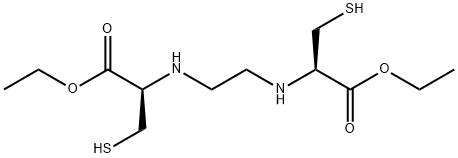
What is L-Cysteine, N,N'-1,2-ethanediylbis-, 1,1'-diethyl ester?
Absorption
After intravenous administration, bicisate presents a very large brain extraction. About 5% of the administered dose remains in the blood one hour after administration. The highest concentration of radioactivity in blood was attained 0.5 minutes after intravenous injection and it represented 13.9% of the injected dose. After intravenous administration of bicisate, the permeability surface area was 0.48 ml.g/min.
Toxicity
In vitro, the complex of bicisate and technetium Tc-99m has been shown to cause unscheduled DNA synthesis and caused an increased frequency of chromatid exchange. Bicisate as a unique compound increased the apparent rate of gene mutation but it did not demonstrate clastogenic activity. Studies related to clastogenic potential or effects in fertility have not been performed.
Indications
Bicisate as a complex with technetium Tc-99m is used in single photon emission computerized tomography (SPECT) as an adjunct to conventional CT or MRI in the localization of stroke in patients whom the presence of a stroke has already been diagnosed. It is not indicated to assess the functional viability of brain tissue or to distinguish between a stroke and other brain lesions.
A stroke is defined as a condition in which the blood stops flowing to any part of the brain causing a damage to brain cells. The potential effect of a stroke depends on the part of the brain that was affected by it as well as the extension of the damage.
Background
Bicisate, also known as ethyl cysteinate dimer (ECD), is a N,N'-1,2-ethylene-di-yl-bis-L-cysteinate diethyl ester. It is used in conjunction with technetium Tc99m as a tracer to measure cerebral blood flow with single-photon emission computed tomography (SPECT). The complex of bicisate and technetium Tc99m as a kit was developed by Lantheus Medcl and FDA-approved on November 23, 1994.
Pharmacokinetics
The neutral and lipophilic nature of bicisate provides it with high stability. This property is given by its N2S2 core. This characteristic has been proven to allow bicisate to be used even several hours after preparation and to present an easy passage through the blood-brain barrier.
Metabolism
Bicisate is metabolized to form mono- and di-acids by the action of esterases. The exact metabolic transformation has not been elucidated.
Properties of L-Cysteine, N,N'-1,2-ethanediylbis-, 1,1'-diethyl ester
| Boiling point: | 444.1±45.0 °C(Predicted) |
| Density | 1.158±0.06 g/cm3(Predicted) |
| pka | 9.11±0.10(Predicted) |
Safety information for L-Cysteine, N,N'-1,2-ethanediylbis-, 1,1'-diethyl ester
Computed Descriptors for L-Cysteine, N,N'-1,2-ethanediylbis-, 1,1'-diethyl ester
New Products
N-Carbethoxy-4-piperidone 1-Aminocyclopentane carbonitrile Tetrabutylammonium perchlorate N,O-Dimethylhydroxylamine hydrochloride (RS)-beta-Amino-beta-(4-bromophenyl)propionic acid 2-Amino-5-bromo-4-(trifluoromethyl)pyridine N-Vinylformamide 4 pentyn 1 ol Phenethyl cinnamate Dipropyl disulfide Ethyl 3-phenylpropanoate β-Bromostyrene Methacrylate-PEG-Methacrylate, Mn:35000 2,4-Dihydroxyacetophenone 2-Chloro 5-Fluoro Pyridine Vasicinone 2-Chloroisonicotinic Acid Tween 80 or Polysorbate 80 5-Bromo-1-Pentyne 1-(2-Methyl-5-nitrophenyl)guanidine Nitrate Methyl trans-4-Aminocyclohexanecarboxylate Hydrochloride N-(4-Cyano-3-(trifluoromethyl)phenyl)-2-methyloxirane-2-carboxamide 2-Pentyn-1-oL 4-NitrobenzotrifluorideYou may like
-
 144-83-2 Sulfapyridine 98+View Details
144-83-2 -
29976-53-2 98+View Details
29976-53-2 -
2-Amino-5-bromo-4-(trifluoromethyl)pyridine 98+View Details
944401-56-3 -
(RS)-beta-Amino-beta-(4-bromophenyl)propionic acid 39773-47-2 98+View Details
39773-47-2 -
6638-79-5 N,O-Dimethylhydroxylamine hydrochloride 98+View Details
6638-79-5 -
674783-97-2 98+View Details
674783-97-2 -
1-Aminocyclopentane carbonitrile 98+View Details
49830-37-7 -
Tetrabutylammonium perchlorate 1923-70-2 98+View Details
1923-70-2