
Isopropyl 2,4-dichlorophenoxyacetate
- CAS NO.:94-11-1
- Empirical Formula: C11H12Cl2O3
- Molecular Weight: 263.12
- MDL number: MFCD00072491
- EINECS: 202-305-6
- SAFETY DATA SHEET (SDS)
- Update Date: 2026-07-31 15:25:14
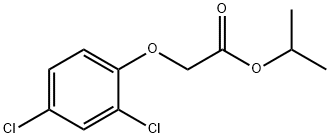
What is Isopropyl 2,4-dichlorophenoxyacetate?
Chemical properties
2,4-Dichlorophenoxyacetic acid is a white to yellow crystalline powder with a slight phenolic odor.
Potential Exposure
2,4-Dichlorophenoxyacetic acid, was introduced as a plant growth-regulator in 1942. It is registered in the United States as a herbicide for control of broadleaf plants and as a plant growth-regulator. Thus, workers engaged in manufacture, formulation or application are affected, as may be citizens in areas of application. The Vietnam war era defoliant, Agent Orange, was a mixture of 2,4-D and 2,4,5-T.
Shipping
UN3345 Phenoxyacetic acid derivative pesticide, solid, toxic, Hazard Class: 6.1; Labels: 6.1-Poisonous materials. A DOT regulated marine pollutant.
Incompatibilities
A weak acid, incompatible with bases. Decomposes in sunlight or heat, forming hydrogen chloride and phosgene. Contact with strong oxidizers may cause fire and explosions.
Waste Disposal
Incineration of phenoxys is effective in 1 second @ 982 C, using a straight combustion process or @ 482℃ using catalytic combustion. Over 99% decomposition was reported when small amounts of 2,4-D were burned in a polyethylene bag. See “References” for additional detail. In accordance with 40CFR165, follow (31); recommendations for the disposal of pesticides and pesticide containers. Must be disposed properly by follow- ing (100) Package (2) label directions or by contacting your local or federal environmental control agency, or by contacting your regional EPA office. Consult with environ- mental regulatory agencies for guidance on acceptable disposal practices. Generators of waste containing this contaminant (≥100 kg/mo) must conform with EPA regu- lations governing storage, transportation, treatment, and waste disposal.
Properties of Isopropyl 2,4-dichlorophenoxyacetate
| Melting point: | 5°C |
| Boiling point: | 371.18°C (rough estimate) |
| Density | 1.2600 |
| refractive index | 1.5209 (estimate) |
| storage temp. | 0-6°C |
| Water Solubility | 27.36mg/L(temperature not stated) |
| NIST Chemistry Reference | Isopropyl (2,4-dichlorophenoxy)acetate(94-11-1) |
| EPA Substance Registry System | 2,4-D isopropyl ester (94-11-1) |
Safety information for Isopropyl 2,4-dichlorophenoxyacetate
Computed Descriptors for Isopropyl 2,4-dichlorophenoxyacetate
New Products
2-(2-Chlorophenyl)glycine Propiolic Acid trans-3-Benzyloxy-4-methoxy-beta-nitrostyrene 1-(3-Hydroxy-4-methoxyphenyl)-2-nitroethene (±)-amino(2-fluorophenyl)acetic acid 1-Pentadecanol N-Vinylformamide 4 pentyn 1 ol 4-(4-Αminophenyl)-3-Morpholinone 3-Morpholino-1-(4-(2-oxopiperidin-1-yl) phenyl)-5,6-dihyropyridin-2-(1H)-one 1-(4-Aminophenyl)-3-morpholino-5,6-dihydropyridin-2(1H)-one N-cyanoacetylurethane 1H-IndazoleRelated products of tetrahydrofuran

You may like
-
 40216-83-9 trans-4-Hydroxy-L-proline methyl ester hydrochloride 98+View Details
40216-83-9 -
471-25-0 Propiolic Acid 98+View Details
471-25-0 -
84145-28-8 98+View Details
84145-28-8 -
trans-3-Benzyloxy-4-methoxy-beta-nitrostyrene 98+View Details
63909-29-5 -
2-(2-Chlorophenyl)glycine 88744-36-9 98+View Details
88744-36-9 -
40216-83-9 trans-4-Hydroxy-L-proline methyl ester hydrochloride 98+View Details
40216-83-9 -
629-76-5 98+View Details
629-76-5 -
1-(3-Hydroxy-4-methoxyphenyl)-2-nitroethene 98+View Details
39816-35-8