
iofendylate
- CAS NO.:99-79-6
- Empirical Formula: C19H29IO2
- Molecular Weight: 416.34
- MDL number: MFCD00867941
- EINECS: 202-787-8
- SAFETY DATA SHEET (SDS)
- Update Date: 2022-12-21 16:56:50
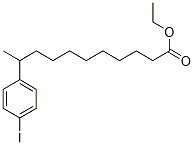
What is iofendylate?
Originator
Pantopaque,Lafayette,US,1944
The Uses of iofendylate
Iofendylate is a compound that is used as a contrast medium.
Indications
Iophendylate is used as a contrast agent to locate spinal tumors.
Background
Iophendylate is a mixture of isomers used as contrast medium, mainly for brain and spinal cord visualization. Iophendylate is a myelographic oil-ester (U.S. Patent 2,348,231). Iophendylate, which was never shown to be safe, was initially introduced for use in small amounts (1-2cc) for locating spinal tumors. It next appeared on the world scene for high volume (12-15cc), routine use, in diagnosing disc herniations. A number of clinicians have published on the dangers of oil myelography. In 1942 Van Wagenen (a neurosurgical colleague of Warrens, at the University of Rochester) identified Iophendylate as causing chemical meningitis in 30 patients where "space-displacing masses within the spinal canal were suspected".
Manufacturing Process
60 volumes of ethyl undecylenate is introduced gradually at 7° to 8°C during 35 minutes to a well-cooled mixture of 52.5 parts of aluminum chloride and 150 volumes of iodobenzene. The mixture is decomposed with cracked ice and dilute hydrochloric acid. The iodobenzene layer is washed with sodium bisulfite solution and with water, and then distilled. The composition of matter having the probable formula, ethyl 4-iodophenyl-undecylate, is a colorless liquid boiling at 196° to 198°C/1 mm, and of specific gravity of 1.26/20°C.
Therapeutic Function
Diagnostic aid (radiopaque medium)
Pharmacokinetics
Iophendylate is a myelographic oil-ester initially introduced for use in small amounts (1-2cc) for locating spinal tumors. Later, it was found to cause adhesive arachnoiditis. Because these substances are hyperbaric once they were placed in the subarachnoid space they would migrate to the distal portion, where they remained, producing progressive scarring.
Metabolism
Not Available
Properties of iofendylate
| Melting point: | 25°C |
| Density | d2020 1.240-1.263 |
| refractive index | nD25 1.5230-1.5280 |
| CAS DataBase Reference | 99-79-6 |
Safety information for iofendylate
Computed Descriptors for iofendylate
New Products
5-bromo-4-fluoro-2-nitrobenzaldehyde (R)-(-)-2-Amino-1-propanol Cyclobutanone Fmoc-OSu 1-(2-Chloroethyl)pyrrolidine Hydrochloride 2-Amino-2-(4-methylphenyl)acetic acid β-Bromostyrene Ethyl 3-phenylpropanoate Phenethyl cinnamate Dipropyl disulfide 4 pentyn 1 ol N-Vinylformamide Methacrylate-PEG-Methacrylate, Mn:35000 2,4-Dihydroxyacetophenone 2-Chloro 5-Fluoro Pyridine Vasicinone 2-Chloroisonicotinic Acid Tween 80 or Polysorbate 80 2-Butyn-1-oL 2-Pentyn-1-oL 4-Nitrobenzotrifluoride N-(4-fluoro-2-methoxy-5-nitrophenyl)-4-(1-methyl-1H-indol-3-yl)pyrimidin-2-amine Pirtobrutinib intd. N-(4-Cyano-3-(trifluoromethyl)phenyl)-2-methyloxirane-2-carboxamideRelated products of tetrahydrofuran


You may like
-
 Fmoc-OSu 98+View Details
82911-69-1 -
(R)-(-)-2-Amino-1-propanol 35320-23-1 98+View Details
35320-23-1 -
7250-67-1 1-(2-Chloroethyl)pyrrolidine Hydrochloride 98+View Details
7250-67-1 -
13227-01-5 98+View Details
13227-01-5 -
7250-67-1 1-(2-Chloroethyl)pyrrolidine Hydrochloride 98+View Details
7250-67-1 -
13227-01-5 98+View Details
13227-01-5 -
7250-67-1 1-(2-Chloroethyl)pyrrolidine Hydrochloride 98+View Details
7250-67-1 -
13227-01-5 98+View Details
13227-01-5