
HKUST-1
- CAS NO.:222404-02-6
- Empirical Formula: C18H9Cu3O15
- Molecular Weight: 655.89
- MDL number: MFCD32706497
- Update Date: 2025-07-16 09:55:36
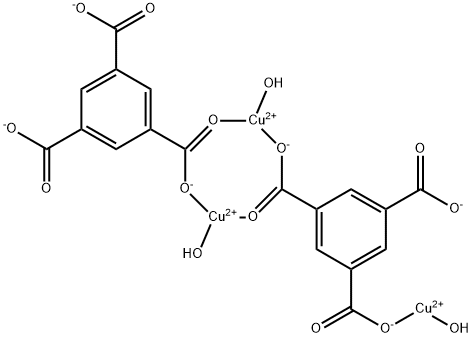
What is HKUST-1?
Description
HKUST-1 is a Cu-based nanosheet metal-organic framework (MOF). This compound can be used for the adsorption of gases (such as carbon dioxide) and pollutants. It also has unsaturated Cu metal sites and has catalytic properties, such as an efficient heterogeneous catalyst for the aziridination of alkene and the ring-opening reaction of activated aziridines. This material was loaded onto the surface of an indium tin oxide (ITO) electrode to catalyze the electrochemical oxidation of ascorbic acid (AA). The superb response could be ascribed to the porous nanosheet structure of HKUST-1, which enhanced both the effective surface area and the electron transfer ability significantly[1-2].
Structure and conformation
HKUST-1 was first reported in 1999 by Chui et al. composed of 1,3,5 benzenetricarboxylate (BTC) ligands coordinating copper ions in a cubic lattice (Fm–3m). It contains an intersecting 3-D system of large square-shaped pores of 9 × 9 ?; in the framework of HKUST-1, Cu (II) ions form dimmers, where each copper atom is coordinated by four oxygen from BTC linkers and water molecules. The presence of water molecules in the first coordination sphere of Cu ions has suggested the possibility of obtaining a coordinative vacancy on Cu (II) species. Both units of MOF materials have been referred to as effective hydrogen storage materials because of their potential interactions with hydrogen. The capture and storage properties of hydrogen are strongly dependent on the structure of the resulting organic and inorganic three-dimensional bridging linking. Hydrogen adsorption, the interaction between the hydrogen molecule and the walls of porous solids, is only significant at low temperatures. HKUST-1 is capable of adsorbing significant amounts of hydrogen at 77 K[3]. Figure: FE-SEM images of HKUST-1 MOF: (a) assynthesized, (b) with octahedral structure, and (c) fine porous surface of the octahedral structure.
References
[1] Debesh Sharma. “HKUST-1 Metal Organic Framework as an Efficient Dual-Function Catalyst: Aziridination and One-Pot Ring-Opening Transformation for Formation of β-Aryl Sulfonamides with C–C, C–N, C–S, and C–O Bonds.” Inorganic Chemistry 60 11 (2021): 7794–7802.
[2] Shen, Tianyang et al. “Cu-based metal–organic framework HKUST-1 as effective catalyst for highly sensitive determination of ascorbic acid.” RSC Advances 39 (2020): 22881–22890.
[3] Kuen-Song Lin. “Synthesis and characterization of porous HKUST-1 metal organic frameworks for hydrogen storage.” International Journal of Hydrogen Energy 37 18 (2012): Pages 13865-13871.
Properties of HKUST-1
| Density | 0.879 g/cm3 |
| InChI | InChI=1S/2C9H6O6.3Cu.3H2O/c2*10-7(11)4-1-5(8(12)13)3-6(2-4)9(14)15;;;;;;/h2*1-3H,(H,10,11)(H,12,13)(H,14,15);;;;3*1H2/q;;3*+3;;;/p-9 |
Safety information for HKUST-1
Computed Descriptors for HKUST-1
| InChIKey | RHNMBRNFDVFZOU-UHFFFAOYSA-E |
| SMILES | C(C1=CC(C(=O)[O-])=CC(C2=O[Cu+2]([O-]C(C3C=C(C(=O)[O-])C=C(C(=O)[O-])C=3)=O[Cu+2](O)[O-]2)O)=C1)(=O)[O-][Cu+2]O |
New Products
N-Carbethoxy-4-piperidone 1-Aminocyclopentane carbonitrile Tetrabutylammonium perchlorate N,O-Dimethylhydroxylamine hydrochloride (RS)-beta-Amino-beta-(4-bromophenyl)propionic acid 2-Amino-5-bromo-4-(trifluoromethyl)pyridine N-Vinylformamide 4 pentyn 1 ol Phenethyl cinnamate Dipropyl disulfide Ethyl 3-phenylpropanoate β-Bromostyrene Methacrylate-PEG-Methacrylate, Mn:35000 2,4-Dihydroxyacetophenone 2-Chloro 5-Fluoro Pyridine Vasicinone 2-Chloroisonicotinic Acid Tween 80 or Polysorbate 80 5-Bromo-1-Pentyne 1-(2-Methyl-5-nitrophenyl)guanidine Nitrate Methyl trans-4-Aminocyclohexanecarboxylate Hydrochloride N-(4-Cyano-3-(trifluoromethyl)phenyl)-2-methyloxirane-2-carboxamide 2-Pentyn-1-oL 4-NitrobenzotrifluorideRelated products of tetrahydrofuran
![Bis(N,N'-diMethylpiperazine)tetra[copper(I) iodide], 98% MOF](https://img.chemicalbook.in/CAS/20180808/GIF/1401708-91-5.gif)
![Iron azobenzene tetracarboxylic, Porous [PCN-250(Fe)], CONEKTIC(TM) F250](https://img.chemicalbook.in/CAS/20180808/GIF/1771755-22-6.gif)
![Iron(III) 1,3,5-benzenetricarboxylate hydrate, porous (F-free MIL-100(Fe), KRICT F100) [Iron trimesate]](https://img.chemicalbook.in/CAS/20180601/GIF/1257379-83-1.gif)
You may like
-
 144-83-2 Sulfapyridine 98+View Details
144-83-2 -
29976-53-2 98+View Details
29976-53-2 -
2-Amino-5-bromo-4-(trifluoromethyl)pyridine 98+View Details
944401-56-3 -
(RS)-beta-Amino-beta-(4-bromophenyl)propionic acid 39773-47-2 98+View Details
39773-47-2 -
6638-79-5 N,O-Dimethylhydroxylamine hydrochloride 98+View Details
6638-79-5 -
674783-97-2 98+View Details
674783-97-2 -
1-Aminocyclopentane carbonitrile 98+View Details
49830-37-7 -
Tetrabutylammonium perchlorate 1923-70-2 98+View Details
1923-70-2