
Hexylcainc
- CAS NO.:532-77-4
- Empirical Formula: C16H23NO2
- Molecular Weight: 261.36
- MDL number: MFCD00864417
- SAFETY DATA SHEET (SDS)
- Update Date: 2026-05-27 23:55:00
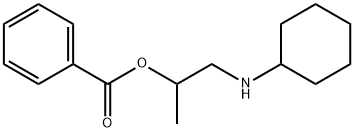
What is Hexylcainc?
Toxicity
Symptoms of anesthetic overdose include headache, tinnitus, circumoral and tongue paresthesias, restlessness, talkativeness, facial twitching, convulsions, respiratory arrest, and cardiac depression
Originator
Cyclaine,MSD,US,1952
The Uses of Hexylcainc
Hexylcaine is an intermediate in the synthesis of Hexylcaine Hydrochloride which is used in pain management in as an antifungal agent. Anaesthetic.
Background
Hexylcaine hydrochloride is also known as cyclaine and osmocaine. It is a short acting local anesthetic that acts through inhibition of sodium channels. Patients experience an overdose may present with headache, tinnitus, numbness and tingling around the mouth and tongue, convulsions, inability to breathe, and decreased heart function. Hexylcaine has been discontinued in the US market.
Indications
Used as a local anesthetic for surface application, infiltration or nerve block
Definition
ChEBI: Hexylcaine is a benzoate ester.
Manufacturing Process
A solution of 0.1 mol of 1-cyclohexylamino-2-propanol in 30 grams of
chloroform was saturated with dry hydrogen chloride gas, with cooling. A
solution of 0.1 mol of benzoyl chloride in 30 grams of chloroform was added
and the solution was heated in a bath at 50° to 55°C for four days under a
reflux condenser protected from atmospheric moisture. Then the solvent was
removed by vacuum distillation while the mixture was warmed on a water
bath. Benzene was then added to the syrupy residue and the reaction product
crystallized out after the benzene was removed by vacuum distillation.
The crystallized solid residue was washed with anhydrous ether to remove any
unreacted benzoyl chloride. The 1-cyclohexylamino-2-propyl benzoate
hydrochloride obtained was purified by two recrystallizations from absolute
alcohol. It melted at 177° to 178.5°C.
Therapeutic Function
Local anesthetic
Pharmacokinetics
Hexylcaine is a local ester-class anesthetic. Local anesthetics produce a transient block of nerve conduction by interfering with sodium channels. This effect of the anesthetic interferes with the development of an action potential across the nerve.
Safety Profile
Human systemic effects. When heated to decomposition it emits toxic vapors of NOx.
Metabolism
Hydrolyzed by plasma esterases to benzoic acid and other derivatives
Properties of Hexylcainc
| Boiling point: | 385.3±25.0 °C(Predicted) |
| Density | 1.05±0.1 g/cm3(Predicted) |
| solubility | soluble in Dichloromethane |
| form | Solid |
| pka | 9.02±0.20(Predicted) |
| color | White |
Safety information for Hexylcainc
Computed Descriptors for Hexylcainc
New Products
2-(2-Chlorophenyl)glycine Propiolic Acid 1-(3-Hydroxy-4-methoxyphenyl)-2-nitroethene (±)-amino(2-fluorophenyl)acetic acid trans-3-Benzyloxy-4-methoxy-beta-nitrostyrene 1-Pentadecanol 2,4-Dihydroxybenzaldehyde Dipropyl disulfide Pyrrolo[1,2-a]pyrimidine-6-carboxylic acid, 4,6,7,8-tetrahydro-4-oxo-, sodium salt (1:1), (6S) Obidoxime hydrochloride API 4 pentyn 1 ol N-Vinylformamide Methacrylate-PEG-Methacrylate, Mn:35000 2,4-Dihydroxyacetophenone 2-Chloro 5-Fluoro Pyridine Vasicinone 2-Chloroisonicotinic Acid Tween 80 or Polysorbate 80 2-Butyn-1-oL N-(4-Cyano-3-(trifluoromethyl)phenyl)-2-methyloxirane-2-carboxamide N-(4-fluoro-2-methoxy-5-nitrophenyl)-4-(1-methyl-1H-indol-3-yl)pyrimidin-2-amine Pirtobrutinib intd. 2-Pentyn-1-oL 4-NitrobenzotrifluorideYou may like
-
 40216-83-9 trans-4-Hydroxy-L-proline methyl ester hydrochloride 98+View Details
40216-83-9 -
471-25-0 Propiolic Acid 98+View Details
471-25-0 -
84145-28-8 98+View Details
84145-28-8 -
trans-3-Benzyloxy-4-methoxy-beta-nitrostyrene 98+View Details
63909-29-5 -
2-(2-Chlorophenyl)glycine 88744-36-9 98+View Details
88744-36-9 -
40216-83-9 trans-4-Hydroxy-L-proline methyl ester hydrochloride 98+View Details
40216-83-9 -
629-76-5 98+View Details
629-76-5 -
1-(3-Hydroxy-4-methoxyphenyl)-2-nitroethene 98+View Details
39816-35-8