
Hexachlorodisilane
Synonym(s):1,1,1,2,2,2-Hexachlorodisilane;Disilicon hexachloride;HCDS
- CAS NO.:13465-77-5
- Empirical Formula: Cl6Si2
- Molecular Weight: 268.89
- MDL number: MFCD00011599
- EINECS: 236-704-1
- SAFETY DATA SHEET (SDS)
- Update Date: 2026-05-28 03:30:43
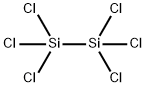
What is Hexachlorodisilane?
Chemical properties
colourless liquid
Physical properties
bp 144–145.5 °C; d 1.562 g cm?3.
The Uses of Hexachlorodisilane
Hexachlorodisilane can be used in deoxygenation and desulfurization of phosphine oxides, phosphine sulfides, and amine oxides; reducing agent for nitro groups and sulfur diimides.
The Uses of Hexachlorodisilane
HCDS may be used as a reducing agent. It may be combined with ammonia to form silicon nitride by chemical vapor deposition(CVD) technique.
What are the applications of Application
Hexachlorodisilane is a reagent for deoxygenation reactions
General Description
Hexachlorodisilane (HCDS) is a chlorosilane used as a precursor for producing disilanes. It is a dioxidizer that is used in the production of silicon films and silicon nitride based films.
Flammability and Explosibility
Non flammable
Properties of Hexachlorodisilane
| Melting point: | <0°C |
| Boiling point: | 144-145.5 °C (lit.) |
| Density | 1.562 g/mL at 25 °C (lit.) |
| vapor pressure | 2.8hPa at 25℃ |
| refractive index | n |
| Flash point: | 78°C |
| storage temp. | below 5° C |
| solubility | sol CHCl3, CH2Cl2, benzene, THF; reacts violently,
producing toxic fumes, with H2O, alcohols. |
| form | liquid |
| color | Colorless to Almost colorless |
| Specific Gravity | 1.562 |
| Hydrolytic Sensitivity | 8: reacts rapidly with moisture, water, protic solvents |
| Stability: | Stable, but reacts violently with water. Moisture sensitive. May be shock sensitive. Incompatible with water, moisture, acids, strong bases, oxidizing agents, alcohols. |
| CAS DataBase Reference | 13465-77-5(CAS DataBase Reference) |
| EPA Substance Registry System | Disilane, hexachloro- (13465-77-5) |
Safety information for Hexachlorodisilane
| Signal word | Danger |
| Pictogram(s) |
 Corrosion Corrosives GHS05 |
| GHS Hazard Statements |
H314:Skin corrosion/irritation |
| Precautionary Statement Codes |
P280:Wear protective gloves/protective clothing/eye protection/face protection. P363:Wash contaminated clothing before reuse. P303+P361+P353:IF ON SKIN (or hair): Remove/Take off Immediately all contaminated clothing. Rinse SKIN with water/shower. P305+P351+P338:IF IN EYES: Rinse cautiously with water for several minutes. Remove contact lenses, if present and easy to do. Continuerinsing. P405:Store locked up. |
Computed Descriptors for Hexachlorodisilane
New Products
2-Bromo-4-hydroxypyridine Dibenzoyl-L-tartaric acid Anhydrous (Resolution Reagent) Dibenzo[b,f][1,4]thiazepin-11(10H)-one 1,2,3,9-Tetrahydro-9-Methyl-4H-Carbazole-4-One Cis-Tosylate 1-(4-methoxyphenyl)-4-(4-Nitrophenyl)Piperazine (IT-1) 1-aminocyclobutanecarbonitrile hydrochloride AMINO-O-TOLYL-ACETIC ACID 1-Aminocyclobutanecarboxylic Acid Hydrochloride AMINO(2-BROMOPHENYL)ACETIC ACID 6-BROMOTETRAZOLO[1,5-A]PYRIDINE 3-Oxocyclobutanecarboxylic acid METHANOL-D1(OD) TERTIARY BUTANOL-D9 N-ETHYL-D5-AMINE HYDROCHLORIDE BENZOIC ACID-D CHLOROFORM-D TOLUENE-D3 2-(2-Bromophenyl)ethanol Boc-D-Glu(OMe)-OMe 2,5 Dibromopyridine Ethyl 4-hydroxy-3-oxobutanoate Dimethyl (2S)-2-((tert-butoxycarbonyl)amino)-4-(cyanomethyl)pentanedioate 1-(3-Chlorophenyl)piperazine hydrochlorideRelated products of tetrahydrofuran


You may like
-
 Hexachlorodisilane CAS 13465-77-5View Details
13465-77-5 -
254762-66-8 AMINO(2-BROMOPHENYL)ACETIC ACID 98+View Details
254762-66-8 -
254762-66-8 AMINO(2-BROMOPHENYL)ACETIC ACID 98+View Details
254762-66-8 -
23716-23-1 98+View Details
23716-23-1 -
6-BROMOTETRAZOLO[1,5-A]PYRIDINE 98+View Details
5799-75-7 -
254762-66-8 AMINO(2-BROMOPHENYL)ACETIC ACID 98+View Details
254762-66-8 -
23716-23-1 98+View Details
23716-23-1 -
6-BROMOTETRAZOLO[1,5-A]PYRIDINE 98+View Details
5799-75-7
Statement: All products displayed on this website are only used for non medical purposes such as industrial applications or scientific research, and cannot be used for clinical diagnosis or treatment of humans or animals. They are not medicinal or edible.