
Heteronium
- CAS NO.:7247-57-6
- Molecular Weight: 0
- SAFETY DATA SHEET (SDS)
- Update Date: 2022-12-21 16:56:50
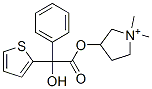
What is Heteronium?
Originator
Hetrum bromide,Lilly
The Uses of Heteronium
Anticholinergic.
Manufacturing Process
A solution of 5.0 g of 1-methyl-3-pyrrolidinol and 12.5 g of methyl phenyl-2-
thienylglycolate in 200 ml of n-heptane is heated to reflux temperature, a
trace of sodium methylate is added, and refluxing of the mixture is continued
for 3 h. A Dean-Stark trap is incorporated in the reflux apparatus to separate
and withdraw the methanol produced by the reaction. At the end of the reflux
period, the reaction mixture is cooled and extracted two times with 100 ml
portions of 2 N hydrochloric acid. The acid extracts are combined, basified
with potassium carbonate, and extracted three times with 50 ml portions of
benzene. The benzene extracts are combined, washed two times with 25 ml
portions of water, and dried. The benzene is removed from the dried extract
by evaporation at reduced pressure. The residue is 1-methyl-3-
pyrrolidylphenyl-2-thienylglycolate in the form of a clear liquid.
1-Methyl-3-pyrrolidylphenyl-2-thienylglycolate is dissolved in ethyl acetate to
a concentration of about 20% by weight. To the solution is added a small
excess of an anhydrous ethanolic solution of hydrogen chloride, whereupon 1-
methyl-3-pyrrolidylphenyl-2-thienylglycolate hydrochloride separates as a
white crystalline solid and is removed by filtration.
5.0 g of 1-methyl-3-pyrrolidylphenyl-2-thienylglycolate hydrochloride are
dissolved in 50 ml of water. The aqueous solution is basified by adding solid
potassium carbonate with stirring, and the basified mixture is extracted three
times with 25 ml portions of benzene. The benzene extracts are combined,
dried with anhydrous magnesium sulfate, and evaporated to dryness. The
residue is dissolved in methyl ethyl ketone. Into the resulting solution is
bubbled an excess amount of methyl bromide, and the mixture is permitted to
stand at room temperature, whereupon a white precipitate appears. The
precipitate is removed by filtration, washed with methyl ethyl ketone,
recrystallized from absolute ethanol, and dried. So the 1-methyl-3-
pyrrolidylphenyl-2-thienylglycolate methobromide was obtained.
1-Methyl-3-pyrrolidylphenyl-2-thienylglycolate methobromide is readily
separated into two diastereoisomeric fractions by fractional crystallization. The
crude mixed 1-methyl-3-pyrrolidylphenyl-2-thienylglycolate methobromide is
dissolved in the minimum quantity of methanol, decolorized with charcoal,
diluted with 4 or 5 volumes of ethyl acetate, concentrated on a steam bath
until crystals begin to appear, and cooled. The resulting crystals are the α-
diastereoisomer of 1-methyl-3-pyrrolidylphenyl-2-thienylglycolate
methobromide, melting point 210°-211°C.
Therapeutic Function
Anticholinergic
Safety information for Heteronium
New Products
3-AMINO-3-(2-CHLORO-PHENYL)-PROPIONIC ACID 4-Fluorophenylglycine 1-Boc-3-(cyanomethyl)azetidine Dimedone 1-N-Boc-3-(aminoethyl)azetidine N-BOC-piperidine-4-carboxylic acid 4,6-Dichlororesorcinol 5-Amino-2-Bromo-3-Chloropyridine 2-Picolinic acid N-oxide 4-Butyl Resorcinol 2-Bromo-5-Chloropyridine 5-Bromo-2-Hydroxy-3-Nitro Pyridine 2-Amino-4-phenyl-thiazole N-(4-Bromophenyl)-2-chloroacetamide TRIFLOURO ACETICACID-D METHANE SULFONIC ACID-D4 PHOSPORIC ACID-D3 85 W% IN D2O DEUTERIUM OXIDE FOR NMR BENZENE-D6 TOLUENE-D3You may like
-
 IODOETHANE-D5 6485-58-1 99%View Details
6485-58-1 -
32008-59-6 PARAFORMALDEHYDE-D2 98%View Details
32008-59-6 -
CHLORO BENZENE-D5 3114-55-4 99%View Details
3114-55-4 -
PHENYL ACETYLENE-D 3240-11-07 99%View Details
3240-11-07 -
918-20-7 TERT-BUTYL CHLORIDE-D9 98%View Details
918-20-7 -
84358-13-4 N-BOC-piperidine-4-carboxylic acid 98+View Details
84358-13-4 -
84358-13-4 N-BOC-piperidine-4-carboxylic acid 98+View Details
84358-13-4 -
84358-13-4 N-BOC-piperidine-4-carboxylic acid 98+View Details
84358-13-4