
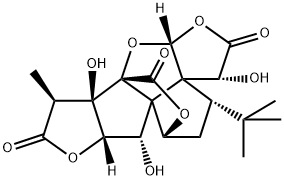
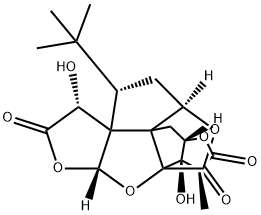
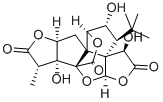
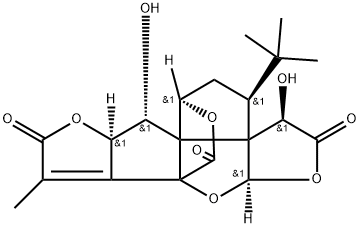
Ginkgolide C
Synonym(s):1,7-Dihydroxy-ginkgolide A
- CAS NO.:15291-76-6
- Empirical Formula: C20H24O11
- Molecular Weight: 440.4
- MDL number: MFCD06642603
- SAFETY DATA SHEET (SDS)
- Update Date: 2026-07-27 17:00:41
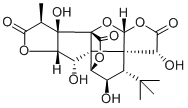
What is Ginkgolide C?
Description
Ginkgolide C is a flavone first extracted from G. biloba leaves with multiple reported biological functions. It has been identified as a selective platelet activating factor receptor antagonist (IC50 = 37.6 μM). Ginkgolide C has also been shown to increase lipolysis and to inhibit adipogenesis in adipocytes via the activated AMPK pathway.
Chemical properties
Crystalline Solid
The Uses of Ginkgolide C
Family of bioactive terpenes treating cardiovascular and cerebrovascular diseases. Specific platelet activating factor (PAF) antagonists
The Uses of Ginkgolide C
Reference compound for PAF receptors in biological systems.
The Uses of Ginkgolide C
Family of bioactive terpenes treating cardiovascular and cerebrovascular diseases. Specific platelet activating factor (PAF) antagonists.
What are the applications of Application
Ginkgolide C is A specific platelet activating factor (PAF) antagonist
Properties of Ginkgolide C
| Melting point: | >3000 (dec) |
| alpha | D24 -14.7° (c = 1 in ethanol) |
| Boiling point: | 813.8±65.0 °C(Predicted) |
| Density | 1.72±0.1 g/cm3(Predicted) |
| storage temp. | Sealed in dry,Store in freezer, under -20°C |
| solubility | DMSO (Slightly), Ethanol (Slightly, Sonicated), Methanol (Slightly, Heated) |
| pka | 10.88±0.70(Predicted) |
| form | neat |
| form | Solid |
| color | White to Off-White |
Safety information for Ginkgolide C
| Signal word | Warning |
| Pictogram(s) |
 Exclamation Mark Irritant GHS07 |
| GHS Hazard Statements |
H315:Skin corrosion/irritation H319:Serious eye damage/eye irritation H335:Specific target organ toxicity, single exposure;Respiratory tract irritation |
| Precautionary Statement Codes |
P261:Avoid breathing dust/fume/gas/mist/vapours/spray. P264:Wash hands thoroughly after handling. P264:Wash skin thouroughly after handling. P271:Use only outdoors or in a well-ventilated area. P280:Wear protective gloves/protective clothing/eye protection/face protection. P302+P352:IF ON SKIN: wash with plenty of soap and water. P305+P351+P338:IF IN EYES: Rinse cautiously with water for several minutes. Remove contact lenses, if present and easy to do. Continuerinsing. |
Computed Descriptors for Ginkgolide C
New Products
2-(2-Chlorophenyl)glycine Propiolic Acid 1-(3-Hydroxy-4-methoxyphenyl)-2-nitroethene (±)-amino(2-fluorophenyl)acetic acid trans-3-Benzyloxy-4-methoxy-beta-nitrostyrene 1-Pentadecanol 2,4-Dihydroxybenzaldehyde Dipropyl disulfide Pyrrolo[1,2-a]pyrimidine-6-carboxylic acid, 4,6,7,8-tetrahydro-4-oxo-, sodium salt (1:1), (6S) Obidoxime hydrochloride API 4 pentyn 1 ol N-Vinylformamide Methacrylate-PEG-Methacrylate, Mn:35000 2,4-Dihydroxyacetophenone 2-Chloro 5-Fluoro Pyridine Vasicinone 2-Chloroisonicotinic Acid Tween 80 or Polysorbate 80 2-Butyn-1-oL N-(4-Cyano-3-(trifluoromethyl)phenyl)-2-methyloxirane-2-carboxamide N-(4-fluoro-2-methoxy-5-nitrophenyl)-4-(1-methyl-1H-indol-3-yl)pyrimidin-2-amine Pirtobrutinib intd. 2-Pentyn-1-oL 4-NitrobenzotrifluorideRelated products of tetrahydrofuran
![Ethyl 4-[2-(5-Chloro-2-methoxybenzamido)ethyl]benzene Sulfonamide Carbamate](https://img.chemicalbook.in/CAS/GIF/14511-59-2.gif)
You may like
-
 Ginkgolide c 95% CAS 15291-76-6View Details
15291-76-6 -
Ginkgolide C CAS 15291-76-6View Details
15291-76-6 -
471-25-0 Propiolic Acid 98+View Details
471-25-0 -
84145-28-8 98+View Details
84145-28-8 -
trans-3-Benzyloxy-4-methoxy-beta-nitrostyrene 98+View Details
63909-29-5 -
2-(2-Chlorophenyl)glycine 88744-36-9 98+View Details
88744-36-9 -
40216-83-9 trans-4-Hydroxy-L-proline methyl ester hydrochloride 98+View Details
40216-83-9 -
1-(3-Hydroxy-4-methoxyphenyl)-2-nitroethene 98+View Details
39816-35-8