
Fmoc-6-chloro L-Tryptophan
- CAS NO.:908847-42-7
- Empirical Formula: C26H21ClN2O4
- Molecular Weight: 460.91
- MDL number: MFCD16883068
- SAFETY DATA SHEET (SDS)
- Update Date: 2026-05-28 04:44:49
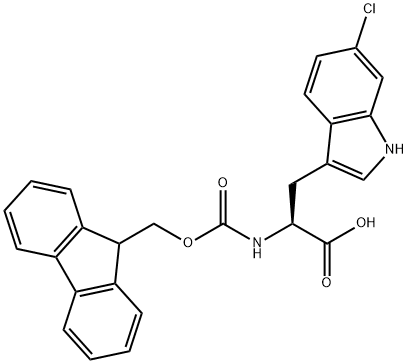
What is Fmoc-6-chloro L-Tryptophan?
The Uses of Fmoc-6-chloro L-Tryptophan
Fmoc-6-chloro L-Tryptophan is used for preparation of acyltryptophanols as FSH antagonists.
What are the applications of Application
Fmoc-6-chloro L-Tryptophan is a chemical used for preparation of acyltryptophanols
Properties of Fmoc-6-chloro L-Tryptophan
| Melting point: | >115°C (dec.) |
| Boiling point: | 732.6±60.0 °C(Predicted) |
| Density | 1.406±0.06 g/cm3(Predicted) |
| storage temp. | 2-8°C |
| solubility | DMSO (Slightly), Methanol (Slightly) |
| form | Solid |
| pka | 3.72±0.10(Predicted) |
| color | White to Off-White |
Safety information for Fmoc-6-chloro L-Tryptophan
Computed Descriptors for Fmoc-6-chloro L-Tryptophan
New Products
Cis-Tosylate Dibenzoyl-L-tartaric acid Anhydrous (Resolution Reagent) 2,6-Dipicolic Acid 4-Fluorophenylglycine Dimedone 1-N-Boc-3-(aminoethyl)azetidine 1-Boc-3-(cyanomethyl)azetidine N-BOC-piperidine-4-carboxylic acid 1-Benzhydrylazetane-3-carbonitrile 5-Amino-2-Iodopyridine 5-Bromo-2-Hydroxy-3-Nitro Pyridine BENZOIC ACID-D METHANE SULFONIC ACID-D4 PHOSPORIC ACID-D3 85 W% IN D2O DEUTERIUM OXIDE FOR NMR TOLUENE-D3 BENZENE-D6 1-Benzhydrylazetidin-3-ol-Hcl 5-Acetylsalicylamide 1-(3-Chlorophenyl)piperazine hydrochlorideYou may like
-
 Fmoc-6-chloro-L-tryptophan 95% CAS 908847-42-7View Details
908847-42-7 -
1-(4-Aminophenyl)-4-(4-methoxyphenyl)Piperazine 74852-62-3View Details
74852-62-3 -
556-08-1 4-Acetamidobenzoic acidView Details
556-08-1 -
5-Bromo-2-Chlorobenzoic acid 21739-92-4View Details
21739-92-4 -
15128-52-6View Details
15128-52-6 -
36476-86-5 1-Benzhydrylazetane-3-carbonitrile 98+View Details
36476-86-5 -
36476-86-5 1-Benzhydrylazetane-3-carbonitrile 98+View Details
36476-86-5 -
36476-86-5 1-Benzhydrylazetane-3-carbonitrile 98+View Details
36476-86-5
Statement: All products displayed on this website are only used for non medical purposes such as industrial applications or scientific research, and cannot be used for clinical diagnosis or treatment of humans or animals. They are not medicinal or edible.