
FLUCYTHRINATE
Synonym(s):α-Cyano-3-phenoxybenzyl 4-difluoromethoxy-α-isopropylphenylacetate
- CAS NO.:70124-77-5
- Empirical Formula: C26H23F2NO4
- Molecular Weight: 451.47
- MDL number: MFCD00137383
- EINECS: 274-322-7
- SAFETY DATA SHEET (SDS)
- Update Date: 2026-07-31 15:25:14
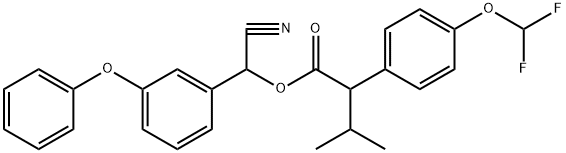
What is FLUCYTHRINATE?
The Uses of FLUCYTHRINATE
Flucythrinate controls a wide range of insects on cotton, fruit trees, vines, citrus, bananas, pineapples, olives, coffee, cocoa, hops, vegetables, soyabeans, cereals, alfalfa, sugar beet, sunflowers and tobacco.
The Uses of FLUCYTHRINATE
Nonsystemic insecticide.
General Description
Flucythrinate belongs to the class of synthetic pyrethroids, primarily used to control Heliothis spp. in cotton and other insect pests in agricultural crops.
Agricultural Uses
Insecticide, Acaricide: Not approved for use in EU countries. Not currently registered in the U.S. Flucythrinate is a synthetic pyrethroid used to control pests in apples, cabbage, head lettuce, pears, corn and cotton, but it was used primarily on cotton.
Trade name
AASTAR®[C]; CYBOLT®; CYTHRIN®; FUCHING JUJR®; GUARDIAN®[C]; PAYOFF®[C]; STOCK GUARD®; TOMAHAWK®
Pharmacology
Flucythrinate is the (S)-2-(4-difluoromethoxyphenyl)-3-methylbutyrate analog of fenvalerate, partially resolved. Its insecticide action is approximately two times higher compared with fenvalerate (138,142).
Environmental Fate
Surface Water. The half-life of ?ucythrinate in an estuarine environment is 34 days (Schimmel et al., 1983).
Chemical/Physical. Hydrolyzes in aqueous solutions forming acetic acid and other compounds.
Metabolic pathway
Flucythrinate is an analogue of fenvalerate and would be expected to have a similar fate.
Degradation
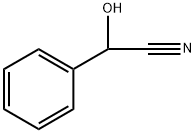
Flucythrinate is a stable compound but it is readily hydrolysed at alkaline pH to afford 2-(4-difluoromethoxyphenyl)-3-methylbutyric acid (2), 3PBAl(3) and cyanide ion. Its DT50 values at 27 °C are 52 days (pH 5) and 6.3 days (pH 9). It undergoes aqueous and soil surface photolysis with DT50 values of 1-4 days and <2 days, respectively. The products formed under aqueous conditions were 2 and 3. Compound 3 was oxidised to 3PBA (4) and reduced to 3PBAlc (5). The α-carbamoyl (amide) derivative (6) of 3PBAlc was also detected. On soil surfaces, products were similar with the exceptions that 3PBA was not formed and the α-amide (7) and a-carboxy derivative (8) were formed. These are usually considered to be products of thermal degradation (Dureja and Chattopadhyay, 1995).
Properties of FLUCYTHRINATE
| Melting point: | <25℃ |
| Boiling point: | 108℃ (0.35mmHg) |
| Density | 1.189 g/cm3 (22℃) |
| vapor pressure | 1.2×10⁻⁶ Pa (25 °C) |
| refractive index | 1.541 (589.3 nm 25℃) |
| Flash point: | -18 °C |
| storage temp. | 2-8°C |
| form | neat |
| Water Solubility | 0.5 mg l-1 (22 °C) |
| Specific Gravity | 1.189 (22℃) |
| BRN | 2195795 |
| CAS DataBase Reference | 70124-77-5(CAS DataBase Reference) |
| EPA Substance Registry System | Flucythrinate (70124-77-5) |
Safety information for FLUCYTHRINATE
| Signal word | Danger |
| Pictogram(s) |
 Flame Flammables GHS02  Skull and Crossbones Acute Toxicity GHS06  Environment GHS09 |
| GHS Hazard Statements |
H226:Flammable liquids H301:Acute toxicity,oral H332:Acute toxicity,inhalation H410:Hazardous to the aquatic environment, long-term hazard |
| Precautionary Statement Codes |
P210:Keep away from heat/sparks/open flames/hot surfaces. — No smoking. P233:Keep container tightly closed. P240:Ground/bond container and receiving equipment. P273:Avoid release to the environment. P301+P310:IF SWALLOWED: Immediately call a POISON CENTER or doctor/physician. |
Computed Descriptors for FLUCYTHRINATE
New Products
9-Mesityl-10-methylacridinium perchlorate Sulfapyridine Fmoc-OSu (R)-(-)-2-Amino-1-propanol Cyclobutanone 5-bromo-4-fluoro-2-nitrobenzaldehyde 4 pentyn 1 ol N-Vinylformamide Phenethyl cinnamate Pyrrolo[1,2-a]pyrimidine-6-carboxylic acid, 4,6,7,8-tetrahydro-4-oxo-, sodium salt (1:1), (6S) Ethyl 3-phenylpropanoate β-Bromostyrene Methacrylate-PEG-Methacrylate, Mn:35000 2,4-Dihydroxyacetophenone 2-Chloro 5-Fluoro Pyridine Vasicinone 2-Chloroisonicotinic Acid Tween 80 or Polysorbate 80 5-Bromo-1-Pentyne 1-(2-Methyl-5-nitrophenyl)guanidine Nitrate Methyl trans-4-Aminocyclohexanecarboxylate Hydrochloride N-(4-Cyano-3-(trifluoromethyl)phenyl)-2-methyloxirane-2-carboxamide 4-Nitrobenzotrifluoride 2-Pentyn-1-oLRelated products of tetrahydrofuran

You may like
-
 Flucythrinate CAS 70124-77-5View Details
70124-77-5 -
Flucythrinate CAS 70124-77-5View Details
70124-77-5 -
Fmoc-OSu 98+View Details
82911-69-1 -
(R)-(-)-2-Amino-1-propanol 35320-23-1 98+View Details
35320-23-1 -
1191-95-3 Cyclobutanone 98+View Details
1191-95-3 -
213382-45-7 98+View Details
213382-45-7 -
Fmoc-OSu 98+View Details
82911-69-1 -
(R)-(-)-2-Amino-1-propanol 35320-23-1 98+View Details
35320-23-1