
Fluclotizolam
- CAS NO.:54123-15-8
- Empirical Formula: C15H10ClFN4S
- Molecular Weight: 332.78
- EINECS: 200-284-8
- Update Date: 2026-05-28 04:45:47
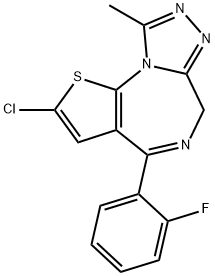
What is Fluclotizolam?
Description
Fluclotizolam (Item No. 23524) is an analytical reference standard categorized as a thienotriazolodiazepine. This product is intended for research and forensic applications.
Chemical properties
Flualprazolam (8-chloro-6-(2-fluorophenyl)-1-methyl-4H- [1,2,4]triazolo[4,3-a][1,4]benzodiazepine) is a triazolobenzodiazepine and is structurally similar to alprazolam. Flualprazolam is composed of a benzene ring fused to a seven-membered 1,4- diazepine ring. Flualprazolam also contains a fused triazolo ring. A methyl (-CH3) group is attached at the 1-position, a 2- fluorophenyl ring is attached at the 6-position, and a chlorine is attached at the 8-position of the triazolobenzodiazepine structure. Flualprazolam has a molecular formula of C17H12ClFN4 and a molecular weight of 326.76 g/mol.
History
Fluclotizolam is a thienotriazolodiazepine derivative which was first synthesised in 1979, but was never marketed. It has subsequently been sold as a designer drug, first being definitively identified in 2017.
The Uses of Fluclotizolam
Fluclotizolam is one of the New Psychoactive Substancces (NPS).
Side Effects
Fluclotizolam produces a sedative-hypnotic effect, often causing drowsiness, muscle relaxation and slowed, sluggish reactions.
Regulatory Status
Flualprazolam is not currently controlled under the Controlled Substances Act. At the 2020 Commission on Narcotic Drugs Sixty-third session, the Commission decided to include flualprazolam in Schedule IV of the 1971 Convention on Psychotropic Substance.
https://www.deadiversion.usdoj.gov
https://www.federalregister.gov
References
1. Moosmann, B., and Auw?rter, V. New Psychoactive Substances. Handbook of Experimental Pharmacology. Designer benzodiazepines: Another class of new psychoactive substances 252, 383-410 (2018).
Properties of Fluclotizolam
| Boiling point: | 524.0±60.0 °C(Predicted) |
| Density | 1.57±0.1 g/cm3(Predicted) |
| storage temp. | -20°C |
| solubility | DMF: 5 mg/ml DMSO: 5 mg/ml DMSO:PBS (pH 7.2) (1:1): 0.5 mg/ml |
| form | A crystalline solid |
| pka | 2.01±0.40(Predicted) |
| λmax | 241 nm |
| InChI | InChI=1S/C15H10ClFN4S/c1-8-19-20-13-7-18-14(9-4-2-3-5-11(9)17)10-6-12(16)22-15(10)21(8)13/h2-6H,7H2,1H3 |
Safety information for Fluclotizolam
Computed Descriptors for Fluclotizolam
| InChIKey | ZDYRCUZZLRLMHG-UHFFFAOYSA-N |
| SMILES | N12C(C)=NN=C1CN=C(C1=CC=CC=C1F)C1C=C(Cl)SC=12 |
New Products
5-bromo-4-fluoro-2-nitrobenzaldehyde Cyclobutanone (R)-(-)-2-Amino-1-propanol Fmoc-OSu 1-(2-Chloroethyl)pyrrolidine Hydrochloride 2-Amino-2-(4-methylphenyl)acetic acid 2,4-Dihydroxybenzaldehyde Obidoxime hydrochloride API Pyrrolo[1,2-a]pyrimidine-6-carboxylic acid, 4,6,7,8-tetrahydro-4-oxo-, sodium salt (1:1), (6S) Dipropyl disulfide 4 pentyn 1 ol N-Vinylformamide Methacrylate-PEG-Methacrylate, Mn:35000 2,4-Dihydroxyacetophenone 2-Chloro 5-Fluoro Pyridine Vasicinone 2-Chloroisonicotinic Acid Tween 80 or Polysorbate 80 2-Butyn-1-oL 2-Pentyn-1-oL 4-Nitrobenzotrifluoride N-(4-Cyano-3-(trifluoromethyl)phenyl)-2-methyloxirane-2-carboxamide N-(4-fluoro-2-methoxy-5-nitrophenyl)-4-(1-methyl-1H-indol-3-yl)pyrimidin-2-amine Pirtobrutinib intd.You may like
-
 7250-67-1 1-(2-Chloroethyl)pyrrolidine Hydrochloride 98+View Details
7250-67-1 -
7250-67-1 1-(2-Chloroethyl)pyrrolidine Hydrochloride 98+View Details
7250-67-1 -
13227-01-5 98+View Details
13227-01-5 -
545445-44-1 3-Morpholino-1-(4-(2-oxopiperidin-1-yl) phenyl)-5,6-dihyropyridin-2-(1H)-one 98%View Details
545445-44-1 -
6629-04-5 98%View Details
6629-04-5 -
4-(4-Αminophenyl)-3-Morpholinone 98%View Details
438056-69-0 -
1-(4-Aminophenyl)-3-morpholino-5,6-dihydropyridin-2(1H)-one 1267610-26-3 98%View Details
1267610-26-3 -
 1H-Indazole | CAS No. 271-44-3 | Pharmaceutical IntermediateView Details
271-44-3